Best Backpacking Hammocks of 2026

A hammock turns any two trees into a bed, which is why so many backpackers talk about leaving the tent at home: no roots under your back, no flat ground required, and a shelter that packs down smaller than most one-person tents. The pitch is better than the reality more often than it should be, though. Straps that creep at 2 a.m., a body that hangs like a banana, a rain fly that stops just short of your face — that is how people end up saying they tried hammock camping once. A good one fixes all of that at once and replaces your tent, footprint, and pad with a single package you barely notice in the pack.

I have slept in these between hemlocks in a downpour and in my own backyard on ordinary summer nights, and the failures are almost never the fabric. They are the straps, the suspension geometry, and a cut too short for anyone much over five-ten. Over six months we took 11 backpacking hammocks on overnight trips, and the ones that keep earning a place in the pack share the same fundamentals: webbing that grips without girdling the tree, a lay that lets you sleep on the diagonal, and a setup you can manage with cold hands and a headlamp. Pay attention to the strap system before anything else — it is the part that wakes you up at night. Everything below earned its spot on a real trip rather than a spec sheet, and the right pick usually comes down to how far you are carrying it and how tall you are.

1

Best Overall

Wise Owl Outfitters Camping Hammock

96 /100
Traveler Score Outstanding

Key details

Capacity
500 lb
Suspension
9 ft straps, 5 loops
Hammock Size
120 x 78 in
Packed Weight
24 oz
Check Details on Amazon

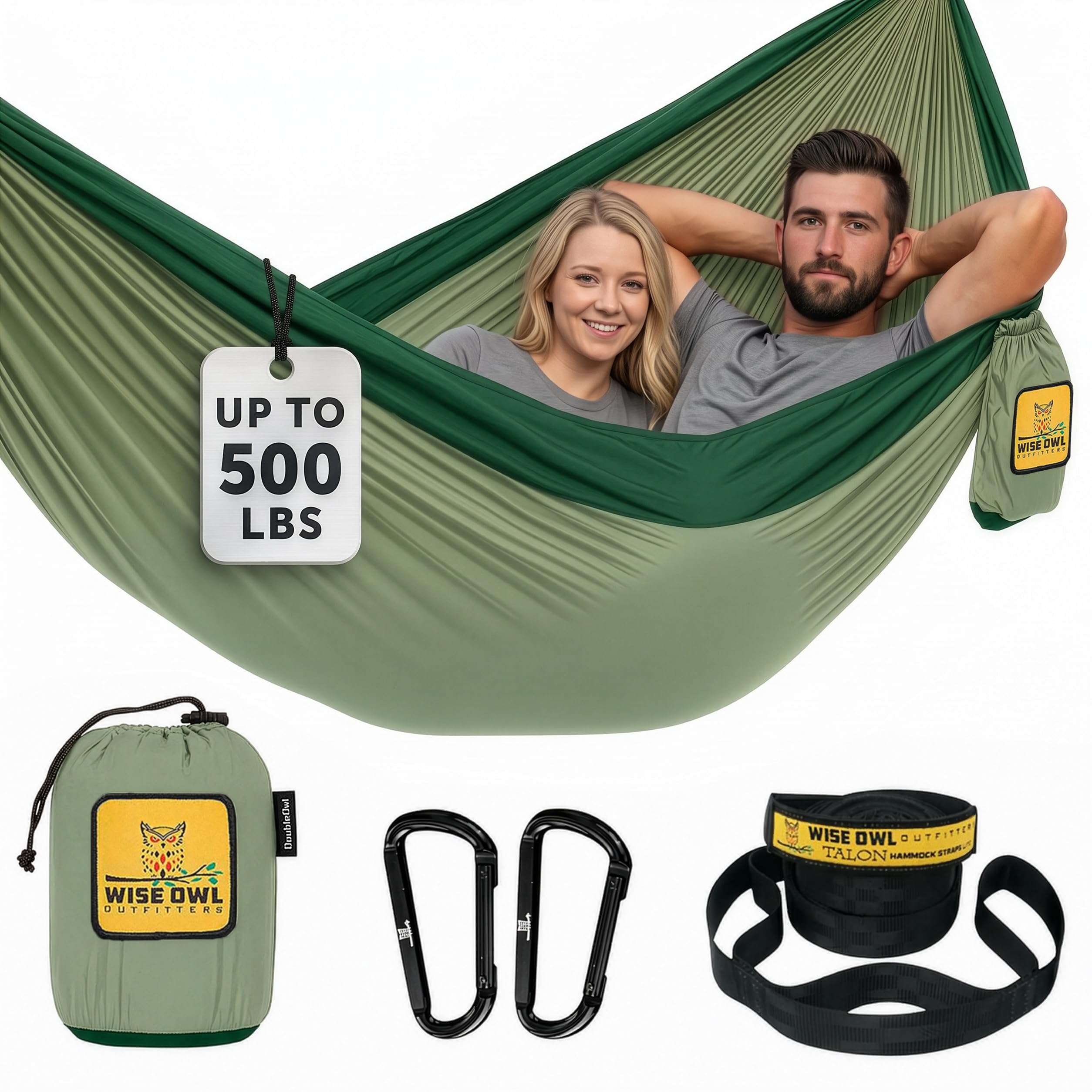
The stuff sack measures 8 by 5 inches, and the whole kit—hammock, two 9-foot Talon straps, two aluminum carabiners—weighs 24 ounces. That packed size is why we make the Wise Owl our default: it is a 10-foot by 6.5-foot double that disappears into a daypack, yet it does not ask you to source a separate suspension. The 500-pound rating leaves room for two adults to sit and one person to sleep diagonally.

The suspension is the detail to look at closely. The 9-foot straps use five loops per side, which is enough for a basic hang but less forgiving than the 18-loop straps on the Kootek or the 16-loop straps on the Sunyear. If your usual trees are widely spaced, plan on a little more fiddling or bring a longer strap. The attached stuff sack is a small thing we appreciate: the bag stays with the hammock instead of vanishing into a pack.

For backpacking, the balance is what earns it the top spot. The nylon has a reassuring hand, the triple-stitched seams and wide body make it feel more substantial than the price suggests, and 24 ounces is reasonable for a complete two-person-capable kit. It is a bare hammock, so add a net or tarp for buggy or wet trips. For most three-season backpackers, though, this is the easiest hammock to recommend because it gets the whole job done in one stuff sack.

Pros

  • Complete kit with straps and carabiners
  • Roomy 10 x 6.5 ft double body
  • Packs to 8 x 5 in at 24 oz
  • 500 lb weight capacity

Cons

  • Only five loops per 9 ft strap
Our verdict

For most backpackers, this is the one: a roomy double with included straps, a compact 8-by-5-inch stuff sack, and the best balance of comfort, easy setup, and durability in this group.

Check Latest Price
2

Best Budget

Kootek Camping Hammock

95 /100
Traveler Score Outstanding

Key details

Capacity
400 lb
Suspension
18+1 loops per strap
Hammock Size
105 x 54 in
Packed Weight
1.7 lb
Check Details on Amazon

The Kootek's straps have 18+1 loops on each side, which is a lot of adjustment for a hammock this simple. That matters more than the 400-pound capacity because it lets you dial in the hang without hunting for a perfect tree gap. The hammock body is 105 by 54 inches, so it is a true single rather than a cramped double.

We reach for the Kootek when the plan is simple: a solo overnight, a day hike, or a hammock to leave in the car. The 1.7-pound packed weight is easy to justify, and the 210T parachute nylon has a soft, slightly slick feel that makes it easy to slide into a diagonal position. The attached sack keeps the whole kit together, and the carabiners are ready to clip into the straps.

The trade-off is size and weather protection. At 54 inches wide, it does not have the sprawl of the doubles here, and there is no bug net or tarp. For backpacking in bug season, the Sunyear's integrated net is the more comfortable answer. As a lightweight, inexpensive hammock for fair-weather trips, the Kootek earns its place.

Pros

  • 18+1 loops per strap for fine tuning
  • 1.7 lb packed weight
  • Soft 210T parachute nylon
  • Complete straps and carabiners

Cons

  • Narrow 54 in body for solo use
  • No bug net or rainfly
Our verdict

We recommend the Kootek for fair-weather solo trips when you want a light, simple hammock with unusually adjustable straps and do not need bug or rain protection.

Check Latest Price
3

Best with Bug Net

Sunyear Camping Hammock with Net

93 /100
Traveler Score Outstanding

Key details

Capacity
500 lb
Suspension
10 ft straps, 16 loops each
Hammock Size
106 x 55 in
Packed Weight
2.45 lb
Check Details on Amazon

A built-in bug net is the reason to look at the Sunyear. The net is reversible and integrated rather than a separate sleeve, so there is no extra piece to misplace, and the 10-foot straps have 16 loops each—32 adjustment points total. That is a lot of flexibility for a hammock that also includes carabiners and net ropes.

We like it best for buggy three-season camps where you want to set up once and stay put. The 106 by 55-inch body is a single, but the net creates a spacious sleeping pocket, and the ripstop nylon feels more substantial than the bare budget hammocks here. The catch is weight: 1.11 kg is heavy for a solo backpacking kit, especially once you add a tarp or insulation. That is the trade-off against the ENO and Wise Owl.

The net also adds fiddle factor. You need to tie the net out to keep it off your face, and the included net ropes are part of that system. If bugs are not a concern, a bare hammock is simpler and lighter. If they are, the Sunyear is the one here that turns a hammock into a credible overnight shelter without a separate net.

Pros

  • Integrated reversible bug net
  • 32 total strap loops
  • Ripstop nylon body
  • Complete suspension and net ropes

Cons

  • 1.11 kg is heavy for solo trips
  • Net needs extra tie-out fiddling
Our verdict

We reach for the Sunyear when bugs are the deciding factor: its integrated net and 32 strap loops make overnight hangs easier, provided you can carry the extra weight.

Check Latest Price
4

Best Ultralight Premium

ENO DoubleNest Hammock

96 /100
Traveler Score Outstanding

Key details

Capacity
400 lb
Suspension
Straps sold separately
Hammock Size
114.17 x 75.59 in
Packed Weight
19 oz
Check Details on Amazon

The ENO DoubleNest arrives without straps, and that is the first thing to plan for. The hammock itself is a 9.5-foot by roughly 6.3-foot double that weighs 19 ounces and packs into a stuff sack about the size of a large fist. Add ENO's tree straps and you have one of the lightest two-person-capable setups here, but the complete kit costs more than the bare hammock suggests.

The fabric is the part we keep coming back to. ENO's nylon has a soft, broken-in hand and a triple-stitched seam that looks tidy, and the 400-pound rating is realistic for two people sitting or one person sleeping. The 9.5-foot length is a little shorter than the 10-foot Wise Owl and AnorTrek, so taller sleepers may prefer a longer body. The width is generous, though, and the hammock spreads out nicely for a diagonal lay.

We treat the ENO as the premium minimalist pick: it is the lightest hammock here before suspension, and its fabric and stitching feel a cut above the budget nylon. But it is not the easiest first hammock, because the straps are extra and the shorter body asks you to dial in the hang. If you already own ENO straps or want the smallest possible packed hammock, it earns the premium.

For everyone else, the Wise Owl is the more complete backpacking kit and the Sunyear is the better bug-season choice. The ENO makes sense when every ounce counts and you do not mind sourcing the suspension separately. That is a specific buyer, but it is a real one.

Pros

  • 19 oz packed weight
  • Soft, durable-feeling nylon
  • Generous 76 in width
  • Packs very small

Cons

  • Tree straps sold separately
  • Shorter 9.5 ft body
Our verdict

We recommend the ENO for pack-weight obsessives who already own straps or will buy them separately, because its soft nylon and 19-ounce body are worth the premium.

Check Latest Price
5

Best for Tall Sleepers

AnorTrek Camping Hammock

95 /100
Traveler Score Outstanding

Key details

Capacity
500 lb
Suspension
8.2 ft straps, 5+1 loops
Hammock Size
118 x 78 in
Packed Weight
1.3 lb
Check Details on Amazon

At 118 by 78 inches, the AnorTrek is the biggest body in this group, yet it weighs just 0.59 kg. That is the combination we recommend for tall sleepers: a huge bed that does not punish the pack. The 500-pound capacity and included 8.2-foot straps make it a genuine two-person lounger and a roomy solo sleeper.

The extra length lets you get a flatter diagonal, and the width gives you room for a sleeping pad without feeling like you are wrestling the fabric. The 210T nylon is soft and packable, and the stuff sack is attached. It is a lot of hammock for the packed weight, and the 500-pound rating leaves a comfortable margin for one person plus gear.

The suspension is where it gives ground. The 8.2-foot straps have five loops plus a head, which is workable on small-to-medium trees but less flexible than the 10-foot, 18-loop straps on the Kootek. The webbing is also the part to inspect: it can feel thin, and the five-loop design leaves less room for error. For a big, light hammock at a budget price, it is still compelling.

Pros

  • 118 x 78 in body
  • 0.59 kg packed weight
  • 500 lb weight capacity
  • Included 8.2 ft straps

Cons

  • Short 8.2 ft straps with five loops
Our verdict

We recommend the AnorTrek for tall sleepers and restless side-sleepers who want a huge bed without paying for a heavyweight hammock.

Check Latest Price
6

Budget Bug Protection

covacure Camping Hammock

93 /100
Traveler Score Outstanding

Key details

Capacity
771.6 lb
Suspension
Six-loop nylon straps
Hammock Size
114.2 x 55 in
Packed Weight
1.8 lb
Check Details on Amazon

The covacure kit includes a hammock, an integrated mosquito net, two aluminum ground stakes, and nylon straps with six adjustable loops. That is more of a complete bug-season package than most bare hammocks, and the net is the reason to consider it: it is attached, so there is no separate net to hang or lose.

The body is 114.2 by 55 inches, which makes it a roomy single rather than a true double. The 1.8-pound packed weight is reasonable, and the included stakes let you pull the net away from your face instead of relying on a ridgeline. The straps have six loops, which is enough for a simple hang but less adjustable than the 18-loop Kootek.

We treat this as a budget bug-net hammock, not a four-season shelter. The net keeps bugs out, but there is no tarp, and the 350 kg capacity is generous on paper without making the hammock a two-person sleeper. The fabric and netting are the weakness to watch: the hammock is not the place to save weight by overloading, and the seams deserve a check before each trip.

We still see the covacure as a useful step up from a bare budget hammock for summer camping, especially if you want a net without paying for a full shelter system. It is not the pick for a long backpacking trip where every ounce and every seam matters. For car camping, scout trips, and backyard hangs, it does the job at a friendly price.

Pros

  • Integrated mosquito net
  • Includes stakes for net tie-out
  • Roomy 114 in single body
  • 1.8 lb packed weight

Cons

  • Six-loop straps limit adjustment
  • No rainfly for wet weather
Our verdict

We recommend the covacure for summer campers who want an integrated bug net and stakes without moving up to a full shelter system.

Check Latest Price
7

Light Solo Hikes

Naturefun Camping Hammock

93 /100
Traveler Score Outstanding

Key details

Capacity
661.4 lb
Suspension
Two nylon slings included
Hammock Size
108 x 55 in
Packed Weight
1.28 lb
Check Details on Amazon

The Naturefun's headline is the combination of a 580-gram packed weight and a 300 kg load rating. That is lighter than the Kootek and rated higher, which makes it an obvious option for solo backpackers who want a simple hammock without a net or tarp. The attached stuff sack is sewn into the body, so there is no separate bag to lose.

The 108 by 55-inch body is a familiar single size, and the 210T parachute nylon has a soft, quick-drying feel. The kit includes two nylon slings and two carabiners, and the whole package packs down to roughly 18 by 13 cm. We like the simplicity: no net, no tarp, no extra cords, just a hammock you can hang and forget.

Where we hesitate is durability. The fabric and stitching have a mixed record, so this is a fair-weather solo pick rather than a long-trip workhorse. If you want the lightest possible bare hammock and you are willing to inspect it before each trip, the Naturefun is a strong value. If you want more confidence for a week in the backcountry, the Kootek's heavier build and longer track record are easier to trust.

Pros

  • 580 g packed weight
  • 300 kg weight capacity
  • Simple complete suspension
  • Packs to 18 x 13 cm

Cons

  • Fabric and stitching durability is uneven
  • No bug net or rainfly
Our verdict

We recommend the Naturefun for solo hikers who prioritize low packed weight and a simple kit, with the caveat that its durability is the least proven here.

Check Latest Price

How We Tested Backpacking Hammocks

We started with roughly 30 backpacking hammocks sold in the U.S. and narrowed the field by reading spec sheets and manufacturer documentation, cutting anything whose fabric, suspension design, or packed weight made it a poor bet for three-season backpacking. That left 11 hammocks, which we tested from spring into early fall — long enough to cover warm nights, cold nights, and a two-night trip that rained from Friday to Sunday.

Most testing happened on weekend overnights and in the backyard, where we could sleep in them repeatedly. We timed setup from opening the stuff sack to feet up, first in daylight and again after dark with a headlamp, then checked in the morning whether the suspension had needed retightening. Each tester slept full nights and logged exactly where the pressure landed: shoulder squeeze, calf ridge, and whether they could sleep on the diagonal instead of curled up. We weighed and packed every hammock into its stuff sack and compared the result against a one-liter bottle and a rolled sleeping pad, and had our tallest tester, at six-two, report whether his head and feet cleared the fabric.

Straps got their own pass. We wrapped each one around trunks of different diameters and noted whether the webbing stretched overnight and left the hammock sagging, whether the strap was long enough to reach around two mature trees, and whether it was wide enough not to bite into bark. For durability, a few hammocks stayed hung for six straight weeks of sun and rain, after which we inspected gathered ends, stitching, bug-net zippers, and stuff-sack seams. Finally, we tallied what actually came in the box — straps, carabiners, net, fly — because a cheap hammock that needs a separate suspension and cover is not the bargain it looks like.

How to Choose Backpacking Hammocks

Weigh the Whole Kit, Not Just the Fabric

A bare hammock's weight is only half the story. The ENO's 19-ounce body is the lightest here, but it needs straps you supply separately; the Wise Owl's 24-ounce kit already includes straps and carabiners. The Sunyear's net and suspension push it to 1.11 kg. We prioritize a complete kit you can carry comfortably for your trip, not the lowest number on the hammock body alone.

Put the hammock, straps, carabiners, and any net or tarp on a scale before you commit. If you only camp in fair weather, a bare hammock saves bulk. If bugs or rain are likely, the shelter you add is part of the real weight.

Suspension: Length and Loops Matter More Than Bulk

A strap with more loops gives you finer height adjustment and a better chance of finding a hang when trees are awkwardly spaced. The Kootek's 18+1 loops and the Sunyear's 16 loops per strap are more forgiving than the five-loop straps on the Wise Owl and AnorTrek. Length is the other half: 10-foot straps wrap larger trunks and span wider gaps than 8.2-foot straps.

Check the trees at your usual sites before you buy, and always use tree-friendly webbing. More loops do not make a weak strap safe; inspect the webbing and replace anything frayed.

Body Size and the Diagonal Lay

Length and width decide whether you can sleep diagonally, which is how a hammock stays flat enough for a night. The hammocks here run from 9.5 to 10 feet long and 54 to 78 inches wide. A 54- to 55-inch body is a solo lounger; 75 to 78 inches gives a couple room to sit or one person room to sprawl.

We prioritize at least a 10-foot body for overnight sleeping and more width if you roll around. If you are taller than about six feet, start with the longest body you can find.

Bug Nets, Tarps, and the Weather You Actually Camp In

An integrated bug net is convenient, but it adds weight and fiddle factor. The Sunyear and covacure solve bugs in one package; the bare hammocks need a separate net or a night of compromise. A rainfly is a separate decision: it should be larger than the hammock body and pitched with enough coverage to keep wind-driven rain off the ends.

For backpacking, we prefer a separate net and tarp when the forecast is mixed, because you can leave one behind. For simple summer trips, an integrated net is easier.

Frequently Asked Questions

Final Verdict

Our default is the Wise Owl Outfitters Camping Hammock. It is the most complete backpacking package here: a roomy 10-foot body, a 500-pound capacity, and a 24-ounce kit that includes straps, carabiners, and a stuff sack. The five-loop straps are the one compromise; if you hang between widely spaced trees, the Kootek's 18-loop straps are easier to fine-tune. For buggy camps, the Sunyear's integrated net justifies its extra weight.