Best Baby Carriers for Hiking of 2026

A structured carrier that keeps a toddler secure on a rocky descent is usually the same one that leaves you sweating on the climb, while the soft carrier that folds into a daypack digs into your shoulders within a mile. That tradeoff defines this category, and it's why so many carriers end up in a closet after two trips. The right one puts the load on your hips and holds a wriggling kid snug without making you dread the trailhead.

A hand-me-down carrier got me through my first hike with my daughter, and a mile in I noticed the lumbar pad, not the shoulder straps, doing the real work. My team and I have spent seven months with eight carriers on gravel rail trails and steep, rooty climbs, and the gap between good and bad shows up around mile two. What nobody tells a first-time buyer: a carrier that fits a 15-pound baby can feel all wrong with a 30-pound toddler, so check the weight range before you fall for the look of one. Both ends of that range are covered below.

1

Best Overall

Kelty Journey Signature

91 /100
Traveler Score Outstanding

Key details

Frame
Aluminum roll cage
Included
Sunshade and foot stirrups
Carrier Weight
7.1 lb
Child Weight Range
16 to 40 pounds
Check Details on Amazon

The adjustment that earns this pack its place happens before your partner takes a turn. Kelty's PerfectFIT suspension retunes the torso in seconds, so two parents of very different heights can swap the same carrier at the trailhead without hunting for a tool or a spare part. Households that share one pack will use that more than any other feature on this list.

Your passenger gets a genuinely good seat: a wide base with adjustable foot stirrups, a five-point harness, and an aluminum roll cage behind the padding that keeps the whole thing rigid when you set it down. Feet with somewhere to rest stop the dangling that turns a happy rider into a squirming one halfway up. The built-in sunshade is the detail we appreciated most on exposed stretches, because it's part of the pack rather than an add-on.

Then there's the trail-side practicality: a large zippered compartment with stretch pockets inside, hip-belt pockets you can reach without stopping, and multiple grab handles for hoisting the pack onto a tailgate or shifting it while the child is still aboard. The handles sound like a small thing until you're alone in a parking lot trying to get a sleeping toddler onto your back.

It is the priciest carrier in this group, and that is the honest trade: you're paying for suspension that adjusts properly and a frame that holds its shape under a load. If your hiking is a couple of easy afternoons a year, the ClevrPlus covers most of it for far less. If you're out most weekends and two adults trade off, this is the one we reach for.

Pros

  • Suspension adjusts between caregivers in seconds
  • Sunshade built in, not sold separately
  • Rigid frame with a five-point harness
  • Pockets and grab handles within reach

Cons

  • Heavy at 7.1 pounds empty
  • Runs large on shorter, smaller wearers
Our verdict

Our top pick for families who hike often and share the carrying: the suspension, rigid frame, and attached sunshade justify the premium price.

Check Latest Price
2

Best Value

ClevrPlus Cross Country

91 /100
Traveler Score Outstanding

Key details

Frame
One-piece frame
Included
Sun canopy, rain cover, changing pad
Carrier Weight
5.5 lb
Child Weight Range
5 to 33 pounds
Check Details on Amazon

Nothing else here delivers a framed, weather-ready child carrier for less money. The Cross Country is the least expensive framed pack in this group, and the sun canopy, rain cover, and changing pad come with it rather than as extras you buy a season later. That combination is why it holds the value spot.

The one-piece frame arrives assembled, which matters more than it sounds: no bolts to lose, no wobble to diagnose on the first morning out. At 5.5 pounds it swings onto your back easily from a tailgate, and the padded hip belt and lumbar panel take the load off your shoulders. The pockets swallow water, snacks, and a layer, and the child sits high enough to see over your shoulder instead of at your back.

The ceiling is 33 pounds, and that's the number to check before you order. A tall two-year-old can approach it, and the pack feels that weight on a climb. As a first framed carrier, or a second one that lives in the grandparents' car, it's hard to argue with.

Pros

  • Least expensive framed carrier here, canopy included
  • Light 5.5-pound frame arrives assembled
  • Load sits on a padded hip belt

Cons

  • Buckle hardware is the weak point
  • Thigh support thins out for heavier toddlers
Our verdict

We recommend it as the value pick: a complete framed carrier with canopy, rain cover, and changing pad, for toddlers comfortably under 33 pounds.

Check Latest Price
3

Best for Loading Solo

besrey Toddler Hiking Carrier

90 /100
Traveler Score Outstanding

Key details

Seat
Three height settings
Included
Detachable sunshade
Carrier Weight
5.5 lb
Child Weight Range
16 to 40 pounds
Check Details on Amazon

A trailhead with nobody to help is the real test of a framed carrier: the pack has to stay upright, the harness has to open wide, and the seat has to be at the right height before you lift. The besrey is built around that sequence rather than around the walking.

The seat adjusts to three heights, the buckle has a secondary safety lock, and the harness opens far enough to drop a toddler in without a wrestling match. Of the framed packs here, this is the one we found easiest to load and hoist alone. The 5.5-pound frame keeps it manageable on the lift, the detachable sunshade handles a bright morning, and the deep back pocket takes wipes, water, and a snack without a second bag.

Two numbers to plan around. The 16-pound minimum means this waits until your child is sitting well and past the newborn stage. And the 44-pound figure in the listing is the total for child, gear, and pack together, so treat the child's share as under 40 — below that, it's a lot of carrier for the money.

Pros

  • Easiest framed pack to load alone
  • Three seat heights as your child grows
  • Locking buckle adds security

Cons

  • Waist belt will not snug down on smaller frames
Our verdict

We found it the easiest framed pack to load alone, with a height-adjustable seat and a locking buckle; start once your child clears 16 pounds.

Check Latest Price
4

Best for Hauling Gear

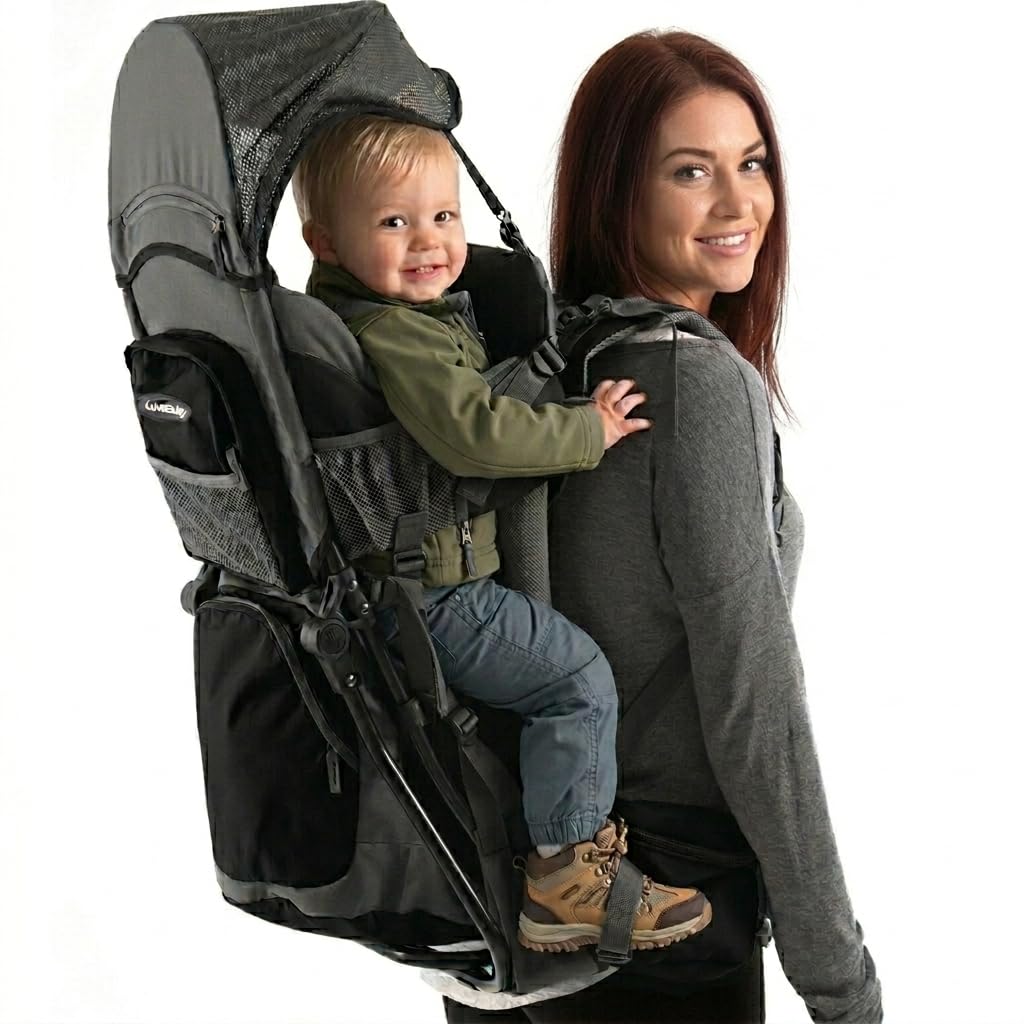
Luvdbaby Hiking Carrier

90 /100
Traveler Score Outstanding

Key details

Storage
Insulated bottle pocket
Included
Changing pad, sun and rain hood
Child Weight Range
16 to 40 pounds
Check Details on Amazon

The insulated bottle pocket is the giveaway: this pack expects you to leave the daypack at home. There's a foldable changing pad, mesh side pockets, a hood that handles sun and rain, and a main body in waterproof material, all built around a child from 16 to 40 pounds.

Adjustment is where it quietly beats pricier packs here. The straps run long enough and the buckles far enough that a six-foot parent and a five-foot-seven one can both dial it in without fighting the same setting — the kind of range that decides whether a shared carrier actually gets shared.

We like it best as the one-pack solution for a long day: the storage is usable rather than decorative, the hood clips on fast when the weather turns, and the stirrups give a tired toddler somewhere to put their feet. The shell wipes clean instead of going in a machine, which is the right call for something that lives in the garage. If you travel light and want the simplest possible pack, the besrey is less to think about.

Pros

  • Insulated bottle pocket and changing pad
  • Adjusts for very different wearers
  • Hood clips on fast in bad weather

Cons

  • Chest strap and support legs are the weak point
  • Straps slip when a toddler shifts weight
Our verdict

Our pick for a full day out: insulated pocket, changing pad, and a fast hood, with adjustment that fits two very different wearers.

Check Latest Price
5

Best for Newborns

LÍLLÉbaby Complete All Seasons

91 /100
Traveler Score Outstanding

Key details

Carrier Weight
2.5 lb
Lumbar Support
Padded panel
Carry Positions
Six, front and back
Child Weight Range
7 to 45 pounds
Check Details on Amazon

Seven pounds is where this carrier starts, and that single figure is why it belongs in a guide about hiking. Framed packs wait until a child is around 16 pounds; the Complete takes a newborn, then keeps going to 45.

Six positions is the headline — front facing in, front facing out, hip, back, and the variations in between — and the two-way straps let you cross them or wear them backpack style. The torso extends as your child grows, the sleeping hood comes off when you don't need it, and the whole thing goes in the machine, which after a summer of sunscreen and snacks is not a small thing.

For long walks, the lumbar panel is the part that matters. It's a firm pad at the small of your back, and it's what keeps a two-hour stretch from turning into an ache, with the wide padded straps spreading the rest across your shoulders. It's also the piece we'd... it's the piece that convinced us a soft carrier can handle a genuine day out rather than a lap around the block.

What you give up is structure. On a flat rail trail with a small baby, this is the carrier we reach for, because the child sits close and high and you can feel what they're doing. On rough ground with a heavy toddler, a framed pack is simply better at the job. That's the boundary worth knowing before you buy, not a flaw in the carrier.

Pros

  • Starts at seven pounds, grows to 45
  • Lumbar pad eases long walks
  • Machine washable body
  • Six positions from newborn to toddler

Cons

  • Bulky and warm on summer trails
  • Six positions take practice to learn
Our verdict

We reach for it with newborns and small babies on gentle trails: a seven-pound floor, real lumbar support, and a washable body.

Check Latest Price
6

Best for Up-And-Down Toddlers

Momcozy Hip Seat Carrier

90 /100
Traveler Score Outstanding

Key details

Waist Fit
Up to 45 inches
Carrier Weight
1.7 lb
Carry Positions
Six, with detachable hip seat
Child Weight Range
7 to 44 pounds
Check Details on Amazon

Toddlers on a trail run in two modes: walking, and suddenly not. A hip seat is built for the switch — the seat stays on your waist on a wide belt, and you lift the child onto it for the stretch that has to be carried.

The Momcozy goes further because the seat detaches and the soft body clips back on, giving six positions from front-facing to back carry for a child from 7 to 44 pounds. The X-shaped straps let one person put it on without help, and at 1.7 pounds it lives in the trunk without complaint. Storage is unusually thoughtful for a carrier this light: a front compartment, a side pocket for a phone, and a hollow in the seat shell that swallows a key and a card.

We rate it for the up-and-down years. The hip seat takes the weight off your shoulders during the carried stretches, and the contoured waist support does real work on a long walk rather than a lap of the park. Just don't mistake it for a framed pack: on a sustained climb with a heavy toddler, load transfer matters more than convenience.

Pros

  • Detachable hip seat for quick carries
  • Puts weight on hips, not shoulders
  • One-person X-strap design

Cons

  • Waist belt does not tighten far enough
Our verdict

Our pick for walk-then-carry toddlers: a detachable hip seat, six positions, and light enough to keep in the car.

Check Latest Price
7

Standing Loads

WIPHA Toddler Hiking Carrier

87 /100
Traveler Score Excellent

Key details

Frame
Collapsible
Storage
Under-seat storage bag
Included
Sun canopy, insulated pocket
Child Weight Range
16 to 40 pounds
Check Details on Amazon

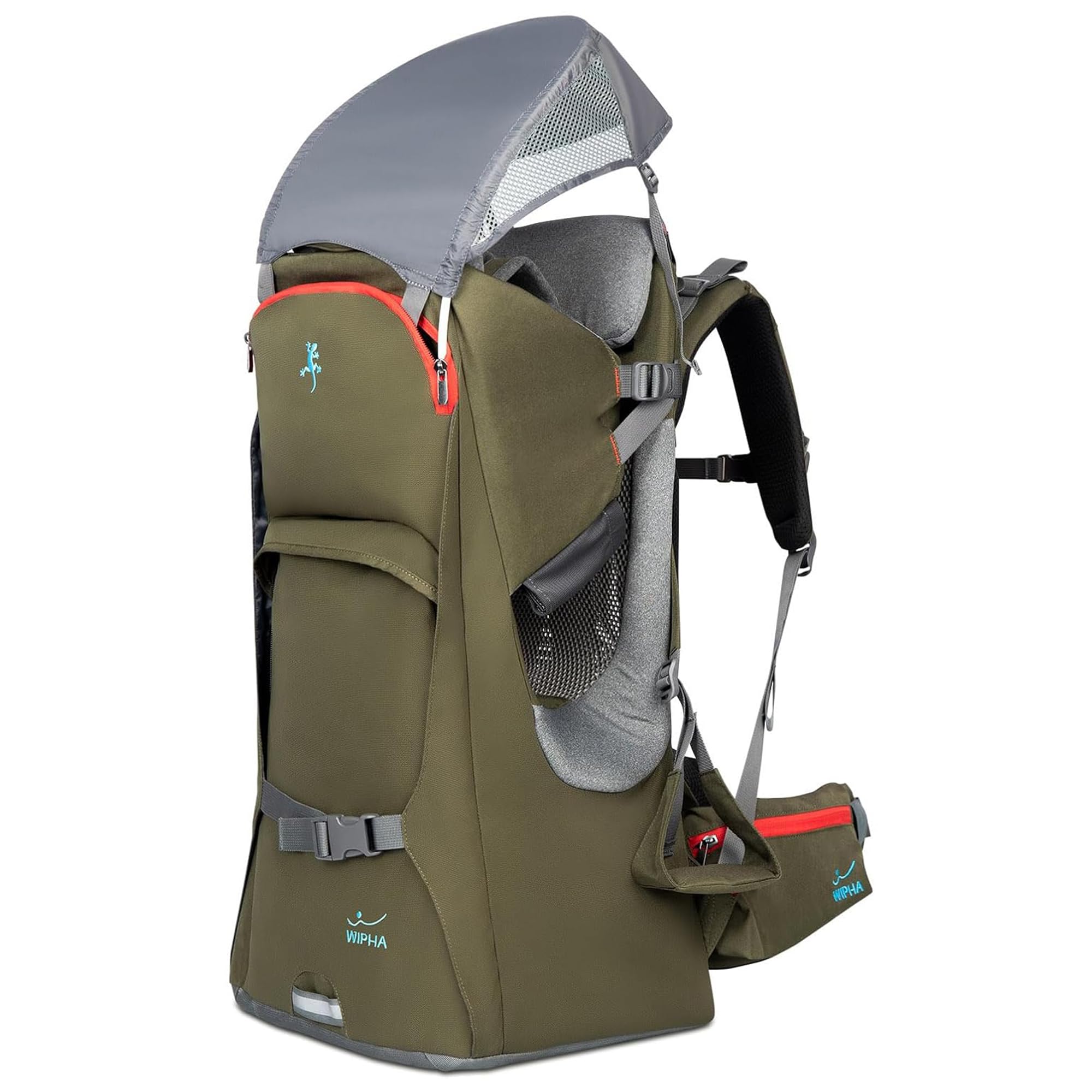
The stand is the reason to look at this one. The frame locks open from the inside, so the pack props itself upright on the ground while you settle a toddler into the seat — no leaning it against a tree, no second adult holding it steady while you work the buckles.

We also like how much it carries. The deep bag under the seat takes bottles, a packed lunch, and diapers; there's an insulated pocket on the outside and a sun canopy that clips over the top. The harness adjusts far enough to fit a tall wearer, and the padded seat keeps a two-and-a-half-year-old comfortable enough to nod off. It's a mid-pack carrier rather than a premium one, but the stand genuinely changes your morning.

Choose it if self-loading and storage matter more to you than the plushest suspension here. The frame collapses for the trunk, the seat takes a child from 16 to 40 pounds, and the removable saliva pads are the difference between a pack you can wash and one you can only wipe.

Pros

  • Stand locks open for solo loading
  • Deep under-seat storage and insulated pocket
  • Canopy and washable pads included

Cons

  • Heavy for a pack this size
  • Shoulder straps need re-adjusting as you walk
Our verdict

We like it for solo loading: the frame locks open, storage handles a full day, and the canopy is included.

Check Latest Price
8

Short Errands

besrey Hip Seat Carrier

86 /100
Traveler Score Excellent

Key details

Seat
Firm EPP hip seat
Waist Support
Wide belt and lumbar pad
Carry Positions
Front, back, and hip
Child Weight Range
7 to 45 pounds
Check Details on Amazon

This one isn't a long-hike carrier and doesn't pretend to be. It's the least expensive carrier in this guide, a soft body over a firm hip seat, and its job is the twenty minutes from the parking lot to the trailhead when your toddler decides walking is over.

The seat is molded EPP, rigid enough to hold a child's hips in the seated M-position instead of letting them sag, and there's an extra lumbar pad on the wide waist belt. Front, back, and hip carry are all covered from 7 to 45 pounds, and it goes in the machine — which, with a snack-covered toddler, is the feature you'll use most.

We treat it as a second carrier: one in the car, one by the door, no fuss. What it won't do is replace a framed pack on a real climb, and the shoulder straps are not built to carry a heavy child for hours. Buy it for convenience and keep the weight low.

Pros

  • Firm hip seat supports a healthy position
  • Machine washable after messy outings
  • Costs the least of any carrier here

Cons

  • Back strap is hard to fasten alone
  • Waist belt runs short for larger frames
Our verdict

We keep it as a cheap second carrier for short walks and errands; the firm hip seat spares your shoulders, but long climbs want a framed pack.

Check Latest Price

How We Tested These Hiking Carriers

We started with roughly 30 hiking-specific carriers and narrowed the list by weight range, frame type, and price, making sure the mix included soft structured carriers, framed backpack carriers, and a hip-seat hybrid. Eight made the final cut. Every carrier was worn by at least two adults of different heights and went on the same outings over seven months: a flat gravel rail trail, a two-mile climb with about 600 feet of gain, a steep rooty descent, and one muddy morning after a rainstorm.

Ease of use got measured in a trailhead parking lot, where I loaded and unloaded a 22-pound toddler while wearing the carrier, noting whether I could do it without setting her down or asking for help. For fit and support, my 5-foot-4 colleague and my 6-foot tester swapped packs and pointed to where they felt weight after mile three: hips, lower back, or shoulders. On descents we watched for side-to-side sway, whether a sleeping kid slumped forward, and how much coaxing it took to get her to arch or twist her way out of the harness.

Back home, each carrier was wiped down or machine-washed to the manufacturer's instructions, then checked for pilling, fading, frayed webbing, and hardware that had started to creep or stick. Versatility showed up off-trail as well, on grocery runs, airport days, and one nap in a museum lobby. Value came down to whether the price bought something we could feel, like a real load-bearing frame or genuine lumbar padding, or just nicer fabric.

How to Choose Baby Carriers for Hiking

Framed pack or soft carrier?

A framed pack's minimum is usually 16 pounds, and the frame is doing real work by then: it moves the load onto your hips, holds the child off your sweaty back, and gives you somewhere to hang a canopy and a day's gear. Below that, a soft carrier like the LÍLLÉbaby is the only option, and it is the better one for a newborn who wants to be high on your chest. The ClevrPlus is rated from 5 pounds on paper, but in practice a baby needs to sit upright and hold their head before a back carry makes sense.

The trap is buying the ceiling instead of the season. A 45-pound soft carrier is a fine thing in a supermarket; on a rocky descent with a sleeping three-year-old, a frame earns its weight. Match the carrier to the next two years, not to the biggest number on the box.

Fit the adult before the child

Every carrier here is a harness for two people, and the adult's fit decides whether the day is pleasant. The hip belt should land on your hip bones rather than your waist and carry most of the load; the shoulder straps should sit flat with the lifters snug. Load the pack with a bag of rice and walk around the block before your first hike — if the weight pulls on your shoulders, no amount of trail-side adjusting will fix it.

Households with two very different wearers should check how far the torso and belt adjust. The Kelty's PerfectFIT suspension and the Luvdbaby's strap range are the two here that swap cleanly between a tall parent and a short one. A pack that fits one of you badly quietly becomes one person's job.

Can you load it alone?

Most of the difficulty with a framed carrier isn't walking, it's the trailhead: getting the pack stable, opening the harness wide enough, lifting a 25-pound child into the seat, then swinging the whole thing onto your back. A pack that stands on its own, like the WIPHA whose frame locks open, or one with a height-adjustable seat and a wide-opening harness, like the besrey, removes most of that fight.

If a second adult is nearly always with you, you can ignore this. If you're the one who does the carrying, weight it heavily: a pack that needs help is a pack you stop taking.

Sun, rain, and where the gear goes

Canopies and rain covers are the difference between a carrier you use in July and one you use in April. Some packs here include them — the ClevrPlus ships with a canopy and a rain cover, the besrey with a detachable sunshade, the Luvdbaby with a hood that handles both — while others expect you to buy protection separately. Check what's in the box before you compare anything, because the add-ons close much of the gap.

Storage is the other quiet decider. A deep bag under the seat or a large zippered compartment with an insulated pocket means you can leave the daypack at home; a couple of mesh pouches means you'll be carrying two things. Count the water you actually drink on a summer walk and buy for that.

Frequently Asked Questions

Final Verdict

Buy the Kelty Journey Signature if you hike often and two adults share the carrying. The PerfectFIT suspension, the rigid frame, and the sunshade that's already attached are what the extra money goes toward, and none of the other framed packs here match that combination.

If the budget is tighter, the ClevrPlus covers most of the same ground — just keep your toddler comfortably under its 33-pound ceiling. And if your baby is still small enough for a front carry, start with the LÍLLÉbaby; the framed packs make more sense once your child is sitting up and past 16 pounds.