Best Water Bottle with Filter for Travel of 2026

Hotel tap water announces itself — one sip at 6 a.m. and you know exactly what the pipes in that building are made of. A filtered bottle fixes that quietly: fill it from the bathroom sink, a fountain, or the tap at a rented cabin, and the water tastes like water. But filtering is only half the job. The bottle also has to survive a carry-on, not leak onto a laptop, hold ice through a layover, and stay small enough that you actually carry it once the trip starts.

A squeeze filter and a straw filter are not interchangeable — flow rate drops as the carbon element loads up, and a bottle that turns fussy on day three is one you'll leave behind in the hotel room. My team and I have spent six months carrying 12 of these through airports, trailheads, and a long string of hotel sinks, and the pattern held. Below are the ones we kept refilling.

1

Best Overall

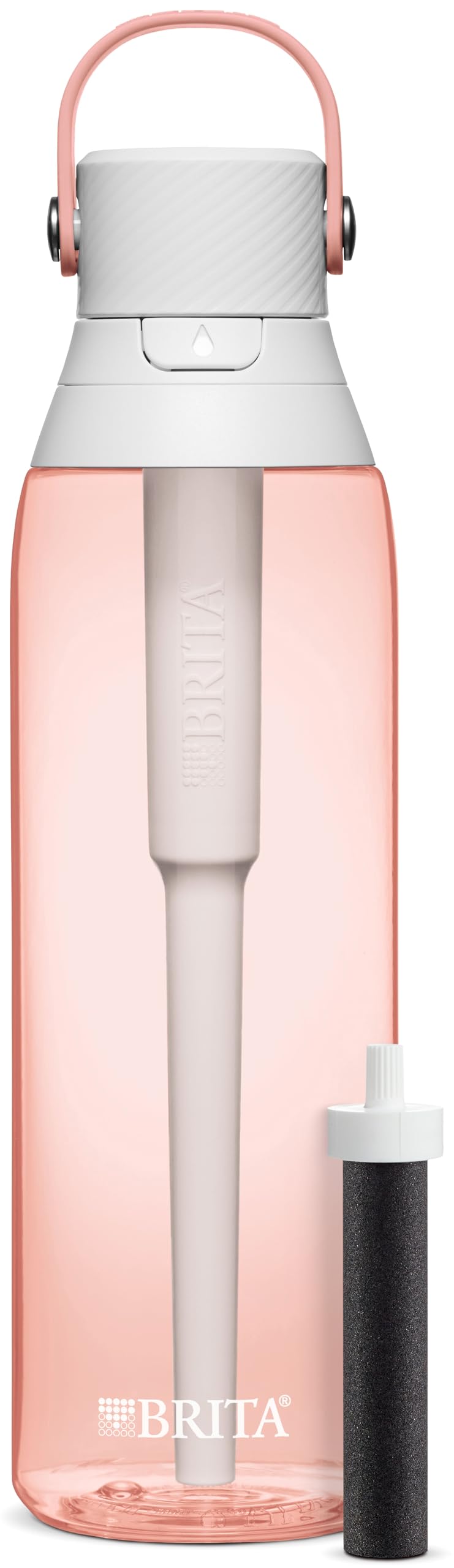
Brita Hard-Sided 26 oz

93 /100
Traveler Score Outstanding

Key details

Filter
Activated carbon block
Weight
7.68 oz
Capacity
26 oz
Filter Life
40 gallons or 2 months
Check Details on Amazon

Hotel tap water announces itself before you taste it — that swimming-pool edge of chlorine, sometimes with a mineral aftertaste behind it. The Brita takes it out at the straw: water passes through the carbon block on the way up, so every mouthful is filtered rather than sitting in a pitcher waiting its turn. On the first fill of a trip we noticed the difference immediately, and it's why this is the bottle we recommend to most travelers.

The rest of the design is built for a bag. At 7.68 ounces it adds very little to a day pack, the 26-ounce body is slim enough for a side pocket, and the push-button lid flips open one-handed while you're holding a phone or a boarding pass in the other. The carrying loop takes a carabiner or a tote strap. Back home, the bottle goes in the top rack of the dishwasher; we still rinse the mouthpiece and straw by hand, because the silicone is where anything that's going to smell will start.

It's plastic and it isn't insulated, so cold water doesn't stay cold and a bottle left in a warm car tastes of the car. We fill it with whatever the tap gives and don't mind, since the filter is doing the work that matters; if you want ice at four in the afternoon, the stainless version below is the one to look at.

One filter comes in the box and Brita rates it for 40 gallons, about two months of daily use. Pack a spare for a long trip — filters are easy to find and small enough to tuck into a corner of a bag — and you're never standing in a bathroom deciding whether the one in the bottle has another week in it.

Pros

  • Reduces chlorine taste and odor at the straw
  • 26-ounce bottle weighs just 7.68 ounces
  • One-handed push-button lid with a carrying loop
  • Bottle body is top-rack dishwasher safe

Cons

  • Not a purifier: won't make unsafe water safe
  • Strong pull needed to draw water through the straw
Our verdict

For tap water that's safe but tastes of chlorine, this is the bottle we hand to friends: light, dishwasher-friendly, and filtering at the straw.

Check Latest Price
2

Best for Unsafe Water

GRAYL GeoPress 24 oz

93 /100
Traveler Score Outstanding

Key details

Weight
15.9 oz
Removes
Viruses, bacteria, protozoa
Capacity
24 oz
Cartridge Life
65 gallons (250 L)
Check Details on Amazon

GRAYL's bottle doesn't filter as you drink. It filters before you drink, and that single change reshapes how the whole thing feels in use. Fill the outer cup from a tap, a fountain or a stream, drop the inner press into it, and push down: roughly eight seconds later there are 24 ounces of purified water in the top half, and the water you started with has never been anywhere near the spout.

We rate it the bottle to take when you genuinely don't know what's in the water. The cartridge is rated to remove viruses as well as bacteria and protozoa — norovirus, hepatitis A, giardia and cryptosporidium are all named — and it adsorbs PFAS, pesticides, heavy metals and the flavors that come with them. That's a different class of protection from the carbon-only bottles here, and it's the reason this one sits near the top of the price range.

The practical boundaries are weight and water quality. Empty it's 15.9 ounces, and 24 ounces of water on top of that makes it a substantial thing to carry all day. GRAYL rates it for water up to 1,000 ppm total dissolved solids, which covers most municipal supplies and most rivers but not brackish water, and the cartridge is good for 65 gallons before it needs replacing.

Pros

  • Removes viruses, bacteria, and protozoa
  • Purifies 24 ounces in about eight seconds
  • Keeps dirty water away from the drinking spout
  • Cartridge rated for 65 gallons

Cons

  • Pressing takes arm strength and a firm surface
  • Heaviest bottle here at 15.9 ounces empty
Our verdict

When the tap is genuinely suspect, this is the bottle we trust: it removes viruses as well as bacteria, and it does it in eight seconds without a straw.

Check Latest Price
3

Best for International Travel

LifeStraw Go Series 22 oz

87 /100
Traveler Score Excellent

Key details

Weight
8.71 oz
Removes
Bacteria, parasites, microplastics
Capacity
22 oz
Filter Life
Membrane 1,000 gal; carbon 26 gal
Check Details on Amazon

The airport bathroom sink, the hotel tap in a city where you've been warned, the gas station on a long drive: this bottle was designed for the moment the plumbing stops being trustworthy. The membrane microfilter strains out bacteria and parasites, and a carbon stage behind it handles chlorine and the flat chemical edge that makes unfamiliar water hard to drink.

Two filters means two clocks, and that's the part people miss. The membrane is rated for 1,000 gallons — about five years of daily use — while the carbon stage lasts around 26 gallons, roughly two months. Budget for the small one, not the big one, and the running cost stays sane.

It sits in the middle of this group in what it gives you: more protection than the Brita, less than the GeoPress, and the only sipping bottle here that's rated to take parasites out of the water. What it asks in return is patience at the straw — the membrane is finer than a carbon block, and the pull is harder than the Brita's, though you're still drinking one-handed like any other straw bottle.

Pros

  • Removes bacteria, parasites, and microplastics
  • Carbon stage improves the taste of treated water
  • Membrane rated for 1,000 gallons
  • Drinks through a straw, with no pressing

Cons

  • Can leak when cabin pressure changes
  • Carbon stage needs changing about every two months
Our verdict

Our pick when the plumbing is doubtful: it strips bacteria and parasites, the carbon stage fixes the taste, and you drink through a straw like any other bottle.

Check Latest Price
4

Best Ultralight

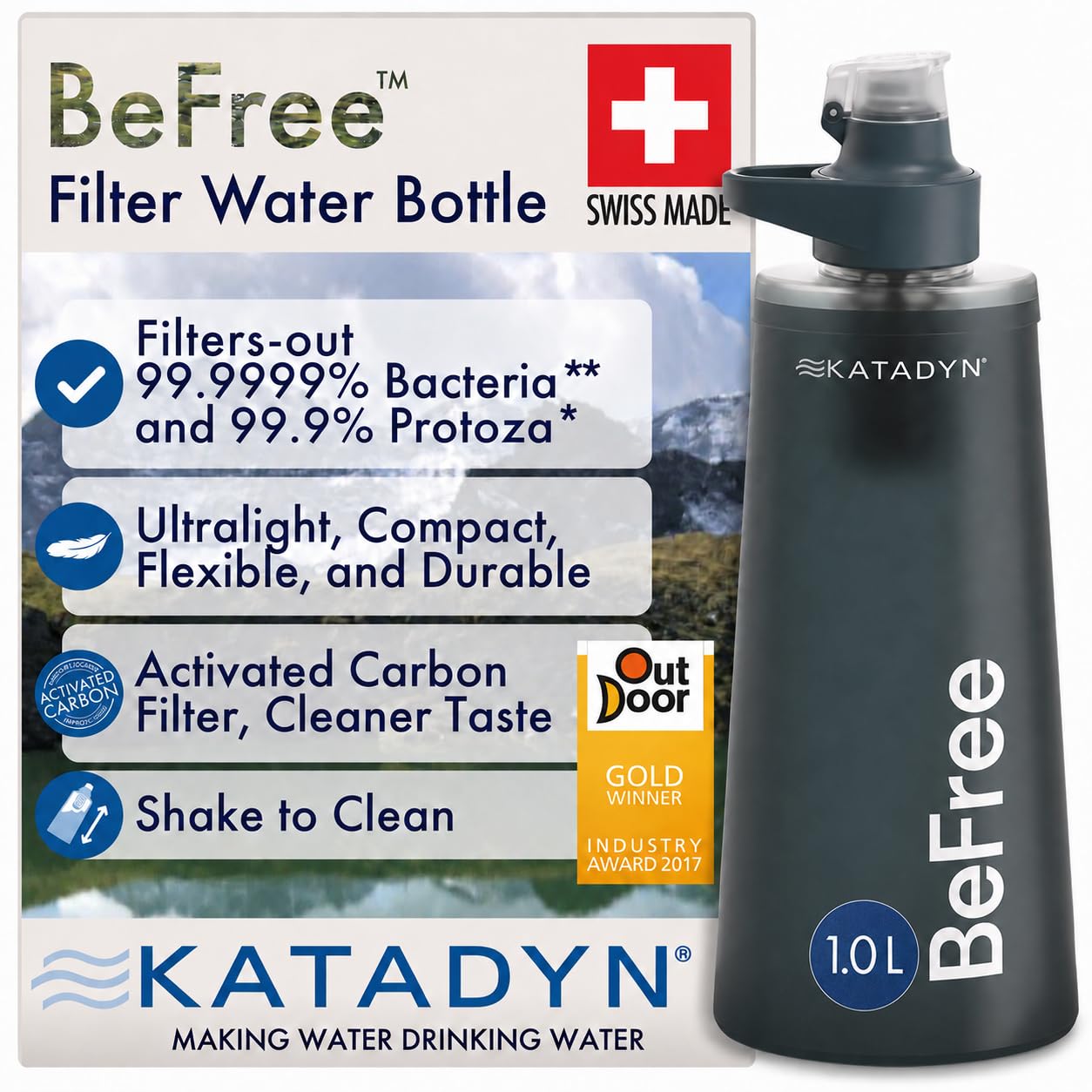
Katadyn BeFree 1 L

93 /100
Traveler Score Outstanding

Key details

Packing
Collapsible, folds flat
Capacity
1 L
Cleaning
Shake or swish, no backflushing
Filtration
Hollow fiber plus carbon
Check Details on Amazon

Most bottles take up exactly as much room at the end of the day as they did at the start. The BeFree doesn't. It's a soft flask, so as you drink it collapses toward the cap, and a liter of water becomes a folded packet at the bottom of a pack. On a trip where every item has to justify its place, that's most of the argument right there.

The filter has two stages and the second one comes out, which is the detail we appreciate most. A hollow-fiber layer handles sediment, fine particles and microplastics; the carbon stage handles taste in tap or treated water. Pull the carbon when you're drawing from a clear stream and want the flow back. None of the other bottles here let you make that call mid-trip.

Cleaning is a shake and a swish — no backflushing, no tools, no disassembly — and after a week of daily use that matters more than it sounds, because a filter you dread cleaning is a filter you stop using. What it isn't is a hotel-room bottle: you drink by squeezing, so there's no straw to sip from while you're reading. Ours rides empty in the top of a pack until the first stream.

Pros

  • Folds flat as it empties
  • Removable carbon stage trades taste for flow
  • Cleans with a shake, no backflushing
  • Carabiner handle clips to a pack

Cons

  • Squeeze-only drinking, with no straw to sip from
Our verdict

For hiking trips where every ounce counts, this is the one we pack: a liter of filtered water in a flask that folds flat when it's empty.

Check Latest Price
5

Best for Cold Water

Brita Insulated Stainless 20 oz

91 /100
Traveler Score Outstanding

Key details

Weight
14.5 oz
Capacity
20 oz
Insulation
Double wall, cold 24 hours
Filter Life
40 gallons or 2 months
Check Details on Amazon

Cold water is the whole point of this one. The double wall holds temperature for a full day — Brita rates it at 24 hours cold — and the carbon filter sits in the straw just as it does in the plastic bottle, so what you're drinking in a hot city in August is cold and tastes of nothing but water. That combination earns its keep on a long afternoon.

The steel body is why the water tastes clean rather than of the bottle, and the one-handed push-button lid and top-rack dishwasher treatment carry over unchanged. Same 40-gallon filter, same roughly two-month cadence, same easy-sip straw.

Where it gives ground is capacity and weight: 20 ounces against the plastic bottle's 26, and 0.41 kg empty, so a full one is a real object in a shoulder bag. On a walking day we refill it more often, and we feel it on the last mile. If you mostly carry water between air-conditioned places, that's a fair trade for ice at the end of the afternoon.

Pros

  • Holds cold for up to 24 hours
  • Same carbon filter as the plastic Brita
  • No metal taste in the water
  • One-hand push-button lid

Cons

  • Plastic cap can crack if the bottle is dropped
Our verdict

If you want cold water at the end of a long day, this is the filtered bottle we reach for; just accept 20 ounces and a heavier carry.

Check Latest Price
6

City Days

Philips Filtered Bottle 22 oz

87 /100
Traveler Score Excellent

Key details

Filter
Activated carbon fiber
Weight
6.81 oz
Capacity
22 oz
Cleaning
Dishwasher safe
Check Details on Amazon

Philips is the least expensive route here to a carbon filter in a bottle you'll be happy to carry, and the hardware doesn't feel like the cheap option: a Tritan body, a soft silicone mouthpiece under a flip cap that locks, and a wide mouth that's easy to fill at a fountain. It weighs 6.81 ounces, which is the number that makes it disappear into a day bag.

For city travel that's most of what you need. The activated carbon fiber filter takes the chlorine edge off tap water, the lock means the cap won't pop open against a bag strap, and the whole thing goes in the dishwasher at the end of the trip. We like it best for the traveler who wants filtered water as a background convenience rather than a project.

The listing promises 24 hours of cold from a plastic bottle this light, which is hard to believe — buy it for the weight, not the chill. And it's a taste filter, not a purifier: fine for a city with treated water, not for a tap you've been told to avoid.

Pros

  • Light at 6.81 ounces
  • Lockable one-touch flip cap
  • Carbon fiber filter fixes flat-tasting tap water
  • Dishwasher safe, with a one-year warranty

Cons

  • Straw stops short of the bottom
  • Takes steady suction to get water
Our verdict

The lightest way into filtered water for city days: 6.8 ounces, a lockable flip cap, and a carbon filter that fixes flat-tasting tap water.

Check Latest Price
7

Long Days Out

Epic Nalgene OG 48 oz

88 /100
Traveler Score Excellent

Key details

Capacity
48 oz
Cleaning
Dishwasher safe, filter excluded
Bottle Material
Nalgene, BPA/BPS-free
Filters Included
EveryTap and Everywhere
Check Details on Amazon

Forty-eight ounces is the whole idea. Two fills see you through a long day of walking, and the Nalgene shell takes the knocks a travel bag deals out without the dents a steel bottle collects.

The second filter is what makes it a travel bottle rather than a big one. Epic ships two cartridges: EveryTap for taps, which reduces chlorine, heavy metals and PFAS among 70-odd contaminants, and Everywhere, a dual-layer CoreXchange stage built for freshwater sources. Swap them to suit where you're filling, and keep the one you're not using in the bottom of the bag.

It's a lot of bottle. Full, you're carrying about three pounds of water before the bottle itself, and a 4-inch body takes up more of a pack than any of the straw bottles here. The trade is refills: on a hiking day, at a festival, or on a train where the trolley never comes, having 48 ounces on your back is worth the weight — and if the only water you find is a stream, the second cartridge means you don't have to think about it.

Pros

  • 48 ounces between refills
  • Two filters for tap and outdoor water
  • Durable Nalgene body
  • Bottle is dishwasher safe without the filter

Cons

  • About 3 pounds of water when full
  • Hard suction near the bottom of the bottle
Our verdict

For long days away from a refill, this is the one: 48 ounces, a Nalgene shell, and a second filter for when the only water left is a stream.

Check Latest Price
8

Tech Lovers

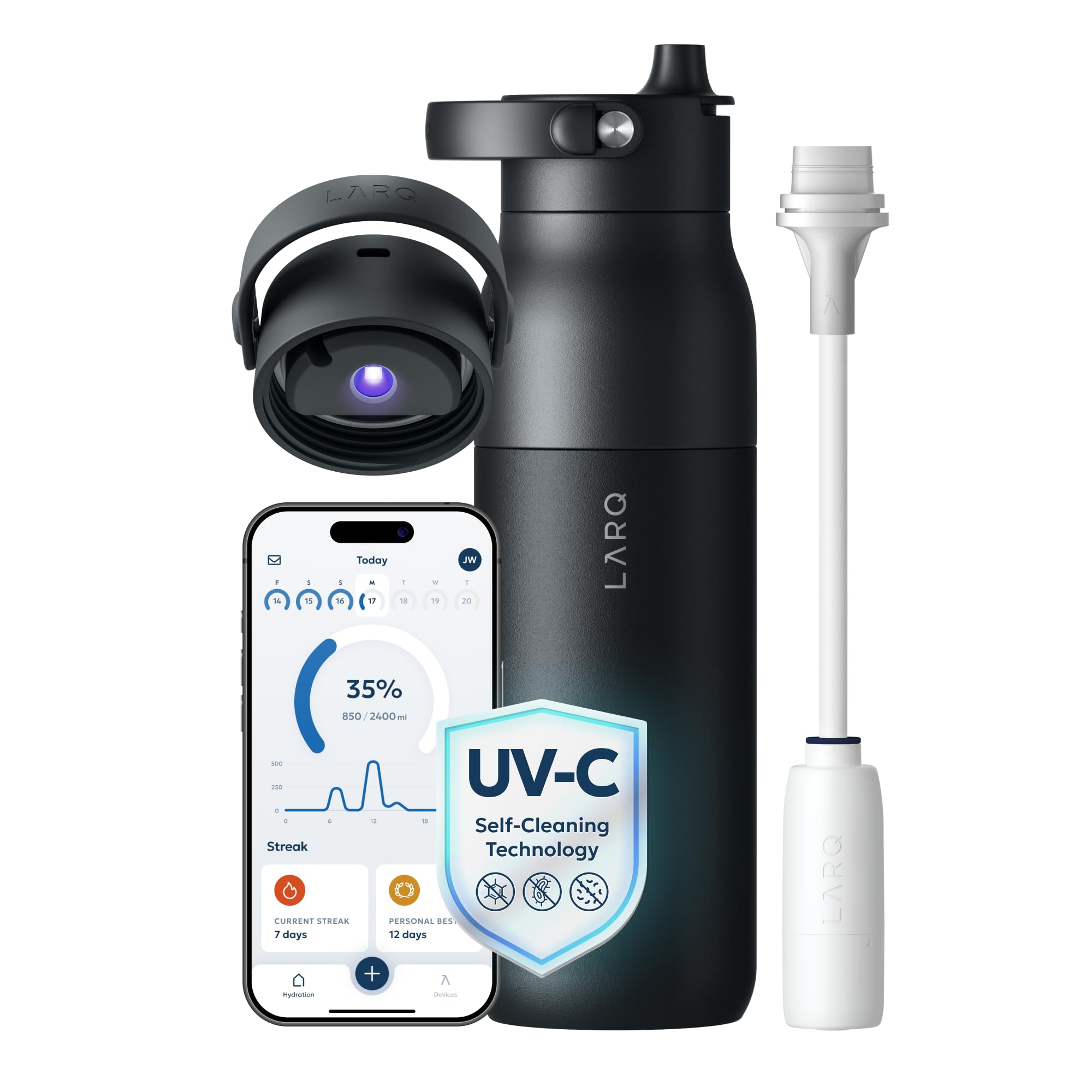
LARQ PureVis 2

80 /100
Traveler Score Excellent

Key details

Filter
Nano filter straw
Capacity
0.68 L
Insulation
Cold up to 24 hours
Filter Life
40 gallons
Check Details on Amazon

The PureVis 2 is the one bottle here with a battery in it, and the price reflects it. A nano filter straw handles chlorine, VOCs, PFAS and pharmaceuticals, tested to NSF/ANSI 42 and 53, and the cap carries a UV-C LED that runs on a schedule to keep the water and the bottle's interior clear of bio-contaminants.

We're of two minds about the smart layer, and the honest answer is that it depends on how much you like gadgets. The filtration is genuinely good, the double wall keeps water cold for a day, and the UV pass is a real comfort when you're filling from a tap you don't quite trust. The sip tracking through the app, which logs a drink when the bottle sits flat on a level surface, is either a quiet motivator or one more thing to maintain.

Charging is the cost of the cleverness: one USB-C charge runs two to three weeks, and when it dies the bottle still filters but stops cleaning itself. At 0.68 liters it's a day bottle rather than a hiking one, and the steel body is dishwasher safe while the cap, straw and filter want hand washing.

Pros

  • Nano filter straw plus UV-C cleaning
  • Keeps drinks cold up to 24 hours
  • App tracks sips through the day
  • USB-C charge lasts two to three weeks

Cons

  • Needs charging to keep the UV working
  • Costs more than anything else here
Our verdict

The premium pick for someone who wants filtration, cold water, and a self-cleaning cap in one piece of kit — and doesn't mind charging it.

Check Latest Price

How We Tested the Best Filtered Water Bottles for Travel

We started with a list of more than 30 bottles and cut anything with an unlisted or hard-to-source replacement filter, anything too tall for a seat-back pocket or a backpack sleeve, and anything whose filter couldn't be swapped without tools. That left 12, which we rotated through six months of real trips and everyday use.

Each one got filled from whatever tap was closest: hotel bathroom sinks, airport bottle-filling stations, gym fountains, and a cabin with hard well water that tastes like a penny. We drank from every bottle and noted whether the water came out neutral, chemical, or flat. We also timed how long a full liter took to flow on the first fill and again near the end of the filter's rated life, since a filter that clogs in three weeks is a filter nobody keeps using.

Portability and size got the undignified treatment — bottles went into tote bags, backpack side pockets, and car cup holders, and we upended each full one over a laptop sleeve and shook it around in a packed bag for a mile to see what leaked. Ice water went in before a flight and we checked the temperature six hours later. Then we took every bottle apart to wash it, counting how many pieces landed in the drying rack and whether a bottle brush could actually reach the filter housing.

Durability showed up on its own: lids dropped on pavement, bottles rolling around a trunk, one unfortunate tumble down stone steps. We tracked cracks, stripped threads, and hinges that loosened, and weighed all of it against the cost of replacement filters per gallon.

How to Choose the Right Water Bottle with Filter for Travel

Match the Filter to the Water You'll Meet

Three kinds of filtration show up in this category, and only one of them protects you from a tap you shouldn't be drinking. Carbon — in the Brita bottles, the Philips, the Epic's EveryTap cartridge — reduces chlorine, odors and some chemicals, which is a taste fix and nothing more. Hollow-fiber membranes, like the ones in the LifeStraw Go and the Katadyn BeFree, physically strain out bacteria, parasites, microplastics and sediment. Purifiers go further: the GRAYL GeoPress is rated for viruses too.

We sort by destination first for exactly that reason. Treated municipal water that tastes bad? Carbon is enough. A tap you've been warned about? Buy the purifier. Check the stated water limits as well, since GRAYL rates the GeoPress to 1,000 ppm TDS and brackish or unusually hard water needs a different tool.

Decide How Much Work a Sip Should Take

Every design here moves the work somewhere. A straw bottle makes you pull, and the finer the filter, the harder the pull — which is why the LifeStraw Go feels stiffer than the Brita. A squeeze flask like the BeFree puts the effort in your hands. The GeoPress has you lean your weight on it, with a firm surface underneath. None of that is difficult for a healthy adult over a day; all of it wears on a two-week trip if your grip or shoulders are sore. Pick the motion you'll least mind repeating: straw for drinking while you walk, squeeze for speed at camp, press for water you don't trust at all.

Weigh It Full, Not Empty

A 26-ounce bottle holds about 1.6 pounds of water before you count the bottle, and the bottles here run from 6.8 ounces to 15.9 empty. That's why capacity isn't automatically a virtue. Match the volume to how often you'll pass a refill: a 20-ounce bottle topped up at every fountain beats a 48-ounce one left in the hotel room because it's heavy. The math flips on a long hiking day with no refill in sight, which is where the Epic's 48 ounces start earning their weight.

Budget for Cartridges, Not Just the Bottle

Filters are consumables, and they run on volume rather than the calendar — the two-month figures on the Brita bottles assume daily use, and the real limit is 40 gallons. The carbon stages here are rated for 26 to 40 gallons, the GRAYL cartridge for 65, and the LifeStraw membrane for 1,000. Buy a spare with the bottle; a filter you're rationing is a filter you drink less water through. It also helps to know which stage wears out first, because on the LifeStraw Go it's the small carbon one rather than the membrane people assume is the expensive part.

Pack It for the Flight, Not Just the Trip

Carry the bottle empty through security and fill it on the far side — that's how a filter bottle earns its place in a carry-on. Pressure is the other thing to plan for: with water in it, a bottle can push moisture out through the mouthpiece as the cabin climbs, so pack it upright in a pocket rather than loose against your passport. And when the trip ends with water still in it, empty it, rinse the mouthpiece and straw, and dry it with the cap off before it goes back in the cupboard.

Frequently Asked Questions

Final Verdict

Choose by the water, not by the bottle. If the tap is treated and the only problem is the way it tastes, buy the Brita Hard-Sided 26-ounce bottle: light, dishwasher-friendly, and filtered at the straw where you need it. It is the one most travelers should put in a bag and stop thinking about.

If the water itself is the risk, the GRAYL GeoPress is the pick, with viruses as well as bacteria and parasites on its list, and the Katadyn BeFree is what goes in a pack when the day is a hike rather than a city.