Best Travel Water Bottles of 2026

There's a specific kind of betrayal only a travel water bottle can deliver: you zip it into a backpack, walk twenty minutes, and feel the damp spread across your back. The category has its own tradeoffs, too — the bottle that keeps ice all day usually weighs as much as a laptop, and the featherweight one sweats through your bag on a July commute. What you actually want is unglamorous: a lid that seals, a size that clears both the cupholder and the side pocket, and insulation that lasts past lunch.

That's what I went looking for. Over six months, my team and I carried 14 bottles through airport security, onto packed commuter trains, up day hikes, and into gym bags. We judged them on what you'd notice by day three: how the finish held up after a knock off the counter, whether drinking from the mouthpiece was comfortable mid-stride, and whether the color still looked sharp after a dozen dishwasher cycles. Few bottles got all of it right, and the ones that did were rarely the priciest.

1

Best Overall

Takeya Actives 22 oz

96 /100
Traveler Score Outstanding

Key details

Lid
Insulated spout lid
Weight
13.8 oz
Capacity
22 fl oz
Dimensions
3.04"W x 9.4"H
Check Details on Amazon

Twenty-two ounces is the travel size we keep coming back to, and the Takeya Actives makes that size feel deliberate. The base is 3.04 inches across, so it settles into most car cup holders, and the 9.4-inch height leaves room in a tote or a backpack side pocket. We carried it full in a shoulder bag and the insulated spout lid kept the inside of the bag dry. The covered spout also means you are not putting a grimy mouthpiece against your lips after a train seat or taxi ride. It makes the ordinary trip feel handled without asking you to relearn how to drink.

The 18/8 stainless steel body is double-wall insulated and rated to keep drinks cold for up to 24 hours, which is more than enough for a flight, a long drive, or a day of walking. We appreciated the wide mouth at refill time: it takes ice without a funnel and gives you room to scrub. The carry loop is small, but it is easy to hook a finger through when your other hand is holding a ticket or a coffee.

Cleaning is where the Takeya pulls ahead of several bottles here. It is dishwasher safe, and the wide mouth and removable lid let you rinse the parts that touch your mouth. The wide opening also makes it easier to dry fully between trips, which matters if the bottle spends a week in a hot car. For the way most people travel, that low-maintenance routine is a bigger deal than an extra ounce of capacity.

Pros

  • Fits most cup holders and daypack pockets
  • Leakproof spout lid with covered mouth
  • Keeps drinks cold up to 24 hours
  • Dishwasher safe and easy to fill

Cons

  • Cap can crack after repeated hard falls
Our verdict

For most travelers, this is the bottle we hand over first: leakproof, cup-holder-friendly, and easy to live with.

Check Latest Price
2

Best Sip-Or-Swig

Owala FreeSip 24 oz

93 /100
Traveler Score Outstanding

Key details

Lid
FreeSip push-button with lock
Weight
13.6 oz
Capacity
24 fl oz
Dimensions
3.24"W x 10.68"H
Check Details on Amazon

The FreeSip's two drinking modes are the reason to pick it over a plain chug bottle. Stand it upright and you sip through the built-in straw; tilt it back and you swig from the spout opening. We found ourselves using the straw on trains and in cars, where a quick sip is easier than tipping a bottle toward your face, and switching to the swig when we wanted a faster drink after a hike. The push-button lid covers the spout between sips, and the carry loop doubles as a lock.

The lock is the detail we trust most in a bag. It takes a deliberate press to open, so the lid is not going to pop open against a notebook or a jacket zipper. The 24-ounce body holds enough for a longer morning, and the wide opening takes ice and a bottle brush without a fight. Double-wall insulation is rated to keep drinks cold for up to 24 hours, which matches the better insulated bottles here.

The wider base does have one payoff: the bottle stands steady on a hotel nightstand or a train tray. That stability is more useful than it sounds when you are fumbling for water in the dark. It is the kind of small advantage you notice after a few nights on the road.

Pros

  • Straw and swig modes in one lid
  • Lock keeps the spout covered in a bag
  • Keeps drinks cold up to 24 hours

Cons

  • Too wide for standard cup holders
  • Body and paint can dent on hard drops
Our verdict

The FreeSip is the one to choose when you want both a straw and a swig from the same bottle, with a lock that keeps the spout covered.

Check Latest Price
3

Best Premium

YETI Rambler 26 oz

96 /100
Traveler Score Outstanding

Key details

Lid
Chug Cap
Weight
1.32 lb
Capacity
26 fl oz
Dimensions
3.5"W x 10.5"H
Check Details on Amazon

The Rambler is the premium pick here, and the chug cap is what you are paying for. A half-twist of the TripleHaul handle opens the cap, and the wide opening lets you drink fast without a straw. We liked that the cap stays attached to the handle, so there is no loose lid to set down on a picnic table or hold in your teeth while you fill the bottle. For a traveler who wants one simple motion at a rest stop, it is a satisfying design.

YETI's 18/8 stainless steel is built to resist punctures and rust, and the double-wall vacuum insulation keeps cold drinks cold without sweat on the outside. The 26-ounce capacity is a good middle ground for a day bag, and the bottle is dishwasher safe. The 10.5-inch height and 3.5-inch base are worth checking against your bag and cup holder before you commit.

We were not surprised by the cold retention; we were more struck by how much the chug cap changes the rhythm of drinking. It is faster than a straw and easier to clean than a lid with a long silicone tube. On a hot day, the wide mouth is also the easiest way to add ice from a hotel machine.

Pros

  • Half-twist chug cap is quick to open
  • TripleHaul handle makes carrying easy
  • 18/8 stainless resists punctures and rust

Cons

  • Chug Cap is not intended for hot drinks
  • At 600 g, it is heavy for a daypack
Our verdict

The Rambler is for the traveler who wants a simple, rugged bottle and does not mind paying for the badge and the chug cap.

Check Latest Price
4

Best One-Handed Lid

CamelBak Chute Mag Insulated 20 oz

95 /100
Traveler Score Outstanding

Key details

Lid
Magnetic Chute Mag cap
Weight
11.1 oz
Capacity
20 fl oz
Dimensions
3.74"W x 9.45"H
Check Details on Amazon

The magnetic cap is the whole reason to choose this Chute Mag over a standard screw-top bottle. Flip the cap open and it parks against the side of the lid instead of swinging into your nose; close it and the magnet helps it settle back into place. We liked that we could drink one-handed while holding a backpack strap or a phone, and the cap stayed out of the way rather than flopping against our cheek.

The 20-ounce insulated body is small enough for a daypack and a car cup holder, and the double-wall steel keeps water cold without condensation on the outside. At 316 grams, it is not the lightest bottle here, but it feels balanced when full. The cap closes with a firm twist, and the covered spout stays clean inside a pack.

The bottle and cap are dishwasher safe, which makes it easier to keep the magnetic mechanism clean. The 20-ounce capacity is the main limit: on a long, hot day you will refill it more often than a 26- or 32-ounce bottle. For commuting, short hikes, and city days, that is a fair trade for a bottle that feels compact in the hand.

Pros

  • Magnetic cap stays clear while you drink
  • Double-wall steel holds cold temperatures
  • Compact 20-ounce body for day trips

Cons

  • Leak-resistant rather than fully leakproof
Our verdict

Choose this if one-handed drinking matters: the magnetic cap parks itself and the insulated body keeps water cold without a straw to clean.

Check Latest Price
5

Best for Hiking

Nalgene Narrow Mouth 32 oz

96 /100
Traveler Score Outstanding

Key details

Lid
Narrow-mouth leakproof lid
Weight
6.25 oz
Capacity
32 fl oz
Material
Tritan Renew
Check Details on Amazon

A 32-ounce Nalgene is not trying to be clever, and that is exactly why it works on a trail. The Tritan Renew body is light at 177.25 grams, the narrow mouth gives you a controlled sip without splashing, and the lid screws down with a seal that has kept water out of our daypack. The measurement lines in ounces and milliliters are a quiet bonus when you are mixing a drink or tracking how much you have had.

We treat this as the bottle for the rough part of a trip: a hike, a campsite, a ferry with a wet deck. The plastic shrugs off knocks that can dent stainless steel, and it does not add the weight of an insulated bottle to a pack. It is dishwasher safe, and the cap comes off completely for filling from a tap or a filter. The shape also fits a backpack side pocket without a struggle.

The narrow mouth is the bottle's personality: it is tidy to drink from and less likely to dump water down your shirt when you are moving. It is also the reason the Nalgene is not our first choice for a road trip with a bag of ice, where a wide-mouth bottle is easier to fill. For hiking and camping, those priorities flip, and the Nalgene becomes the easy answer.

Pros

  • Very light at 177.25 g
  • Leakproof lid and tough Tritan body
  • Measurement lines in ounces and milliliters
  • Dishwasher safe

Cons

  • Not insulated; water warms on hot days
Our verdict

This is the bottle we take when the trip involves trails, rough handling, and all-day refills; it is light, tough, and simple.

Check Latest Price
6

Best Filtered Water

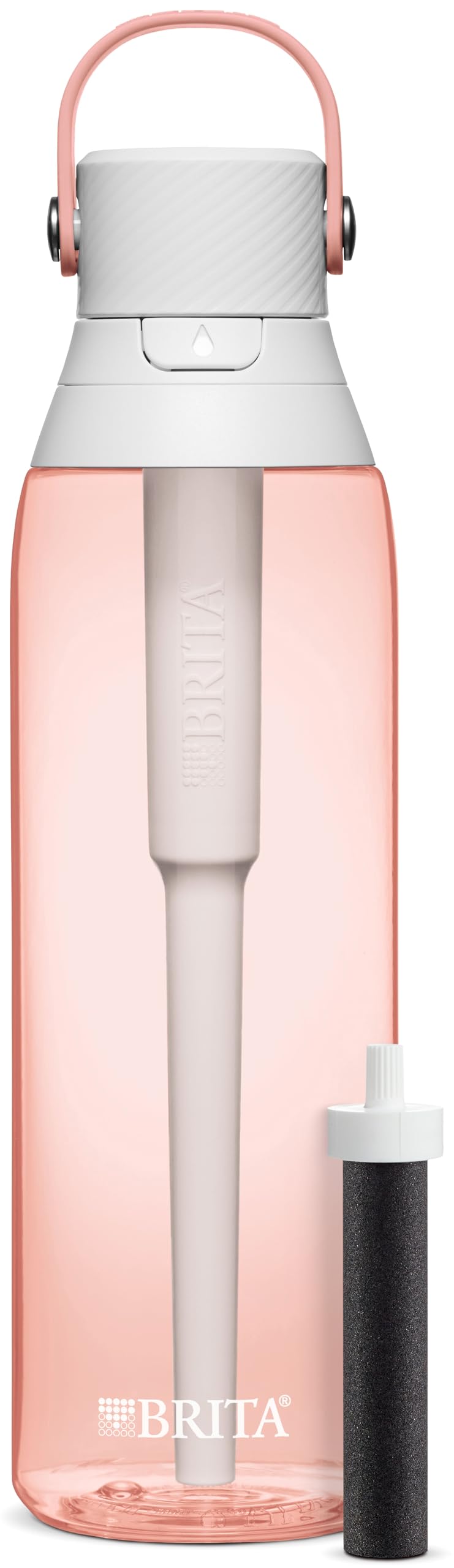
Brita Filtering Bottle 26 oz

93 /100
Traveler Score Outstanding

Key details

Lid
Push-button with straw
Weight
7.68 oz
Capacity
26 fl oz
Filter Life
2 months or 40 gallons
Check Details on Amazon

The Brita earns its place when you are filling from a hotel sink, a gym fountain, or a tap that tastes more like a swimming pool than water. The activated carbon block filter reduces chlorine taste and odor and cuts particulates as you drink, so you are not carrying a separate pitcher or buying plastic bottles for a week. The 26-ounce body is light at 7.68 ounces, and the push-button lid and carry loop make it easy to fill and go.

We used it on a trip where the tap was technically fine but tasted flat and chemical; the water came out neutral enough to drink without wincing. The filter lasts about two months or 40 gallons, which is a reasonable interval for a personal bottle. The built-in straw is covered when the lid is closed, so the mouthpiece stays out of whatever is rolling around in your bag.

We treat it as a taste fixer, not a safety device. Brita rates this as not a water purifier bottle, so we do not fill it from a questionable stream or a tap under a boil-water notice and assume it is safe. On the road, that distinction matters: it is excellent for making ordinary municipal water pleasant, and it is the wrong tool for backcountry water.

Pros

  • Reduces chlorine taste and odor
  • Push-button lid and carry loop
  • Filter lasts 2 months or 40 gallons

Cons

  • Straw takes real suction to drink through
  • Replacement filters are a recurring cost
Our verdict

For trips where the tap is the question, this is the bottle we pack: the filter improves taste and the push-button lid makes refilling simple.

Check Latest Price
7

Everyday Insulated Use

Hydro Flask Wide Mouth 20 oz

95 /100
Traveler Score Outstanding

Key details

Lid
Wide Mouth Flex Cap
Weight
14.1 oz
Capacity
20 fl oz
Insulation
Cold 24 hours, hot 12 hours
Check Details on Amazon

The Hydro Flask's wide mouth is the feature that makes it feel familiar: it takes ice from a hotel machine, a bottle brush, and a quick rinse without a special tool. The 20-ounce body is 9.25 inches tall and 3.74 inches across, so it fits most cup holders and slips into a backpack side pocket. The Flex Cap has a flexible handle that is comfortable to hook on a finger when your hands are full.

TempShield double-wall insulation is rated to keep drinks cold for 24 hours and hot for 12, and the pro-grade stainless steel does not hold onto the taste of yesterday's iced tea. At 400 grams, it is lighter than the YETI and heavier than the plastic bottles here. The bottle and cap are dishwasher safe, which is a real convenience on a trip where you are rinsing and refilling every day.

The wide mouth is also the reason this bottle is easy to live with at a hotel sink: you can fill it from a shallow tap and add ice without a funnel. It is not the biggest bottle here, so it suits city days and short hikes better than a full day in dry heat. That is a capacity choice, not a flaw in the insulation.

The detail that keeps the Hydro Flask in our rotation is the handle: it is wide enough to carry with two fingers when the bottle is full, and it folds out of the way when you set the bottle down. We kept coming back to that small convenience on the third day of a trip, when every bit of ease counts.

Pros

  • Fits most cup holders
  • Cold 24 hours, hot 12 hours
  • Dishwasher safe

Cons

  • Cap needs a firm twist to seal
  • Premium price for a 20-ounce bottle
Our verdict

A familiar, dishwasher-safe insulated bottle for travelers who want straightforward all-day cold and a wide mouth for ice.

Check Latest Price
8

Lightweight Day Trips

CamelBak Chute Mag 25 oz

95 /100
Traveler Score Outstanding

Key details

Lid
Magnetic Chute Mag cap
Weight
5.96 oz
Capacity
25 fl oz
Dimensions
2.99"W x 9.65"H
Check Details on Amazon

At 169 grams, the Chute Mag is the bottle we toss in a daypack and forget about until we need it. The Tritan body is light and clear enough to see how much water is left, and the 25-ounce capacity is a useful step up from a disposable bottle without becoming a burden. The molded carry handle is comfortable for a finger or a carabiner, and the bottle is dishwasher safe.

The magnetic cap is more than a gimmick on a moving train or a trail. It flips open, stays attached, and parks to the side while you drink, so you are not juggling a lid or letting it swing into your face. We also like that the cap covers the drinking surface when it is closed, which matters when the bottle has been rolling around in a bag.

That light weight is the point. It disappears into a pack in a way a stainless bottle does not, and the wide mouth is easy to fill at a fountain. On a city break, where you pass a refill every few blocks, we carried it without thinking about it.

We reach for it as a second bottle, not the one we baby. It is affordable enough to take on a boat or a dusty trail, and the magnetic cap makes it pleasant to drink from while you are moving. The cap is the clever part; the low weight is what keeps it in the bag.

Pros

  • Very light at 169 g
  • Magnetic cap stays out of the way
  • Integrated carry handle

Cons

  • Not insulated, so drinks warm up
  • Cap must be screwed down firmly to seal
Our verdict

The lightest bottle here is also one of the easiest to drink from, thanks to a magnetic cap that stays out of the way.

Check Latest Price

How We Tested 14 Travel Water Bottles

We built the shortlist from bottles that keep turning up in reviews and carry-on packing lists, then filtered for the specs that actually matter on the road: capacity between about 16 and 40 ounces, a base narrow enough for a standard car cupholder, a lid you can open with one hand, and a weight that doesn't punish you on a long walk. Anything that couldn't survive the top rack of a dishwasher, or had a reputation for peeling paint, got cut before we ordered it. That left 14 bottles, which we carried for six months.

Each one was filled to the same line with ice water and left in a hot car, on an open train platform, and on a desk, with ice levels checked at six, twelve, and twenty-four hours; we repeated the whole thing with coffee to see which lids held heat without making the exterior too hot to grip. Leak testing was less dignified. We added a drop of food coloring to the water, screwed the lid on as tight as seemed reasonable, shook it, laid it sideways in a tote bag, then stood it upside down on a paper towel for a full hour to see if anything crept through.

We opened and closed every lid one-handed while walking, noted whether the spout delivered a decent flow or made us work for it, and whether a straw or wide mouth slowed us down mid-stride. Bottles were dropped from counter height onto pavement, run through a dozen dishwasher cycles, and checked afterward for scratches, dents, and faded color. At the end we weighed what each one cost against how much it carried and how well it held up — more than one bottle that looked great on day one had a loose gasket or a stubborn-to-clean crevice by week eight.

How to Choose Travel Water Bottles

Start With the Lid and the Seal

Leak resistance comes from the lid, not the bottle body. A covered spout, a locking button, or a cap that seats with a firm twist all reduce the chance of a spill, but each depends on you closing it properly. The Takeya's insulated spout lid and the Owala's locking FreeSip are the two we trust most in a packed bag. If you prefer a magnetic cap, the CamelBak Chute Mag is convenient, though it is leak resistant rather than fully leakproof.

Match Capacity to the Trip, Not the Biggest Bottle

Twenty to 26 ounces is the sweet spot for flights, trains, and city days: enough to skip constant refills without making your shoulder ache. A 32-ounce bottle like the Nalgene earns its place on a hike, where refills are farther apart. Check the base against your cup holder and the height against your bag. The Takeya is 9.4 inches tall with a 3.04-inch base; the YETI is 10.5 inches tall and 3.5 inches across.

Decide How Much Insulation You Need

Double-wall stainless steel keeps water cold for hours and stops condensation, but it adds weight. The YETI Rambler is 600 grams; the Takeya is 13.76 ounces, or about 390 grams; the plastic CamelBak is 169 grams. If you are carrying the bottle all day, that difference matters. If it rides in a car or a daypack and you want cold water at the end of a hike, the insulated bottle earns its weight.

Plan for Cleaning and Wear

Daily use exposes the lid gasket, straw, and threads to whatever grows in warm water. A wide mouth and dishwasher-safe parts make the routine easier; the Takeya, Hydro Flask, and CamelBak bottles all go in the dishwasher. Narrow-mouth bottles need a long brush. Caps and hinges are the first parts to wear, especially after drops, so check replacement lids before a big trip. A bottle you can clean properly is more likely to stay in service.

Know When a Filter Is Worth It

A carbon filter bottle is for taste, not purification. The Brita reduces chlorine odor and particulates, which helps with municipal water that tastes flat or chemical, but it is not a purifier and does not make unsafe water safe. Pack it for hotel sinks and gym fountains, not for streams or a boil-water notice. If you only need cold water, a plain insulated bottle is simpler and easier to drink from.

Frequently Asked Questions

Final Verdict

The Takeya Actives is the travel bottle we recommend first. It pairs a leakproof spout lid with a 22-ounce body that fits most cup holders, and it is dishwasher-safe and light enough to carry all day. That combination covers the ordinary trip better than a bigger, heavier bottle does. If you know you will refill from iffy taps, choose the Brita; if you want straw and swig options, choose the Owala. For a hiking pack, the Nalgene's 32-ounce capacity and tough plastic make more sense.