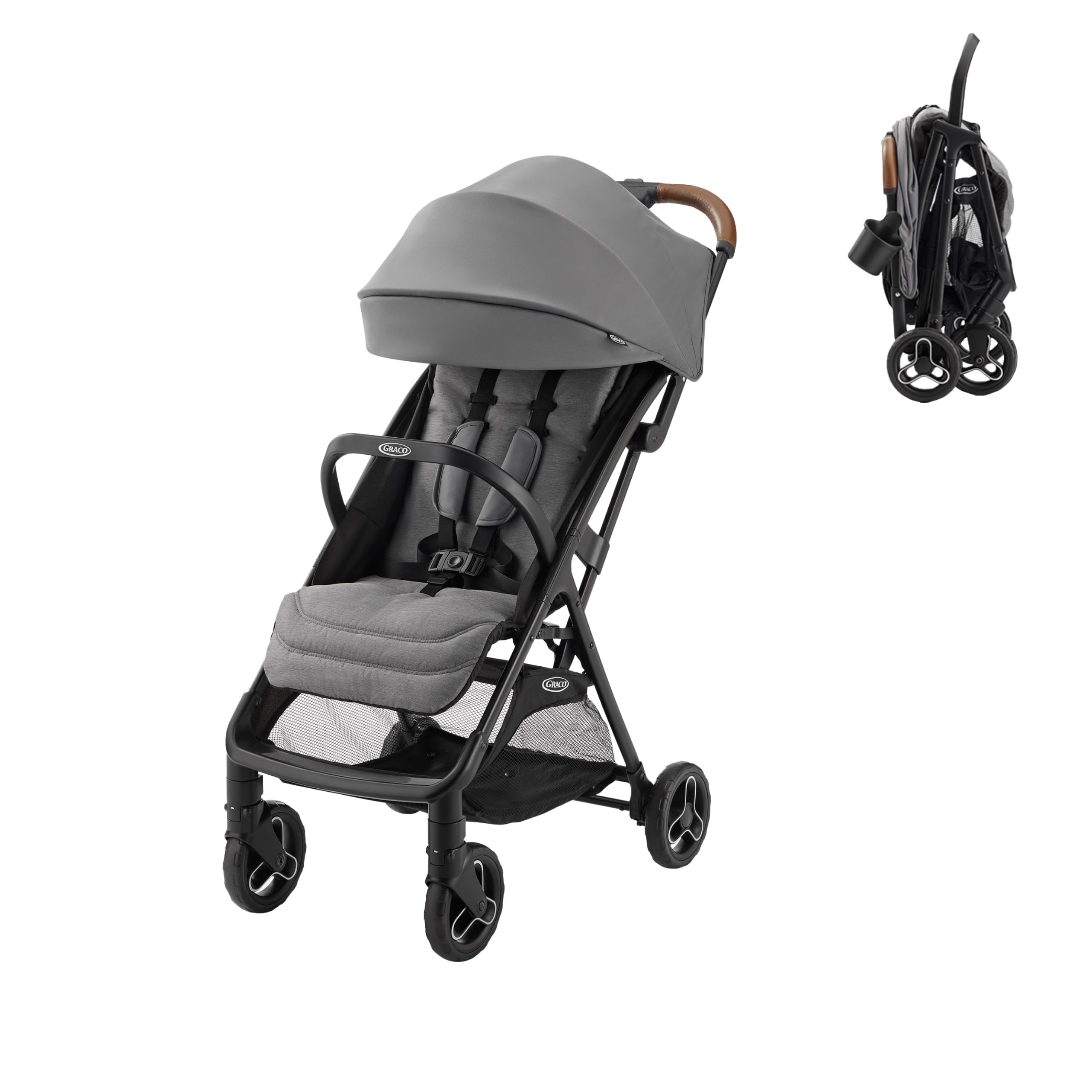
We started by reading through owner reviews and spec sheets, then narrowed by folded dimensions, weight, price, and whether an infant car seat could clip on with or without a separate adapter. Anything that demanded two hands to fold or wouldn't clear a standard overhead bin came off the list early. That left twelve strollers, which we lived with for eight months.
Each one was used the way a travel stroller actually gets used: in a trunk, on a jet bridge, in a theme park queue, over cobblestones, up two flights of stairs with a toddler on a hip. We timed the fold one-handed with a tote on one shoulder and counted the steps, then repeated it holding a squirming 25-pound kid. Every model went on a luggage scale and onto a tape-measured folded footprint, and we lifted each one into an overhead bin and into the trunk of a compact sedan.
Outside, we loaded the basket and pushed over cracked pavement, gravel, and curb drops, listening for rattles and watching whether the frame flexed under the weight. Two testers, one at 5-foot-2 and one at 6-foot-2, took turns on the handle to see who kicked the rear axle. We hung a loaded diaper bag off the bar and let go on a slight incline to see which ones tipped, and clipped in a car seat to check whether the adapters were included or sold separately. After eight months we looked at wheel wear, brake drag, loose joints, and whether the fabrics still looked presentable after being thrown in and out of a trunk — and noted what came in the box, since a rain cover or travel bag swings the value question a long way.