Best Small Travel Daypacks of 2026

A packable daypack is a small miracle until you lean on one. The lightest models fold into a pocket the size of a fist, then feel like a grocery bag against your spine by lunchtime; the burlier ones shrug off rain but eat half your carry-on. That trade — thin fabric versus a shell that can take a beating — is the whole decision, and it's why the liters printed on the tag rarely match what a pack comfortably holds. Get it right and you stop noticing the bag at all.

Over the past six months my team and I have carried 12 small daypacks through airport security lines, museum afternoons, and last-minute grocery runs. The ones that survived the rotation share one thing: they feel sturdier than they look. A lesson that's easy to learn the hard way — a 16-liter pack that sits right on your shoulders beats a 24-liter one that saws at them, and on bags this small, zipper and seam quality matter more than fabric weight. Here's what earned a spot.

1

Best Overall

Osprey Daylite

94 /100
Traveler Score Outstanding

Key details

Fits
Tablet or 14-inch laptop
Weight
1.1 lb
Capacity
13 liters
Dimensions
7.9"D x 10.2"W x 16.9"H
Check Details on Amazon

Most of the packs here are stuff sacks that happen to have shoulder straps. The Daylite is the opposite: a 13-liter daypack built around a padded, ventilated back panel, wide shoulder straps, a panel-opening main compartment, two stretch side pockets, and an interior sleeve that takes a hydration reservoir or most tablets and 14-inch laptops.

That structure is why it's our top pick. Over a long day — a train, a museum, then a trailhead — it stays where you put it and the straps keep spreading the load, which is exactly what a frameless sack stops doing once there's a bottle and a rain shell inside. It slides under an airplane seat, and the top loop hangs on a luggage handle while you wheel through the terminal. Thirteen liters is a genuinely small load, though: a shell, a camera, a bottle, snacks, and a paperback and you're full.

The compromise is stowability. There's no pouch to fold it into, so on a long trip it either travels as your personal item or eats most of a packing cube. We take it as the primary pack and add a folder like the WATERFLY as the backup — that pairing covers both jobs better than one bag trying to be both.

Pros

  • Holds its shape with a full load
  • Slides under an airplane seat
  • Sleeve takes a reservoir or 14-inch laptop
  • Two stretch bottle pockets and a luggage loop

Cons

  • Priciest pack in this group for 13 liters
Our verdict

Buy this if you want one small pack that carries a real load and keeps its shape from the office through a full day of travel.

Check Latest Price
2

Best Value Packable

WATERFLY Packable Daypack

91 /100
Traveler Score Outstanding

Key details

Weight
10.2 oz
Pockets
4
Capacity
20 liters
Folded Size
8.7 x 6.3 inches
Check Details on Amazon

Ten ounces and a folded footprint of roughly 8.7 by 6.3 inches: the WATERFLY disappears into a carry-on and then opens to 20 liters, which is why it's the pack we recommend to anyone who wants a travel daypack without spending much. Four compartments, including a front pocket that zips out entirely, and side pockets that take a full bottle.

Open, it measures 16.9 by 11.4 by 5.5 inches — enough for a jacket, lunch, a camera, and a souvenir or two, with the flat profile that slides down the back of a plane seat. The recycled nylon has a water-resistant finish, the webbing straps adjust easily, and half a day of walking is comfortable.

Two small realities. With little in it the bag slumps and the contents shift, which is the price of folding down that small; a folded jacket in the bottom fixes most of it. And getting it back into its own pouch takes a couple of tries the first time — roll it rather than folding it flat.

Pros

  • Folds to a paperback-sized pouch
  • Twenty liters across four compartments
  • A front pocket that zips off entirely
  • Recycled nylon with a water-resistant finish

Cons

  • Minimal strap padding under a heavy load
Our verdict

Our value pick: it stows in a carry-on, opens to a workable 20 liters, and comes back out whenever a day out demands more room.

Check Latest Price
3

Best for Packing in a Carry-On

Osprey Ultralight Stuff Pack

91 /100
Traveler Score Outstanding

Key details

Fabric
40D recycled high-tenacity nylon
Weight
5.29 oz
Capacity
18 liters
Water Resistance
Not water resistant
Check Details on Amazon

Osprey calls this one not water resistant, and that's the first thing to know: the 40-denier nylon will wet out in steady rain. Put a phone, a passport, and a camera in a dry bag and the rest of the trip is fine — everything else about this pack is what we want in a stowaway.

At 0.15 kg it stuffs into its own top pocket until it's about fist-sized, and it has no business being this comfortable for the weight: mesh-padded shoulder straps, an adjustable sternum strap whose buckle doubles as an emergency whistle, dual stretch side pockets, an internal key clip, and YKK zippers with pulls big enough for gloves. This is the pack we tuck into a carry-on for two weeks and forget about until the day someone suggests a walk.

The hardware is where the thought went. YKK zippers and reinforced pulls, a key clip so small things have a home, side pockets that swallow a one-liter bottle, and a recycled, bluesign-approved shell. Nothing here feels like the free tote that came with something else.

Pros

  • Stuffs into its own top pocket
  • Weighs just 0.15 kg
  • Padded mesh straps and a sternum strap with a whistle
  • Recycled bluesign-approved shell and YKK zips

Cons

  • No frame or back padding, so heavy loads sag
Our verdict

For a second bag that lives in your carry-on until a market day or a spur-of-the-moment hike, this is the one we reach for.

Check Latest Price
4

Best Packable With a Hip Belt

Eddie Bauer Stowaway 20L

89 /100
Traveler Score Excellent

Key details

Weight
0.6 lb
Capacity
20 liters
Hip Belt
Included
Packed Size
8.5" x 7" x 1.5"
Check Details on Amazon

If you want a hip belt on a pack that folds into itself, this is the one. Eddie Bauer builds the Stowaway from ripstop polyester with a StormRepel WR finish, gives it extended shoulder straps and a real hip belt, and packs the whole thing into its own 8.5 by 7 by 1.5-inch pocket.

Open, it's 18 by 10 by 9 inches and 20 liters, and the hip belt is what changes the day: on a long walk it moves weight off your shoulders, which none of the other packables here do. The pocket that holds the folded bag becomes an internal pocket once the pack is in use — a neat trick that gives you one slightly hidden place for a wallet or keys. StormRepel shrugs off drizzle and a damp ferry deck; it won't handle an hour of real rain.

Of the packables here it isn't the smallest folded — that's the Nanobag — but it's the one that carries best once it's open, and the only one with a hip belt. For a trip that mixes flights with long walking days, that's the combination we want.

Pros

  • Hip belt moves weight off your shoulders
  • Packs into its own pocket
  • StormRepel finish sheds light rain
  • Under a pound in ripstop polyester

Cons

  • Frameless, so heavy loads ride on your shoulders
Our verdict

The packable to take when you'll be on your feet all day — a hip belt and weather-resistant fabric make a real difference over miles.

Check Latest Price
5

Best Organization for Day Hikes

SKYSPER 20L Hiking Daypack

93 /100
Traveler Score Outstanding

Key details

Weight
1.1 lb
Capacity
20 liters
Max Load
15.4 lb
Compartments
7
Check Details on Amazon

The most organized pack in this group isn't a packable at all. SKYSPER's 20-liter has seven compartments, an anti-theft zipper across the main opening, trekking pole fixtures, and a breathable grooved back panel — closer to a proper hiking daypack than to the stuff sacks that fill most of this list.

That matters when a day out involves more than a wallet and a bottle. Documents go in one pocket, snacks in another, a bottle in an outside pocket, and the wide shoulder straps plus a chest strap keep the whole thing steady on a climb. SKYSPER lists a maximum recommended load of 7 kg, and the 600-denier polyester shell is the thickest here — it shrugs off being set down on rock and doesn't collapse when it's half empty.

This is the pack for a day hike where gear multiplies, or for a trip where the daypack is the only bag you carry. It doesn't fold away and it weighs 1.1 lbs, so it takes suitcase room the packables don't — a fair exchange for a harness that handles a loaded day without complaint.

Pros

  • Seven compartments organize a full day
  • Anti-theft zipper on the main opening
  • Ventilated back panel and chest strap
  • 600D shell rated to a 7 kg load

Cons

  • Stitching at the strap anchors can pull apart under load
Our verdict

Pick this when organizing a day's gear matters more than folding the pack away — the harness and thick shell carry a loaded day better than the stuff sacks here.

Check Latest Price
6

Minimal Day Loads

G4Free Packable Daypack

91 /100
Traveler Score Outstanding

Key details

Weight
4.59 oz
Pockets
4
Capacity
11 liters
Dimensions
6.3"D x 8.27"W x 13"H
Check Details on Amazon

The cheapest pack here is also the smallest: 11 liters, 0.13 kg, two zippered compartments, two mesh side pockets, and a tear-resistant polyamide shell with SBS zippers. For a light day — water, a layer, phone, keys, a snack — that's all anyone needs, and it's the pack we hand to a kid or drop in a tote for a theme park.

Folded, it disappears into a day bag; open, its 13-inch height keeps it close to your back instead of swinging. The fabric is thin enough that corners and hard edges show through, so pack something soft against anything sharp and the shell does its job.

It's a light-load pack, full stop. A laptop, a full day of hiking, or two liters of water pushes it past what it's built for — the 11 liters are real, but the harness isn't.

Pros

  • 0.13 kg and folds into a day bag
  • Two zippered compartments plus bottle pockets
  • Water-resistant polyamide with SBS zippers

Cons

  • Unpadded webbing straps dig in when loaded
Our verdict

A tiny, inexpensive pack for short light days — water, a layer, a phone — that folds away to nothing when the day is over.

Check Latest Price
7

Light Sightseeing

4Monster Hiking Daypack

91 /100
Traveler Score Outstanding

Key details

Pockets
4
Capacity
16 liters
Dimensions
7.1"D x 11.8"W x 18.5"H
Water Resistance
Water resistant
Check Details on Amazon

The stuff sack is sewn to the bag, which sounds like a small thing until you've spent a trip hunting for a loose pouch at the bottom of a suitcase. 4Monster's 16-liter folds into its own attached sack about the size of a fist, so the pack and its pocket always stay together.

Open, it's 18.5 inches tall with a main compartment, a front zip pocket, and two mesh side pockets, in a 30-denier ripstop nylon with reinforced stitching and a water-resistant finish. The straps are a little wider than the flat webbing on most packs of this type, which makes a difference over an afternoon of walking.

We used it as a sightseeing pack: a light jacket, water, a camera, and whatever came home from a market. At 16 liters it sits in the middle of this group — bigger than the G4Free, smaller than the 20-liter packs — and that's a useful place to land if you want one bag for a day out without extra volume to fill.

The thin 30-denier shell is the compromise: it folds small because there's almost nothing to it, so don't expect it to protect a laptop or carry a day's water. As a stowable second bag for city days and short walks, it's one we keep coming back to.

Pros

  • Attached stuff sack won't get lost
  • Sixteen liters in a fist-sized bundle
  • Straps wider than most packables
  • Water-resistant ripstop with reinforced stitching

Cons

  • Thin 30D shell protects nothing inside
Our verdict

A sensible middle size for sightseeing days, with an attached stuff sack that ends the hunt for a loose pouch in your suitcase.

Check Latest Price
8

Pocket-Size Backup

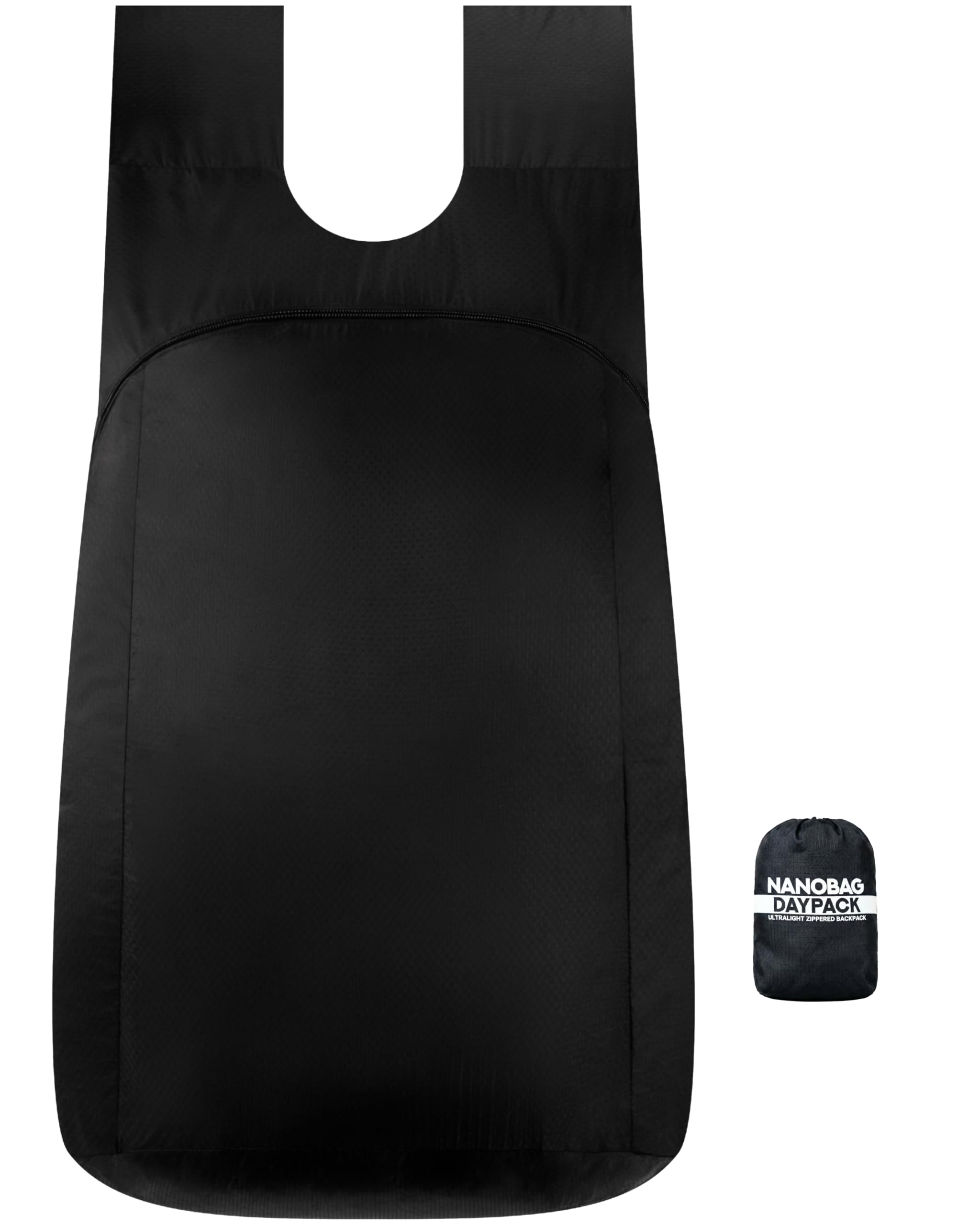
Nanobag Daypack 16L

90 /100
Traveler Score Outstanding

Key details

Fabric
0.05 mm ripstop nylon
Weight
1.15 oz
Capacity
16 liters
Water Resistance
Water repellent
Check Details on Amazon

The weight reads like a misprint: 1.15 ounces for a 16-liter backpack. The fabric is 0.05 mm ripstop nylon, the straps are 27 inches of wide webbing, and the whole thing stuffs into an attached pouch with no folding at all.

That's the appeal — it goes in a jeans pocket or the bottom of a purse and comes out when you've bought more than you planned. The wide straps spread a grocery load better than a tote bag's handles, and there's a YKK zipper rather than a drawstring, so small things don't spill onto the pavement.

Two numbers deserve skepticism. The 66 lb carry claim is a ceiling for the stitching, not a load to put on webbing straps for an afternoon, and "water repellent" means drizzle rather than downpour. Neither is a dealbreaker for a bag that lives folded in a pocket.

So it isn't the pack for a hike. It's the pack that sits in your day bag until the day the day bag isn't enough — groceries, souvenirs, a beach towel — and at that job it's small, light, and genuinely useful.

Pros

  • Packs to pocket size at 1.15 ounces
  • Wide 27-inch straps spread a load
  • YKK zipper keeps small items contained
  • Water-repellent ripstop nylon

Cons

  • Fixed-length straps that don't adjust for fit
  • One compartment with a single zipper
Our verdict

Not a hiking pack — it's the one that lives in your bag for the day your bag stops being enough, and for that it's excellent.

Check Latest Price

How We Tested a Dozen Small Travel Daypacks

We started with every small daypack we could find that packed down to roughly paperback size and weighed under a pound, then cut anything with an unclear return policy or straps that looked like an afterthought. That left 12 packs, and we bought every one ourselves.

Each got the same load — a one-liter water bottle, a rain shell, a mirrorless camera, a paperback, and a bag of trail mix — and the same week of use: a carry-on-only flight, a long walking day, and a grocery run in the rain. We weighed every pack empty on a kitchen scale and again loaded, then noted where the straps had pressed after a full day and whether they left marks on a collared shirt.

To check the capacity claims, we packed that same kit and watched which bags swallowed it with room left for a jacket and which needed a shove. We stuffed each one into its own pocket and timed how small it actually got, since compact size on paper and compact size in a crowded suitcase are different things. Fingernails went across every fabric panel, because the packs that snagged on the first pass were the ones that later fuzzed at the corners, and we opened and closed each zipper a hundred times with two fingers to see which teeth caught or skipped.

Inside the main compartment we looked at how the seams were finished and whether the bottom panel had any real thickness to it, which is where light fabric gives out first. Halfway through, the pattern was clear: the packs that still felt solid were the ones with a reinforced base and a shoulder strap anchored low on the back. We're still carrying the survivors on weekend trips and will update if anything tears.

How to Choose Small Travel Daypacks

Packable or Structured?

Two designs sit under the same search. A packable daypack weighs a few ounces, folds into its own pocket, and rides in a suitcase until you need it; a structured daypack like the Osprey Daylite has a padded back, a shaped harness, and volume it holds on its own. The trap is reading "packable" as portable in every sense: check the folded size rather than the liters, because that's the number that decides whether it earns luggage space.

Our rule: if the daypack will double as your personal item on the plane, buy structured. If it's insurance for the afternoon you buy too much, buy packable.

Matching Liters to the Day You're Actually Planning

Eleven or twelve liters holds water, a layer, a phone, and a wallet — a museum morning or a short walk. Sixteen to twenty liters adds a camera, lunch, and somewhere to put what you bring back.

Liters on frameless packs are optimistic. A soft 20-liter sack holds less than a structured 20-liter pack because it needs soft contents to fill its corners, and a hard-edged box wastes space in both. If souvenirs are part of the plan, size up instead of counting on compression.

Harness, Weight, and the Load You Really Carry

The harness is where a few ounces get spent or saved. Flat webbing straps are fine to about five pounds; past that, wide straps and a sternum strap keep the bag from sliding, and a hip belt moves weight onto your hips — the Eddie Bauer Stowaway is the only packable here with one.

A liter of water weighs about two pounds, so a bottle, a camera, and a jacket is already a load. Respect the stated limits too: SKYSPER rates its pack to 7 kg, which is a carrying limit, not a challenge.

Water Resistance Is a Range, Not a Yes

Water resistant, water repellent, and waterproof get used loosely. Most of the packs here carry a coating that sheds drizzle and a damp ferry seat; the Osprey Ultralight Stuff Pack is explicitly not water resistant, and zippers are the weak point on all of them.

A one-liter dry bag or a sealed phone pouch settles the question cheaply. Treat the pack's finish as protection for your jacket, not your passport.

Under-Seat Fit and the Personal-Item Question

Airline personal-item limits vary by carrier and change, so check your airline's number before you plan around a small daypack. A pack that measures within the limit can still be too fat when it's full, and a half-empty soft pack squashes into spaces a structured one won't.

Measure, then pack it and measure again. The Daylite's 16.9-inch height is the reason it slides under a seat; a stuffed 20-liter bag with a bottle in each side pocket is a different shape entirely.

Frequently Asked Questions

Final Verdict

Our pick is the Osprey Daylite. It works hardest across a whole trip — a laptop sleeve and a luggage loop for the travel days, a ventilated back and real straps for the walking ones — and it keeps its shape instead of collapsing around your gear.

If your daypack has to fold into a suitcase, the WATERFLY gives you 20 usable liters and a pouch that fits in a corner. If you'll be on your feet all day, the Eddie Bauer Stowaway's hip belt is the difference between a long walk and a long slog.