Best Packable Travel Backpacks of 2026

A packable backpack earns its place by disappearing — folded into its own pocket, tossed in a carry-on, forgotten until the day you need a second bag. The catch is that the thinness that makes that possible is also what makes cheap ones feel like a grocery sack with straps. What you want is a bag that stays small and light when stowed but still holds its shape, swallows a day's worth of gear, and survives being overstuffed for a week. That's the difference between a backup bag and a burden.

I've crammed a week of clothes into a carry-on plenty of times, and a packable bag is usually what saves the trip — and what I've most often regretted buying on price. Over the past eight months, my team and I have carried 12 of them through airports, onto trains, up day hikes, and through a couple of downpours. The ones that held up share unglamorous traits: tight stitching, zippers that don't catch, fabric that feels thin without feeling flimsy. The picks below are the ones I'd hand to a friend without a caveat.

1

Best Overall

Gonex Packable Daypack 20L

93 /100
Traveler Score Outstanding

Key details

Weight
6.53 oz
Capacity
20 liters
Packed Size
6.29 x 6.29 in
Compartments
3 zippered
Check Details on Amazon

The folded Gonex is a 6.29-inch square, which is the detail that earns it a permanent spot in our carry-on. Unfolded, it is a 20-liter daypack with three zippered compartments, and at 185 grams it adds less weight than a paperback. We used it as the bag that disappears into luggage and comes out for city days, and that is exactly the job this category needs to do.

What separates it from the thin emergency bags here is construction: reinforced bartack stitching in more than 25 places, an SBS metal zipper, and tear-resistant nylon. We were glad to see the reinforcement at the strap attachments, where lightweight packs usually start to give. The main compartment swallows a jacket, water bottle, and camera without turning into a black hole, and the front pocket keeps a phone and transit card reachable.

The soft body is what lets it fold so small, and we treat it as a day bag rather than a laptop bag: a camera goes in a padded insert, and a tablet needs its own sleeve. The shoulder straps are simple, comfortable for a few hours of walking, and best suited to a normal day's load rather than a weighted hike.

What we keep coming back to is the balance. The Gonex is not the absolute lightest or the most compact bag here, but it is the one that best combines a useful 20 liters, a genuinely small packed size, and seams that look like they will survive repeated folding.

Pros

  • Folds into a 6.29-inch square
  • 20-liter capacity with three zippered compartments
  • Reinforced seams and metal zipper
  • Weighs just 185 grams

Cons

  • No sternum strap for heavier loads
Our verdict

For travelers who want one packable bag for sightseeing and souvenirs, the Gonex is our default: 20 liters, a 6.3-inch folded square, and reinforced seams.

Check Latest Price
2

Best for Organization

Outlander Packable 20L

93 /100
Traveler Score Outstanding

Key details

Weight
8 oz
Pockets
5
Capacity
20 liters
Packed Storage
Folds into inner pocket
Check Details on Amazon

Five pockets and a carabiner clip are what make the Outlander the most organized 20-liter bag here. The main compartment is roomy, two front zippers keep small items from sliding around, and the new version adds a clip for a hat or water bottle. The rip-resistant nylon is light, and the whole bag folds into its own inner pocket when you reach your destination.

That organization is why we rank it near the top of this set for city days: you can keep a passport, phone, and snack in separate places without unpacking the whole bag. The trade-off is durability. The fabric and seams are not as reassuring as the Gonex when the pack is stuffed, so we keep it for day trips and light travel rather than overpacking it for a week. The carabiner is a small touch, but it is the kind of detail that makes a packable bag feel less like a sack.

Pros

  • Five pockets keep small gear organized
  • Folds into its own inner pocket
  • Carabiner clip for extra gear
  • 20 liters for day trips

Cons

  • No sternum strap for heavier loads
Our verdict

The Outlander is our pick for travelers who want a place for everything: five pockets, a 20-liter main compartment, and a carabiner, with a lighter build than the toughest packs here.

Check Latest Price
3

Best Ultralight

4Monster Hiking Daypack 16L

91 /100
Traveler Score Outstanding

Key details

Fabric
30D nylon
Weight
4 oz (113 g)
Capacity
16 liters
Packed Size
Wallet-sized pouch
Check Details on Amazon

The 4Monster is the bag we reach for when every ounce counts: at 4 ounces, it packs into a wallet-sized pouch and unfurls into a 16-liter daypack. Compared with the Gonex, it gives up capacity and organization, but it disappears into a jacket pocket in a way the bigger packs cannot.

The 30D nylon is water-resistant and tear-resistant, and the four pockets cover the basics: a main compartment, front zip, and two mesh side pockets. We liked the wider shoulder straps compared with the thinnest emergency bags; they spread the load better when the pack holds a water bottle and a layer. The bag has no frame, so pack it with soft items and it rides close to your back.

The pouch is small enough to leave in a glove box or day bag, which is the real luxury: you stop thinking about it until you need it. It is a day bag by design, not a one-bag travel pack, and that is the right role for it.

Pros

  • Weighs just 4 ounces
  • Packs to wallet size
  • 16 liters with four pockets

Cons

  • 16 liters is day-trip only
Our verdict

The 4Monster is the minimalist traveler's backup: 16 liters and four pockets in a 4-ounce pack that folds to wallet size and disappears into a jacket.

Check Latest Price
4

Best for Day Hikes

SKYSPER Iminix 15L

93 /100
Traveler Score Outstanding

Key details

Weight
0.75 lb
Pockets
6
Capacity
15 liters
Packed Size
7.9 x 6.7 in
Check Details on Amazon

A chest strap is one of the first things we check on a packable daypack, and the SKYSPER is one of the few bags here with one that also includes a safety whistle. It is a 15-liter pack with six pockets, a 0.75-pound body, and a folded size of 7.9 by 6.7 inches. On paper, it is the most hiking-oriented bag here.

The six pockets are useful in the way trail bags need to be: a main compartment, front zip, side bottle pockets deep enough for full-size bottles, and a small back pocket for keys. We found the wide straps and chest strap kept the pack from sliding when we bent over to tie a boot. The 0.75-pound body buys a more substantial harness and fabric than the 4-ounce bags.

For day hikes and long sightseeing walks, we rank the SKYSPER near the top of this set on carry comfort. It is not the bag for a minimalist who wants the smallest possible pouch, and 15 liters is enough for a trail lunch, water, and a layer rather than a beach day. If you want a packable daypack that feels like a real hiking pack, this is the one we pack for a trail day.

Pros

  • Chest strap with safety whistle
  • Six pockets for trail gear
  • Folds to 7.9 x 6.7 inches

Cons

  • Heavier than ultralight picks
  • 15 liters limits bulky loads
Our verdict

The SKYSPER is the day-hike pick: a chest strap and whistle, six pockets, and a 15-liter body that carries more comfortably than the ultralight bags here.

Check Latest Price
5

Best Large Capacity

MIYCOO Packable 35L

90 /100
Traveler Score Outstanding

Key details

Weight
12.8 oz
Pockets
5
Capacity
35 liters
Water Resistance
IPX4
Check Details on Amazon

The MIYCOO is the outlier here: a 35-liter packable bag with a wet compartment, anti-theft zipper clips, and a survival whistle, all in a body that weighs 12.8 ounces and folds into its own pocket. It is less a daypack than a spare travel bag for the return trip.

That 35-liter capacity is why we keep it on the list. It is the one here that can swallow a pair of size 14 sneakers, a towel, and a change of clothes, which makes it useful for gym days, beach days, and the moment your suitcase is already full. The wet pocket is the detail we appreciate most: it gives damp swimwear somewhere to go without soaking the rest of the bag.

The size cuts both ways. At 20.9 inches tall, it is a large bag for a packable daypack, and it will not disappear into a small purse or a cramped personal-item slot. We treat it as a travel overflow bag, not a hiking pack.

Pros

  • 35-liter capacity handles overflow
  • Wet compartment separates damp clothes
  • Anti-theft zipper clips
  • Folds into its own pocket

Cons

  • Straps limit comfort under a full load
Our verdict

The MIYCOO is the packable bag we choose when capacity matters more than a tiny folded footprint: 35 liters, a wet pocket, and zipper clips for travel days.

Check Latest Price
6

Best Premium

Osprey Ultralight Stuff Pack

91 /100
Traveler Score Outstanding

Key details

Fabric
40D recycled nylon
Weight
5.29 oz
Pockets
4
Capacity
18 liters
Check Details on Amazon

The Osprey costs more than the rest of this group, and the reason is in the harness: padded mesh shoulder straps, a sternum strap with a whistle, and a waist strap that helps steady the load. The 18-liter body is made from 40D recycled nylon and folds into its own top pocket. It is the most expensive pick here, and it feels like it.

We noticed the difference on longer walks. The padded straps and sternum strap keep the bag from swinging, and the waist strap takes some weight off the shoulders in a way the simple strap packs cannot. The trade-off is that this is still an 18-liter stuff pack, not a framed daypack; it carries a jacket, water, and camera well, but it will not make a heavy load disappear.

Organization is deliberately simple: one main compartment, a quick-access top pocket, dual stretch side pockets, and an internal key clip. The YKK zippers feel more substantial than the price-first packs here, and the recycled nylon has a slightly crisper hand than the thin polyester bags. We kept keys and a wallet in the top pocket and let the main compartment stay a single open space.

For travelers who will wear a daypack for hours and want the straps to feel like a real pack, the Osprey is the premium pick we recommend. It holds less than the 20-liter bags and asks you to pack around its single compartment, so it earns its place on comfort and construction rather than capacity.

Pros

  • Padded mesh shoulder straps
  • Sternum and waist straps
  • 40D recycled nylon and YKK zippers

Cons

  • Not water resistant
Our verdict

The Osprey is the comfort-first choice: padded mesh straps, a sternum and waist belt, and recycled nylon in an 18-liter pack that folds away, for travelers who will walk for hours.

Check Latest Price
7

Recycled Gear

WATERFLY Packable 20L

91 /100
Traveler Score Outstanding

Key details

Weight
10.2 oz
Pockets
4
Capacity
20 liters
Packed Size
8.7 x 6.3 in
Check Details on Amazon

The WATERFLY's recycled nylon body is the first thing that sets it apart in this group, and the 20-liter size puts it right in the sweet spot for a travel daypack. It weighs 10.2 ounces and folds into an 8.7-by-6.3-inch pouch, with four zippered compartments and a removable zip pocket.

The pocket layout is generous for the weight: one main compartment, two front pockets, and a zipper-removable pocket that can live in a tote or be clipped inside the pack. We found the side pockets fit a standard water bottle, and the teal color is easy to spot in a dark suitcase. The 10.2-ounce weight is a little heavier than the 4-ounce ultralight bags, but it still disappears into a carry-on.

Where the WATERFLY falls behind the top picks is in load comfort. The shoulder straps have little padding, so a full 20 liters can dig in after a few hours, and the bag has no sternum strap to keep the load steady. We rank it as a solid value pick for light travel, not the bag we carry on a long hike.

Pros

  • Recycled nylon body
  • 20 liters with four zippered compartments
  • Folds to 8.7 x 6.3 inches

Cons

  • Not fully waterproof
Our verdict

The WATERFLY is a well-organized 20-liter pack with recycled nylon and a compact fold, a good choice for light travel days when you want more pockets than the ultralight bags.

Check Latest Price
8

Pocket Backup

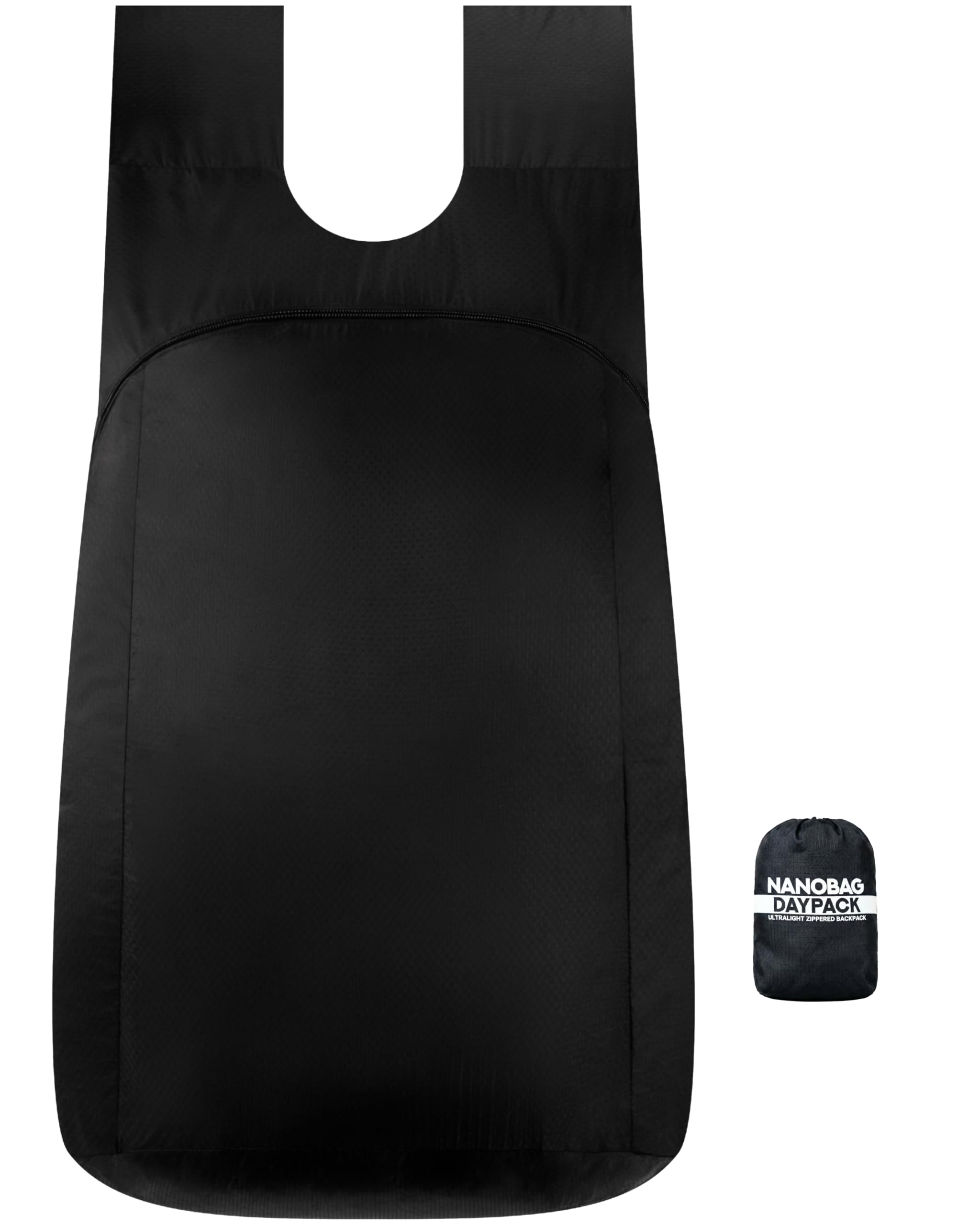
Nanobag Daypack 16L

90 /100
Traveler Score Outstanding

Key details

Fabric
Diamond ripstop nylon
Weight
1.15 oz
Capacity
16 liters
Packed Storage
Attached pouch
Check Details on Amazon

At 1.15 ounces, the Nanobag Daypack is lighter than most phones, and it packs into an attached pouch small enough to live in a jacket pocket. The 16-liter body is made from 0.05mm diamond ripstop nylon, with wide 27-inch shoulder straps and a YKK zipper.

The first thing we noticed is how little space it takes up. It is the bag we tuck into a purse or glove box for the just-in-case moments: a farmers market, a souvenir shop, a beach walk where you end up carrying more than you planned. The attached pouch means there is no separate stuff sack to lose.

The fabric is remarkably strong for its weight—Nanobag rates it to carry up to 66 pounds—and the wide straps spread a light load comfortably. It is still a single-layer nylon with no padding, so a heavy load will press against your back. We kept our loads light and were happy with it for errands and short walks.

There is just one compartment, so keys and a phone need their own pouch. The fabric also has no padding, so heavy loads press against your back. The wide straps stayed put on our shoulders, but this is not a pack for a long hike with weight.

Where the Nanobag earns its place is as a backup, not a primary travel pack. It is the one here that can disappear into a pocket and still carry a surprising amount, and that is worth paying for if you want a safety net without giving up space in your bag.

Pros

  • Weighs 1.15 ounces
  • Packs into attached pouch
  • 16 liters with wide straps

Cons

  • Fixed straps can't be adjusted
  • Costs more than other ultralight backups
Our verdict

The Nanobag is the tiny backup we keep for just-in-case errands: 1.15 ounces, a pocket-sized pouch, and 16 liters of carrying space when you need it.

Check Latest Price
9

Kids and Errands

G4Free Packable Daypack

91 /100
Traveler Score Outstanding

Key details

Weight
4.59 oz
Pockets
4
Capacity
11 liters
Packed Storage
Folds into pouch
Check Details on Amazon

The G4Free is the smallest pack we recommend, and the 11-liter capacity tells you what it is for: a child's daypack, a quick errand bag, or a minimalist pack for a concert or theme park. It weighs 4.59 ounces and folds into a compact pouch, with two zippered compartments and two mesh side pockets.

The small size is the point. It holds a water bottle, phone, sunscreen, and a light layer, and it does not turn into a bulky bag on your back. We liked the two zippered compartments for separating a wallet from a snack, and the side mesh pockets make a bottle reachable without opening the main bag.

The trade-offs show up when you push it. The polyamide fabric is thin, and the bag takes the shape of whatever you put inside, so a hard camera or a tablet needs its own protection. The main compartment lacks interior pockets. This is not the pack for a full day of sightseeing with a camera and a jacket.

For a light day out, a child, or a backup bag that takes up almost no room, the G4Free is a sensible small choice. We don't make it the only bag for a trip.

Pros

  • Weighs 4.59 ounces
  • Folds into compact pouch
  • 11 liters with two zippered compartments

Cons

  • Side pockets fit only slim bottles
Our verdict

The G4Free is the small, light backup for quick errands, kids, or theme-park days, with a compact fold and just enough room for the essentials.

Check Latest Price

How We Tested a Dozen Packable Backpacks

We started with a list of about 40 packable backpacks from brands with a track record in travel gear, then narrowed it by packed volume, listed weight, claimed capacity, price, and whether each one stuffs into its own pocket or needs a separate sack. Twelve made the cut, and we've lived with them for eight months.

Every pack went through the same rounds. We weighed it on a kitchen scale, then folded and unfolded it 20 times to see whether it went back into its pocket as neatly on the last try as the first. We filled each one with a packing cube, a water bottle, a paperback, and a laptop to check whether the stated capacity was honest and whether the bag stood upright or slumped into a puddle of nylon. Then we carried each one loaded for an hour at a stretch — through airport terminals, onto trains, along a day-hike trail, and to the grocery store — noting where straps dug in, whether the back panel turned clammy, and how much the whole thing sagged by the end.

Since thin fabric is where these bags usually fail, we held each one up to a lamp to see how much light passed through, sat a paper-towel-lined pack in the shower for five minutes and checked for damp spots, and tugged every zipper and strap anchor hard enough to make ourselves nervous. We also overloaded them past any reasonable comfort zone with 20 pounds of gear and dragged a loaded pack across gravel to see how the base wore. Eight months in, the ones that still look new are the ones that earned a spot below; the ones that frayed at the strap joins or tore at the zipper tape did not.

How to Choose Packable Travel Backpacks

Start With Packed Size, Not Just Capacity

Packed size is the first number we look at, because a packable bag only earns its place if it disappears into the bag you already have. A 6.3-inch square like the Gonex is easy to tuck into a carry-on corner; the 4Monster goes smaller, to a wallet-sized pouch, while the Nanobag compresses enough for a jacket pocket. The trap is assuming a low liter count means a tiny packed size; those are different measurements.

Before you buy, empty the suitcase you plan to travel with, pack it, and look for the awkward gaps around shoes and toiletries. That is where a stuff pack actually goes. If the bag will ride in a daypack instead, check that its pouch is small enough to leave in place rather than something you unpack and repack every morning.

Match Capacity to the Day You're Packing

Capacity should match the day you are packing, not the whole trip. An 11-liter bag like the G4Free is a kid's pack or an essentials-only errand bag; 15 to 20 liters, where the SKYSPER, Gonex, Outlander, and WATERFLY sit, is the useful range for a city day, a hike, or a beach trip. The MIYCOO's 35 liters is for overflow, souvenirs, or a full change of clothes.

Think in loads: a water bottle, phone, sunscreen, and a layer fit in 15 to 20 liters; a towel, shoes, and a change of clothes need closer to 35. If you are choosing one bag for both sightseeing and the return trip, start at 20 liters and accept a little more folded bulk.

Look at the Harness Before You Load It Up

The harness is what separates a bag you tolerate from one you carry all day. Padded shoulder straps, a sternum strap, and a hip belt spread the load and keep the pack from swinging. The SKYSPER's chest strap and the Osprey's padded mesh harness are the clearest examples here; the Nanobag's wide straps are comfortable for light loads but do not adjust. The trap is assuming a packable bag can carry a heavy load just because the seams hold.

If you plan to carry more than a liter bottle and a jacket, choose padding and a sternum strap over the lightest possible weight. For a backup bag that lives in a purse, simple straps are a reasonable trade.

Decide How Much Organization You Need

Organization is personal, but the number of pockets should match the small things you carry. Five pockets on the Outlander or six on the SKYSPER give a phone, passport, keys, and water bottle separate homes; the Osprey keeps things simple with one main compartment and a quick-access top pocket. More pockets add convenience and a little weight.

Look for a quick-access pocket for a phone or transit card, side pockets deep enough for your bottle, and an internal clip for keys. If you prefer packing cubes, a single compartment like the Osprey's is easier to organize; if you want to grab and go, the Outlander's pocket layout is the easier choice.

Treat Water Resistance and Durability as Limits

Water-resistant is not waterproof. Most of these bags use a water-resistant nylon or polyester that sheds a drizzle, but seams and zippers are the weak points. The MIYCOO lists IPX4 water resistance and a wet compartment; the Osprey is not water resistant at all, so it needs a dry pouch for electronics. Thin fabric also means less abrasion resistance, especially at the bottom.

Pack electronics in a sealed pouch, avoid overstuffing a packable bag until the seams pull, and air-dry the bag fully after a wet day. If you expect heavy rain, treat the pack as a secondary layer rather than your only protection.

Frequently Asked Questions

Final Verdict

For most travelers, the Gonex 20L is the one to pack. It folds into a 6.3-inch square, weighs 185 grams, and has the reinforced seams and metal zipper to survive being stuffed into a carry-on and pulled out at the destination. It is the best balance of capacity, packed size, and construction in this group.

If you need to haul more, the MIYCOO 35L is the overflow bag; if comfort matters more than a tiny fold, the Osprey 18L earns its premium with a padded harness. For a tiny backup, the 4Monster is the one we keep in a pocket.