Best Motion Sickness Bands of 2026

Motion sickness doesn't care how much you spent on the trip. It shows up on the second loop of a mountain road, midway through a ferry crossing, or somewhere over Nebraska, and suddenly the scenery is the last thing you want to look at. Motion sickness bands work on a simple premise: a small button presses into the inside of your wrist, and that pressure is supposed to dial down the queasiness without the drowsiness of medication. Whether that actually happens—and whether the band stays put long enough to matter—is the whole game.

I'm prone to car sickness, so I volunteered for the back seat. Over six months, my team and I wore 14 bands on highway drives, a choppy ferry, a couple of flights, and through one tester's first trimester of morning sickness. We noted which ones eased nausea, slipped into a jacket pocket without snagging, stayed snug under a sleeve, and didn't leave a red ring after twenty minutes. Color mattered more than I expected, and the right pick is below.

1

Best Overall

Sea-Band Adult Wristband 2-Pack

86 /100
Traveler Score Excellent

Key details

Cuff Material
Knitted elastic
Bands Included
2 sets
Pressure Point
P6, sewn-in plastic knob
Listed Dimensions
2.3 x 2 x 2.75 inches; 1.1 ounces
Check Details on Amazon

The band that goes into the bag first is this one. Sea-Band's knitted cuff, with its plastic knob sewn into the inside, has the most consistent motion-sickness results of anything here: it's the pair we reach for before a ferry crossing, a winding coastal road, or a short hop in a small plane. The knob is fixed to the cuff rather than threaded on, so it presses the P6 point on the inner wrist and stays there while you pull the band on.

What you feel is firm, continuous pressure, and that firmness is the whole trade. On a long crossing we were aware of the knob the entire way, and a shallow oval mark is still on the wrist when it comes off. That's a band doing its job — but if you know you'll fiddle with anything tight, buy for comfort instead: the stretch fabric of our family pick goes on easier and asks less of your patience.

It's an adult band, which matters on a family trip, because a child's wrist won't get useful pressure from it. The two sets in the pack help there: one can live in the glovebox and one in the carry-on, so a band is at hand when the road starts to turn instead of zipped into a suitcase. They're reusable and need nothing but a wrist.

Acupressure isn't a guarantee, and we've had trips where a band made no difference at all — a band worn off the point, or one you take off early because it's pinching, is the usual reason. What the extra money buys over the cheaper pairs here is the sewn-in knob and elastic firm enough to hold pressure through a full day of travel. If most of your motion is car journeys and you want to forget you're wearing anything, the softer bands below suit better; for a cruise or a long flight, this is the pair we pack.

Pros

  • Two sets, so a spare stays packed
  • Most consistent motion-sickness results here
  • Sewn-in knob holds the P6 point
  • Drug-free, non-drowsy and reusable

Cons

  • Adult sizing only; kids need a separate band
Our verdict

Our pick for most travelers: the firmest, most consistent pressure on the P6 point, sold as two sets so a spare stays packed and ready.
Check Latest Price
2

Best for the Whole Family

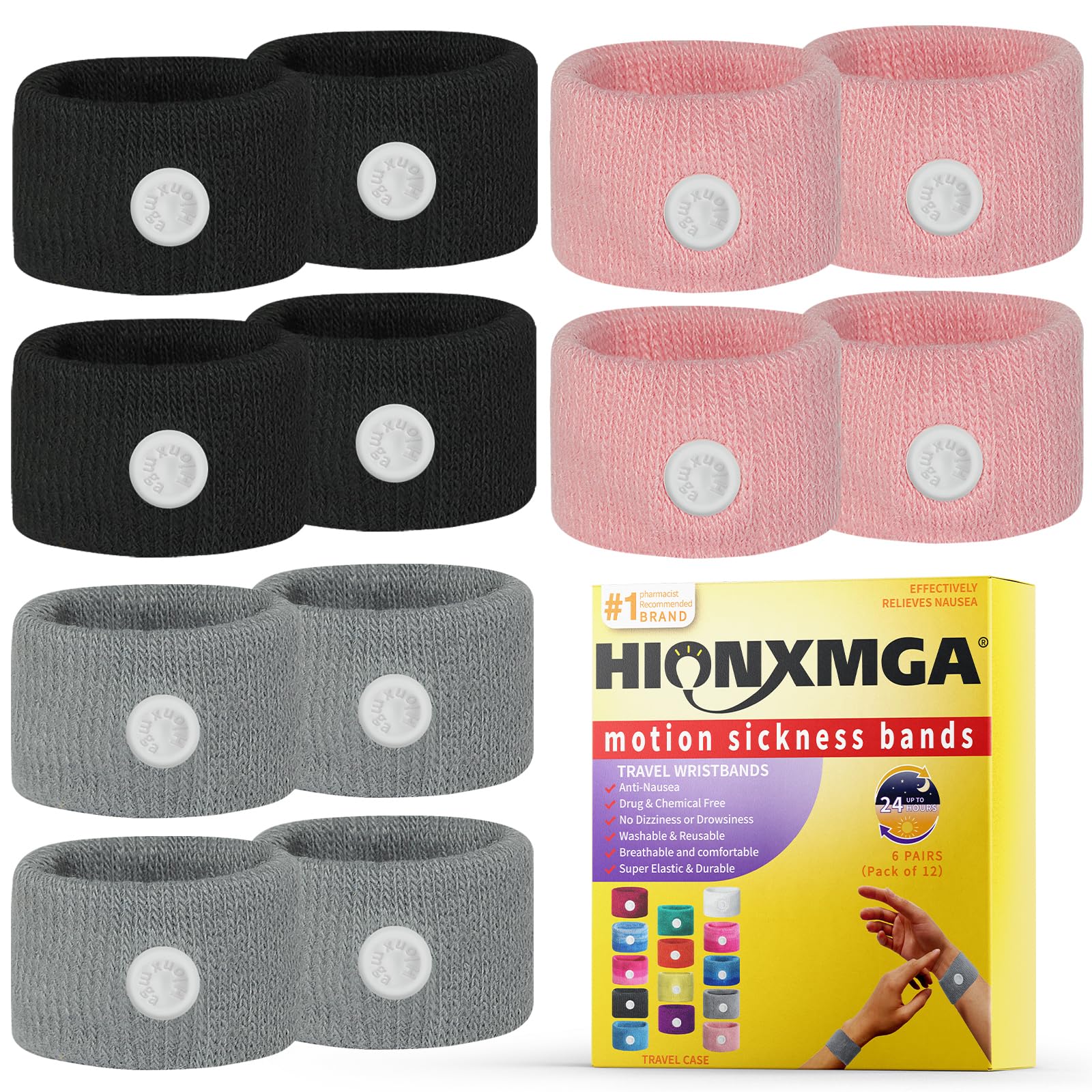
HIONXMGA Motion Sickness Bands

89 /100
Traveler Score Excellent

Key details

Sizing
One size fits all
Cuff Material
Stretch fabric, plant-based dyes
Pressure Point
Neiguan (P6)
Listed Dimensions
5.51 x 4.72 x 0.51 inches; 1.76 ounces
Check Details on Amazon

The first thing you notice is that these don't look like medical equipment. The stretch fabric is colored with plant extracts rather than synthetic dye, and the shades are the kind a child picks out and then keeps on, which is most of the battle with a wristband. The knit pulls on without a fight and sits flat against the skin instead of digging a ridge into the wrist.

One size is meant to cover adults, kids and seniors, and that's why a set of these lives in the car. The stretch gets a band onto a small wrist without a wrestling match, and the lighter fabric makes it the one a child is least likely to peel off halfway through a drive. Because the cuff is soft rather than firm, we check that the bead has landed on the P6 point after pulling one on — a stretch band can settle a little off where you first placed it.

The plant-dye claim is the listing's, but the practical point stands: there's nothing scratchy or chemical-smelling about the fabric, and it wears lightly through a full day of travel. It's also the cheapest way to outfit a whole family, which is how we ended up with a set in the car, a set in the suitcase, and no particular worry about one going missing in a rental.

Where these give ground is precision. A firm cuff holds a bead exactly where you put it; a soft one needs a glance before you set off. If you want to fit it and forget it on a long cruise, the Sea-Band is the surer choice. If you're kitting out a family of mixed ages for a summer of car trips, this is the set we pass around.

Pros

  • Stretch fabric pulls on easily
  • Plant-based dyes, gentle on skin
  • Covers adults, kids and seniors
  • Budget price makes spare sets easy

Cons

  • Snug on wider adult wrists
Our verdict

The family set: stretchy, plant-dyed bands that fit children and adults alike, at a price that makes buying spares painless.

Check Latest Price
3

Best for Car Sickness

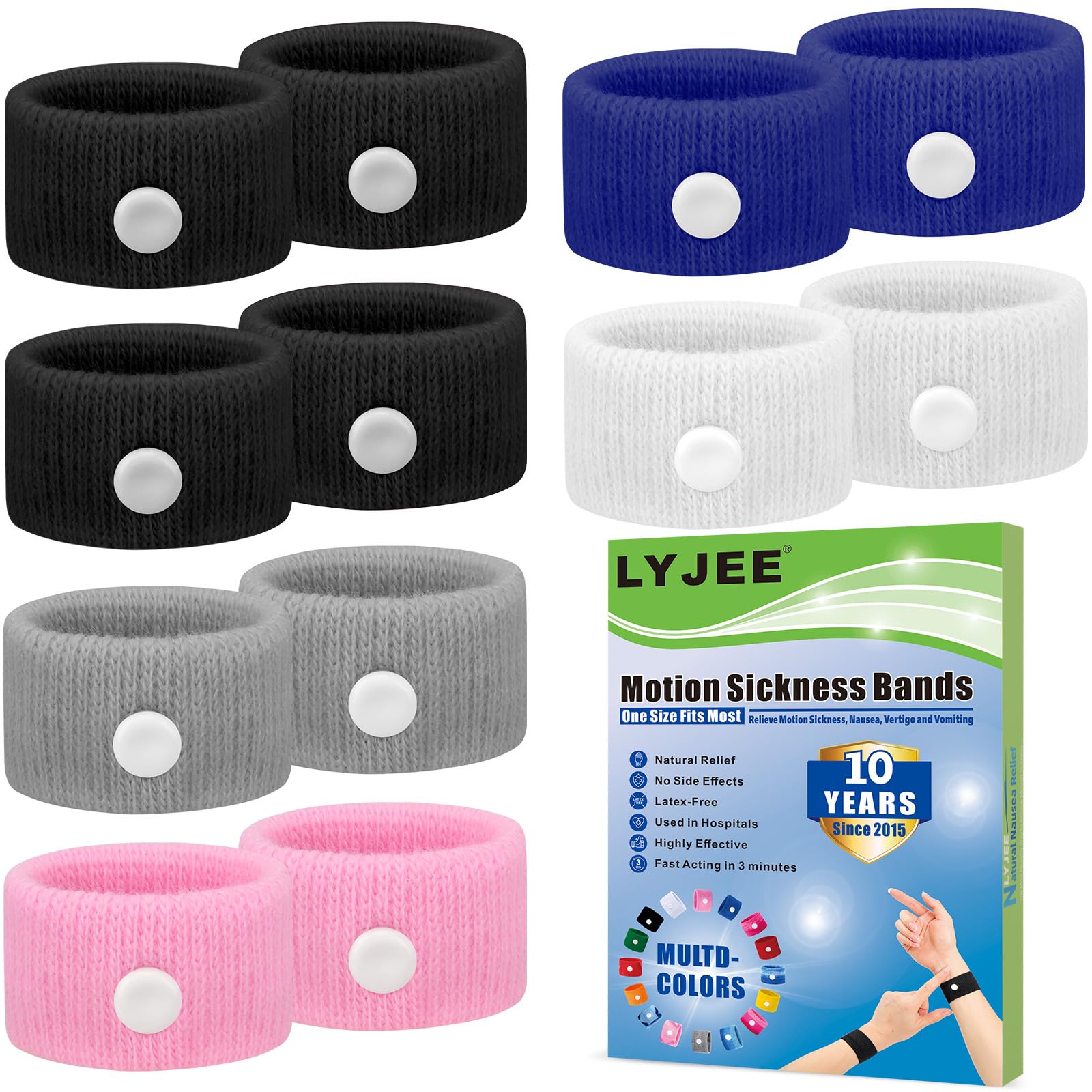
LYJEE Motion Sickness Bracelets

86 /100
Traveler Score Excellent

Key details

Sizing
One size fits all
Cuff Material
Long-staple fabric, plant dyes
Pressure Point
Nei-Kuan (P6) massage bead
Listed Dimensions
2.16 x 1.18 x 1.18 inches; 0.88 ounces
Check Details on Amazon

The back seat on a winding road is the job these do best. The band is small, the bead is a plastic ball on the inside of the cuff, and the elastic is soft enough that a child who hates anything on their wrists will usually leave it alone — which is most of what you're asking of a motion sickness band in a car. It's light enough to vanish into a door pocket and cheap enough to buy a second pair for the other child.

The fabric is a long-staple knit colored with plant dyes, the whole band weighs under an ounce, and it doesn't itch or go clammy over a long drive. Ours lives in the glovebox and comes out every time the road starts folding back on itself, which is more often than we take a ferry.

What keeps these in the rotation is the car-sickness record: this is the pair that most often gets a queasy child through a two-hour drive without a stop. The catch is the size. The band is built to a small wrist, and a grown adult will find it snug rather than comfortable — if you're buying for yourself rather than the kids, start with the Sea-Band or the stretch HIONXMGA bands and leave these to smaller arms.

Pros

  • Our pick for winding-road car sickness
  • Under an ounce, easy to stash
  • Soft long-staple fabric, plant-dyed

Cons

No notable drawbacks to flag.

Our verdict

Our pick for car sickness: small, soft and light enough to live in the glovebox, and the band a queasy child will actually leave on.

Check Latest Price
4

Best for Kids

SZSTYYP Kids Motion Sickness Bands

87 /100
Traveler Score Excellent

Key details

Band Size
5 x 3 cm, stretches to 5.5 in
Cuff Material
Soft cotton with elastic
Pressure Point
Plastic acupressure ball
Listed Dimensions
5.35 x 4.61 x 0.51 inches; 1.13 ounces
Check Details on Amazon

A child's band isn't a scaled-down adult one, and this pair shows why. The cotton cuff is soft rather than grippy, the elastic is gentle enough that it doesn't have to be wrestled over a small hand, and the band is diminutive enough to sit on a child's wrist instead of riding up the forearm. On a long drive, a band that stays where you put it beats one with stronger pressure.

For a first trip with a car-sick child, this is the pair we hand over. The colors help — a band that looks like something from a sticker sheet is a band that stays on — and the cotton is still comfortable past the point where a tight elastic cuff would have been picked at. The bead is a plastic ball fixed inside the cuff; we give it a tug before each trip, which is the one check worth making on any children's band.

These are children's bands, sized for children's wrists. If your child is already in adult-sized things, the LYJEE pair is the next size up, and for two adults on a cruise the Sea-Band sets are the better buy. Otherwise you get a soft, bright pair that a child will wear for a whole trip, which is the only test that really matters with a wristband.

Pros

  • Soft cotton that stays comfortable
  • Built for children's wrists
  • Low price makes replacing easy

Cons

  • Snug on older children's wrists
Our verdict

The pair we hand to a car-sick child: soft cotton, bright colors and a build made for small wrists, which is the easiest first band to try.

Check Latest Price

How We Tested Motion Sickness Bands

We started by pulling together the bands that show up most often in travel aisles and online reviews, then filtered out anything with a fixed strap, a plastic button that dug in, or a price that felt hard to justify for two pieces of elastic. That left 14 bands, which we wore for six months. Three testers covered a range of wrist sizes, from 5.5 to 7.5 inches, so we could see how each strap adjusted and whether the button landed on the same spot every time.

The testing wasn't a lab exercise. We wore them in the back seat on winding highway drives, on a choppy ferry crossing, on two short flights, and during a week of morning sickness in the first trimester. Each band went on before the nausea started, and we logged how long it took to feel any change—or whether we felt one at all. We also wore them for full afternoons at a desk, under a sweater, to see if the fabric rolled, the button left a dent, or the strap loosened after an hour.

Portability got its own test: each band went into a jacket pocket and a small purse, then came back out to see if the button had bent or the elastic had twisted. We washed every band by hand and checked whether the color faded or the stitching frayed, since value here is less about the sticker price and more about how many trips it survives. And because these are often bought in a hurry, we noted which ones came with clear instructions and a travel case, and which ones you had to figure out by looking at a diagram.

How to Choose Motion Sickness Bands

Put the Bead on the P6 Point Before You Go

Every band here works the same way: a bead or button presses the P6 acupressure point on the inside of the forearm, roughly three finger-widths up from the wrist crease and between the two tendons. A cuff worn loose, or sitting on the bone below the crease, is just a bracelet.

The mistake is timing. Fit the bands before you board or pull out of the driveway, and wear both wrists, which is why they're sold in pairs. Wrestling a band on mid-journey, when you're already queasy in a swaying aisle, is how people end up deciding acupressure doesn't work at all.

Fit Decides Whether It Stays On

Tightness is the thing most likely to go wrong. A cuff that leaves a deep mark, or makes your fingers tingle, comes off before the trip is half over, and a band in a pocket does nothing. Knitted elastic, like the Sea-Band, holds firmer pressure and feels tight from the first minute; stretch fabric, like the HIONXMGA bands, goes on easily and is gentler on the wrist, though you'll want to re-seat the bead after pulling it on.

Try a new band for half an hour at home before a big trip. If it leaves more than a light mark, move to a stretch cuff or a roomier band. Wide wrists and cold hands are where firm elastic most often disappoints.

Bands for Children Are Their Own Purchase

A children's band isn't an adult band in a smaller size. The cuff has to sit on a wrist that's still growing, and the elastic has to be gentle enough that a child forgets it's there — the SZSTYYP bands are 5 by 3 cm and stretch to about 5.5 inches, which tells you more than a claim of one-size-fits-all.

The bead matters more on a child's band. Give it a tug before each trip, and retire a band that's damaged rather than wearing it with the bead loose; a small plastic piece that comes free on a toddler's wrist is a choking risk.

Sets, Spares and What You Get for the Money

Most of these bands cost roughly the same, with the Sea-Band the outlier at the premium end, so the decision is less about money than about how many bands you want in circulation. Buy for spares: a set in the car, a set in the carry-on, a set in the bag that goes to the beach, so you're never hunting for one when the road starts to turn.

All of them are reusable, and none needs batteries, refills or a charging cable. What you're weighing up is the cuff material, the bead and how many wrists you're outfitting.

Frequently Asked Questions

Final Verdict

When the road starts to turn, the band we want on is the Sea-Band. It holds the firmest, most consistent pressure on the P6 point of anything here, and the second set in the pack means a spare is already in the bag rather than in a suitcase somewhere below deck.

If you know a tight cuff will be in your pocket by the second hour, buy the stretchy HIONXMGA bands instead: softer on the wrist and far easier to buy in multiples for a family. For a child's wrist, start with the cotton SZSTYYP pair.