Best Mosquito Repellent for Camping

The worst part of camping isn’t the tent setup—it’s the moment the mosquitoes find you at dusk. I’ve spent enough nights swatting at my ankles and cutting dinner short to know that a repellent either buys you a quiet hour around the fire or sends you to the car early. The right one should keep mosquitoes and ticks off without making you smell like a chemical plant or leaving your skin greasy, and it should be easy to spray evenly when you’re already holding a headlamp and a skewer. Over the past five months, my team and I took 16 repellents on camping trips, from damp lakeside sites to dusty trailheads, and paid attention to which ones actually kept bites away—not just which ones smelled pleasant.

Scent turned out to be more divisive than I expected: some natural formulas smelled like salad dressing, while a few conventional ones were nearly odorless. We also learned that spray quality matters as much as the ingredient list—a clogged nozzle or a watery stream leaves gaps at the wrist and neckline, which is exactly where I get bitten. A repellent can be effective and still feel like poor value if you have to douse yourself every hour, so we tracked how long each one lasted through sweaty hikes and campfire smoke. The picks below reflect that balance; some are built for deep woods, others for a buggy backyard campsite.

1

Best Overall

OFF! Deep Woods Dry

95 /100
Traveler Score Outstanding

Key details

Form
Aerosol spray
Size
Two 4 oz cans
Finish
Powder-dry
Active Ingredient
25% DEET
Check Details on Amazon

Most repellents announce themselves: wet for ten minutes, then a film you can feel on the back of your neck all evening. This one doesn't. The 25% DEET formula goes on powder-dry, and by the time the tent is up there is nothing to feel and nothing transferring onto a sleeping bag. It is the can we reach for first on a normal camping trip, and that finish is as much the reason as the formula. One lesson learned the hard way: spray from further back than feels natural. Close range leaves a pale cast on dark clothing that does not wipe off cleanly, so we hold the can at arm's length now.

Twenty-five percent sits in the middle of the DEET range and close to the sweet spot for camping: enough for an evening around the fire and a walk down to the water, without the solvent harshness of the near-pure formulas. The label covers mosquitoes, ticks, biting flies, and gnats, and the tick line is the one that matters if your site is in tall grass. The dry finish also means you can hit a hat brim, a shirt cuff, or an ankle without leaving a damp patch that collects pine needles.

Wind is where an aerosol earns its keep or loses it. On an exposed site, spray downwind of yourself and accept that some leaves with the gust; what does land still dries clear. Four ounces disappears quickly when you are spraying three other people, so buy the two-pack rather than a single can and keep one in the pack, one in the tent bag.

Pros

  • Dries to a powder finish, no greasy film
  • 25% DEET covers mosquitoes, ticks, flies, and gnats
  • Two cans, so one lives in the pack

Cons

  • Strong scent for the first few minutes
Our verdict

The spray we reach for on an ordinary camping trip: 25% DEET, a powder-dry finish you forget about, and a second can for the pack.

Check Latest Price
2

Best Gear and Clothing Treatment

Sawyer Permethrin

93 /100
Traveler Score Outstanding

Key details

Form
Trigger spray
Treats
Clothing, gear, and tents
Treatment Life
Up to 6 weeks or 6 washings
Active Ingredient
Permethrin
Check Details on Amazon

The first thing to know about this bottle is that it never touches your skin. Sawyer's permethrin is a fabric treatment: you spray shirts, socks, boots, and the tent, let it dry, and the permethrin bonds to the fibers. Your DEET or picaridin handles the skin; this handles everything the spray missed, which on a hot day in short sleeves is a lot.

We treat socks, boots, and the tent's door panel before every trip, and it is the piece of our kit we would replace last. The bond lasts up to six weeks or six washings, whichever comes first, and it holds through sweat and rain once dry. What breaks it down is UV and the washing machine's agitation, so plan on re-treating after a few laundry cycles. The label covers more than 55 kinds of insects, ticks included, and treated socks are the part we care about most, because that is where ticks climb aboard.

Application needs a dry afternoon and some ventilation: spray outdoors, hang everything until it is completely dry, and resist the urge to speed that up. The trigger head is the weak point on this bottle, so if yours arrives faulty or quits mid-job, pour the contents into a spare spray bottle and carry on, because the liquid is what does the work. Wet, it smells like a solvent. Dry, we do not notice it at all.

Pros

  • Bonds to fabric for six weeks or six washes
  • Protects the spots a skin spray misses
  • Keeps working through sweat and rain

Cons

  • Clothing and gear only, never skin
Our verdict

Treat your clothes before you go. It is not a skin product, and that is precisely why it covers what your spray misses.

Check Latest Price
3

Best DEET-Free for Families

Boogie Picaridin Lotion

94 /100
Traveler Score Outstanding

Key details

Form
Lotion
Size
6 fl oz
Protection Time
Up to 14 hours for mosquitoes and ticks, 8 hours for flies and gnats
Active Ingredient
20% Picaridin
Check Details on Amazon

Fourteen hours is a long time in bug country. Boogie gets there with 20% picaridin rather than DEET, in a lotion that has no smell at all, not a masked smell and not a faint chemical edge. We put it on before a slow morning of coffee and camp setup and stopped thinking about mosquitoes until the light changed. Of everything here, it is the one we hand to people who say they hate bug spray.

It goes on like a light body lotion and dries down without the tacky film that sends people to the washbasin ten minutes after spraying. Applying it to a child's face is the real argument for the form: no mist cloud, no holding your breath, no overspray across a pair of sunglasses. It is clear on the skin and does not stain clothing.

The window is species-specific. Fourteen hours is the mosquito and tick number; flies, gnats, chiggers, and no-see-ums get eight, which is the figure to remember on a river trip. Six fluid ounces stretches further than it sounds because you use a dab per limb, but four people over a long weekend will want a second bottle, and because it is a lotion your palms need a wipe before you get into a sleeping bag.

Pros

  • Odorless 20% picaridin, no DEET smell
  • Up to 14 hours against mosquitoes and ticks
  • Lotion goes exactly where you put it

Cons

  • Flies and gnats only get eight hours
  • Lotion leaves your hands to wipe
Our verdict

For anyone who hates the smell and feel of bug spray, this is the one to buy: odorless, nongreasy, and labeled for fourteen hours.

Check Latest Price
4

Best for Severe Bug Pressure

Repel 100

93 /100
Traveler Score Outstanding

Key details

Form
Pump spray
Size
4 oz
Protection Time
Up to 10 hours
Active Ingredient
98.11% DEET
Check Details on Amazon

Some trips are not about a pleasant evening outdoors. A June morning in black-fly country, a marsh at dusk, a portage through standing water: that is the work Repel 100 is built for. The active ingredient is 98.11% DEET, close to the ceiling, and the label claims up to ten hours, the longest stated window in this group by a wide margin.

We keep a bottle in the pack for exactly those conditions and do not reach for it on a mild evening. What you trade for the duration is a solvent smell that hangs around far longer than a 25% formula does, and a spray that will mark plastic and rubber if it drifts: sunglass frames, watch bands, the buckles on a pack, a phone case. Spray it in the open, standing upwind of your gear rather than over it.

The four-ounce pump bottle is genuinely pocketable, and the pump gives more control than an aerosol. Two or three strokes covers a forearm, and you can put it where you want it instead of chasing a cloud. It is labeled against ticks, gnats, biting flies, chiggers, and fleas as well as mosquitoes, which is why it earns space on a trip where you do not know what is going to find you.

Pros

  • 98% DEET for the worst bug pressure
  • Up to ten hours per application
  • Pocket-size pump gives precise coverage

Cons

  • Sharp solvent smell that lingers
  • Can mark plastic and rubber gear
Our verdict

Keep it for black-fly season and swampy sites, where ten hours of 98% DEET is worth the smell and the risk to your sunglasses.

Check Latest Price
5

Best Plant-Based Option

Repel Lemon Eucalyptus

91 /100
Traveler Score Outstanding

Key details

Size
Two 4 oz bottles
Age Limit
Not for children under 3
Protection Time
Up to 6 hours
Active Ingredient
Oil of lemon eucalyptus
Check Details on Amazon

Plant-based on the front of a bottle often means a scent and not much else. This one is different. The active ingredient is oil of lemon eucalyptus, a genuine repellent rather than a fragrance, and the label sets a hard boundary: not for children under 3. That line is the first thing to check if you are packing for a family.

Six hours is the stated window and it is an honest description of a summer evening: apply before you start cooking and you will be reaching for the bottle again after the marshmallows. The pump spray is light and not greasy, and the scent is lemon rather than solvent, which makes it one of the few here we do not mind smelling on ourselves.

Where we are careful is sensitive skin. Misted directly onto an arm it can tingle, sometimes sharply, so we now spray it into a palm and wipe it on rather than misting a shoulder or a neck. That is a small adjustment for a formula with no DEET in it, and for plenty of campers the smell alone settles the choice.

Pros

  • Genuine plant-derived repellent with no DEET
  • Lemon scent rather than a chemical one
  • Light, non-greasy pump spray

Cons

  • Not for children under 3
  • Can tingle on sensitive skin
Our verdict

A DEET-free spray that genuinely repels, with a lemon scent and a six-hour window. Check the age line before you pack it for a family.

Check Latest Price
6

Best Wipes for Packing

OFF! Deep Woods Wipes

94 /100
Traveler Score Outstanding

Key details

Form
Individually wrapped wipes
Count
12 wipes
Protection Time
Up to 8 hours
Active Ingredient
25% DEET
Check Details on Amazon

Wind ruins aerosols. On an exposed site, half of a fine mist leaves with the gust before it reaches your arm, and the half you do breathe in is the half you did not want. A wipe sidesteps all of it: you take it out of the packet and put it exactly where you need it, with no cloud and nothing to inhale.

Each towelette is individually wrapped and carries 25% DEET, the same active ingredient and strength as our top pick, with a stated eight hours of mosquito protection. One wipe covers an adult's arms, legs, and neck with a little to spare, so a twelve-count box is about a dozen applications for one person. They are what we hand someone heading into the trees for twenty minutes who does not want to strip off and spray.

What we appreciate most is that they live in a hip-belt pocket without leaking or puncturing, and nobody at a trailhead has to negotiate over liquids. Treat them as a per-person supply: one wipe, one person, one application. The catch is the packet itself. An opened box left in a hot car can dry the towelettes out, so keep it sealed and check one before a long trip rather than discovering it at dusk.

Pros

  • No spray cloud in wind
  • Individually wrapped, packs anywhere
  • 25% DEET with up to eight hours

Cons

  • Towelettes dry out in an opened box
  • One wipe per application, so a group burns through a box
Our verdict

The answer to a windy campsite: 25% DEET in a wipe, with no cloud to breathe and nothing to puncture in your pack.

Check Latest Price
7

Sitting Around Camp

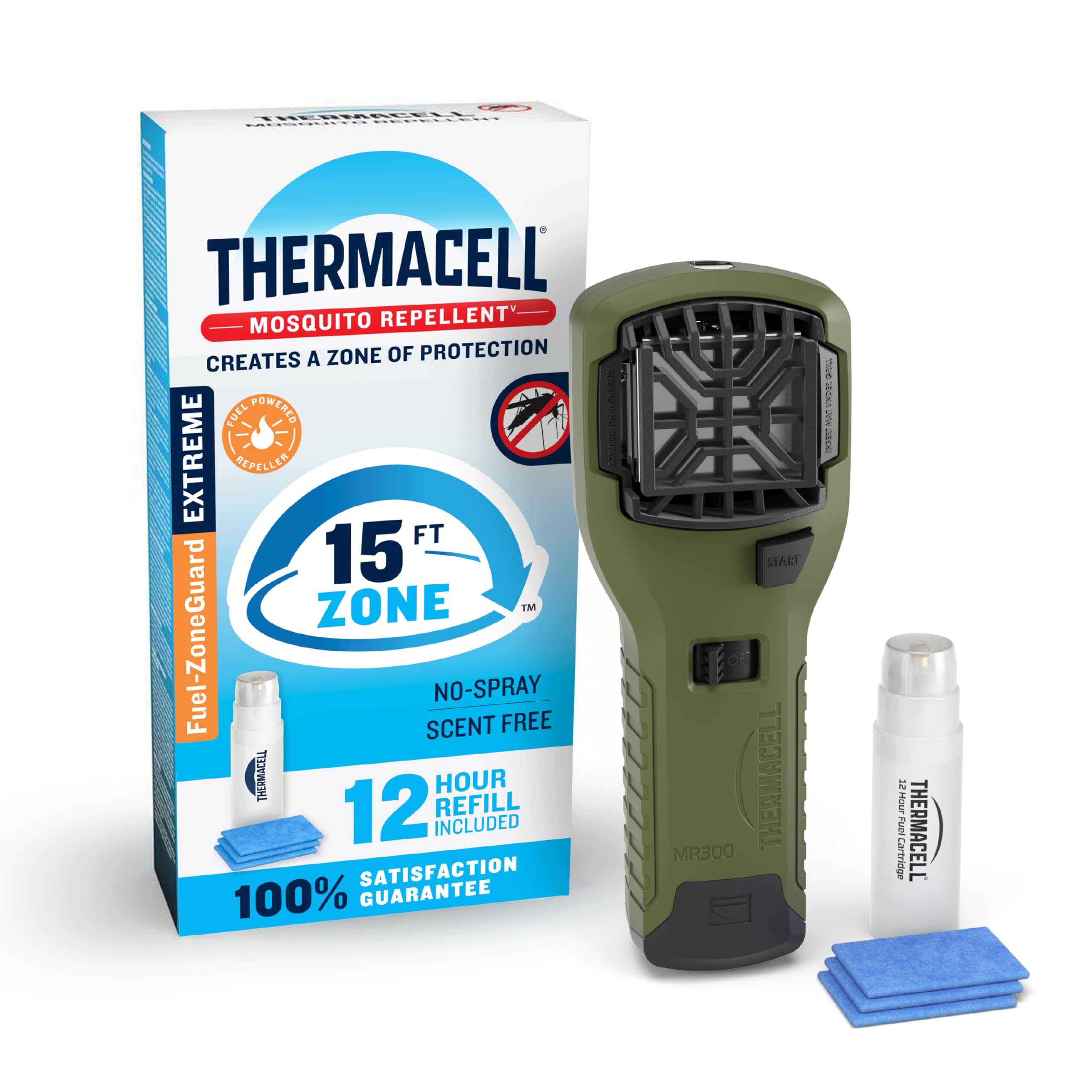
Thermacell MR300

89 /100
Traveler Score Excellent

Key details

Power
Butane fuel cartridge
Weight
6.4 oz
Coverage
15-foot zone
Fuel Life
12-hour cartridge
Check Details on Amazon

A Thermacell does not repel mosquitoes from you; it clears a piece of ground. The unit heats a repellent mat over a butane cartridge and puts out a scent-free cloud that keeps a 15-foot circle more or less clear. That is either exactly what you need or completely useless, depending on whether you are sitting still.

The hardware is simple in a way we appreciate at camp: a 12-hour fuel cartridge, no batteries, no cord, 6.4 ounces in a pack. It runs silent, so it does not ruin a quiet evening, and it is scent-free, which is why hunters and anglers put up with buying refills. Give it a few minutes to build the zone before you expect anything from it.

Those refills are the real cost of ownership. Fuel cartridges and mats are consumables, and across a season of weekend trips they add up faster than bottles of spray do, which is the argument for treating this as basecamp gear rather than a daily driver. It is also wind-sensitive: on an exposed ridge the cloud scatters and the zone shrinks to nothing. Check the igniter at home before you leave, because a unit that will not light is dead weight.

Where it earns its place is the two hours after dinner, when everyone is in a chair and nobody wants to re-spray their ankles. We take it when the plan is a long, buggy evening in one spot and leave it home when the plan is miles. Pair it with a personal repellent and it is a genuine luxury; rely on it alone and you will be bitten on the walk to the water.

Pros

  • Clears a 15-foot zone with nothing on your skin
  • 12-hour cartridge, no batteries or cord
  • Silent and scent-free around camp

Cons

  • Refills cost more than spray over a season
  • Zone shrinks in wind and open ground
Our verdict

Buy it for camp chairs and evening cooking, not for the trail. A scent-free fifteen-foot bubble that leaves your skin bare.

Check Latest Price

How We Tested Camping Mosquito Repellents

We started with a shortlist of 16 repellents—sprays, lotions, and wipes—chosen after reading ingredient panels, label claims, and customer reviews. We filtered for formulas that covered both conventional actives and natural options, kept an eye on price per ounce, and skipped any bottle with repeated complaints about leaking or a nozzle that quit mid-trip. Then we packed them for five months of camping: damp lakeside sites, wooded trails, and grassy overlooks.

Each formula went on before a two-mile dusk hike, during tent setup, and again after dinner when the mosquitoes came out. We applied to arms, legs, neck, and ankles, then checked coverage under a headlamp for missed patches, greasy film, or a white cast. We sprayed from arm’s length to judge the mist, watched for clogging or dripping, and noted when a stray spray left a bitter or soapy taste near the mouth. During wooded walks we counted bites and checked exposed skin and clothing for ticks.

Scent got rated twice—wet and dry—and we tracked whether natural formulas faded fast or drew bees. We logged how long each kept mosquitoes, black flies, and no-see-ums off through sweaty hikes and campfire smoke, and calculated value by cost per use rather than sticker price. The best ones were the ones we reached for without thinking: even coverage, a nozzle that behaved, and no bites at the end of the night.

How to Choose the Right Mosquito Repellent for Camping

Skin and fabric are two separate jobs

The mosquito landing on your neck and the tick climbing your sock are two different problems, and one bottle rarely solves both. Skin repellents, whether DEET, picaridin, or oil of lemon eucalyptus, go on you and work for hours. Permethrin goes on the shirt, the sock, the boot, and the tent, bonds to the fibers, and holds through sweat and rain for up to six weeks or six washings. Treat your clothes a day before you leave so they can dry properly, and start with socks and boots, because that is where ticks get their grip.

A treated shirt covers the strip of shoulder your spray missed, which is the whole argument for doing both. It also means a hot afternoon in short sleeves is not a gamble.

Read the active ingredient, not the biggest number

More DEET does not repel harder; it repels for longer. Past about 30% you are mostly buying hours and a stronger solvent smell, and for ordinary camping 15 to 30% is plenty. Picaridin at 20% is odorless, runs as long as most DEET formulas, and is easier on gear. Oil of lemon eucalyptus is the plant-derived option that genuinely works, on a shorter clock of roughly six hours.

The trap is gear damage. DEET is a solvent and it clouds plastics and rubber, including sunglass lenses, watch bands, phone cases, and pack buckles. If your trip involves a camera, a paddle, or a rental car's dashboard, picaridin or lemon eucalyptus is the friendlier choice.

Pick a form you will actually use

Aerosols are fastest for legs and arms and the worst option in wind, where a fine mist goes sideways and you breathe part of it. Pumps give more control and travel better. Lotions and wipes put the repellent exactly where you want it, which is why we reach for them on faces, necks, and children. A wipe also survives being sat on in a hip belt, where a pressurized can is a puncture waiting to happen.

The split that works for a group: one aerosol or pump for everybody's legs, one box of wipes for hands, faces, and the late arrival who needs to be out the door in thirty seconds.

Decide whether you are sitting still or moving

Personal repellent protects you wherever you go; a zone device protects a patch of ground. Thermacell's fuel-powered repeller clears a 15-foot circle and holds it for the length of a cartridge, which is a pleasure beside a camp chair and useless on a hike. It is wind-sensitive, so it works best in a sheltered site, and the refills are a running cost that eventually outruns what you would spend on spray.

Buy one if your evenings are long and stationary, and skip it if your trip is miles. Either way it sits alongside a personal repellent rather than replacing one.

Frequently Asked Questions

Final Verdict

Start with OFF! Deep Woods Dry. It suits more trips than anything else here: 25% DEET, a finish you forget about ten minutes after you spray, and a second can that lives in the pack. Add Sawyer Permethrin and your clothes do half the work for the next six weeks.

If someone in the group will not wear DEET or cannot stand the smell, the swap is Boogie's picaridin lotion: odorless, long-lasting, and easy to put on a child's face. That is a complete kit for a normal camping trip.