Best Minimalist Travel Backpacks of 2026

A minimalist travel backpack is a simple bargain: you carry less, and in exchange the bag moves with you instead of against you. The trouble is that "minimal" has become shorthand for thin nylon and no structure at all. I once packed four days of clothes into a bag that went slack the moment I pulled my laptop out, then spent the trip hauling what felt like a sack of laundry through the airport.

What a good one actually fixes is that collapse: it holds its shape half-empty, opens flat on a hotel bed, and stays out of your way on a crowded train. One thing I'd tell any first-time buyer — liter counts lie a little, and a clamshell opening matters more than the number on the tag. My team and I have carried 11 of these for eight months through weekend drives, four-day work trips, and one sprint to a connecting gate, and the spread in usable capacity was wider than the specs suggest. The ones that survived are below.

1

Best Overall

Osprey Daylite 26+6

93 /100
Traveler Score Outstanding

Key details

Weight
1.7 lb
Capacity
26 L
Expansion
Adds 6 L
Dimensions
6.3"D x 13"W x 16.9"H
Check Details on Amazon

Two inches of zipper is what separates this Osprey from a plain 26-liter daypack. Run the expansion open and the main compartment grows by six liters, so a bag that boards as a personal item can come home with an extra pair of shoes and a jacket you bought on the trip inside it. The shell is recycled 300D polyester with a DWR finish made without PFAS, the listed weight is 1.7 pounds, and the outside measures 6.3 by 13 by 16.9 inches — depth first, which is the number that decides whether it slides under a seat.

What earns it the top spot is restraint. There's no laptop-organizer scaffolding and no dozen zips to relearn: one main compartment that opens along its side like a suitcase, a front pocket, a tech sleeve, two stretch bottle pockets and a pass-through for a rolling bag's handle. We used it as the only bag for a few nights and as a day bag once we arrived, and it behaved like a proper travel pack in both roles. The AirScape back panel holds the pack off your spine, which matters more than it sounds like it should when you're standing in a boarding line in August.

The carrying is better than the weight suggests. At 1.7 pounds the pack doesn't feel like a penalty on the long walk to the gate, the shoulder straps are contoured rather than flat webbing, and the bottle pockets stretch far enough to take a full one-liter bottle. Organization is deliberately thin — a sleeve against the back rather than a padded compartment, and a single front pocket for the things you want in a security line.

Two things to know before ordering. Osprey sizes this to the personal-item limits most major airlines publish, but carriers disagree with each other, so measure it against your own airline's number; the gate agent has the final word. And the flat-opening design rewards packing cubes while punishing loose packing, so budget for a set if you don't own one. Those caveats aside, this is the pack that comes with us when there's only room for one bag.

Pros

  • Adds six liters when the trip runs long
  • Sized to most airlines' personal-item limits
  • Ventilated back panel and luggage pass-through
  • 1.7 lb with contoured shoulder straps

Cons

  • Priciest pack in this group
  • Tech sleeve only, no padded laptop compartment
Our verdict

We point most travelers to this Osprey: 26 liters that board as a personal item and grow by six more when the trip does, at a price you notice once.

Check Latest Price
2

Best Packable Daypack

Osprey Ultralight Stuff Pack

91 /100
Traveler Score Outstanding

Key details

Weight
5.29 oz
Pockets
4
Capacity
18 L
Water Resistance
Not water resistant
Check Details on Amazon

There is no structure in this pack at all, and after a few trips we've stopped counting that as a fault. The Ultralight Stuff Pack is a stuff sack with shoulder straps: 18 liters, four pockets, a listed 0.15 kg, and soft enough to push into a corner of a carry-on that's already full. Ours lives at the bottom of a suitcase and comes out at the beach, at a market, or on the walk back from a train station.

For the size it swallows more than we expected. The stretch side pockets each take a one-liter bottle, there's an internal key clip so keys stop migrating, and the zip pulls are reinforced and easy to find by feel. The sternum strap carries an emergency whistle, which reads as a gimmick until you're walking a trail alone.

The water-resistance rating is the plainest limitation — this bag is listed as not water resistant — so a small dry bag for a phone and a passport is the sensible partner. What you get in exchange is fabric and straps and nothing else: no back padding, no frame, nothing to spread a load across. That's the bargain, and for a bag that disappears into your luggage until the afternoon you need it, we take it happily.

Pros

  • 0.15 kg and disappears into a suitcase
  • Stretch side pockets each hold a one-liter bottle
  • Key clip and an emergency whistle on the harness

Cons

  • Not water resistant
  • Costs more than the other stuff packs here
Our verdict

Buy this as the bag that lives in your suitcase and appears when the day calls for one — not as the pack that carries your trip.

Check Latest Price
3

Best for Day Hikes

Eddie Bauer Stowaway 20L

89 /100
Traveler Score Excellent

Key details

Weight
4.8 oz
Capacity
20 L
Open Size
18" x 10" x 9"
Packs Into
8.5" x 7" x 1.5" pocket
Check Details on Amazon

Packable bags almost always stop at two shoulder straps. This one adds a hip belt, and that single piece of webbing changes what the Stowaway is for: with the belt clipped, a 20-liter load sits on your hips instead of hanging off your shoulders.

The rest is quietly sensible. Ripstop polyester with a StormRepel WR finish that sheds a shower, extended shoulder straps that clear a broader frame, and a listed weight of 4.8 ounces. Open, it measures 18 by 10 by 9 inches; packed, it rolls into its own 8.5 by 7 by 1.5-inch pocket, which then becomes an internal pocket while you're wearing the bag.

We've had it out as the only bag on a long weekend and as a day pack on trips where the big luggage stayed in the room, and what we appreciated most is that it doesn't feel like a compromise in either role. Two one-liter bottles, snacks, a phone and a rain shell disappear into it, and the side pockets are deep enough that the bottles stay put when you set the bag down.

Structure is the catch. There's no padding in the back panel, so a full pack slumps against your spine and the corner of anything hard prints through the fabric. Keep it to clothing, food and soft gear and it's excellent; add a camera and you'll want the tomtoc instead.

Pros

  • Hip belt takes the load off your shoulders
  • Packs into its own 8.5 x 7 x 1.5-inch pocket
  • StormRepel finish sheds rain
  • 20 L holds bottles, snacks and a shell

Cons

  • No back padding, so a full pack slumps
Our verdict

This is the packable we hand to anyone whose trip includes an actual trail, because the hip belt makes a light bag behave like a real one.

Check Latest Price
4

Best Small Daypack

SKYSPER Small Daypack 10L

93 /100
Traveler Score Outstanding

Key details

Weight
9.17 oz
Capacity
10 L
Folded Size
6.7" x 7"
Water Resistance
Water resistant
Check Details on Amazon

The most useful pocket on this pack is the one facing your back. It's a flat zipped compartment against the back panel, out of reach while you're wearing the bag, which is precisely the point in a crowded market — and it's where a wallet and a phone went on a trip where pickpockets were the main worry.

At 10 liters and 0.26 kg, this is the pack we reach for when the day is short and the bag has to vanish afterwards. It folds to roughly 6.7 by 7 inches, pencil-case size, and the pouch it folds into doubles as an internal pocket once the pack is out, so it doesn't get lost in a drawer. Three compartments, deep mesh side pockets that hold a 21-ounce bottle without sagging, and a water-resistant finish that handles a wet afternoon.

Two things to know. The straps are unpadded webbing, comfortable with a light load and less so once you add a couple of bottles and a camera; and 10 liters covers a day out rather than a trip, so this is a second bag and not a one-bag answer. For the money, it's the tidiest small daypack here.

Pros

  • Hidden back-panel pocket for wallet and phone
  • Folds to pencil-case size
  • Deep mesh pockets hold a 21 oz bottle

Cons

  • Unpadded webbing straps suit light loads only
Our verdict

For short days where the bag has to vanish afterwards, we take this one: a hidden back pocket, deep bottle sleeves and pencil-case packed size.

Check Latest Price
5

Best Budget Personal Item

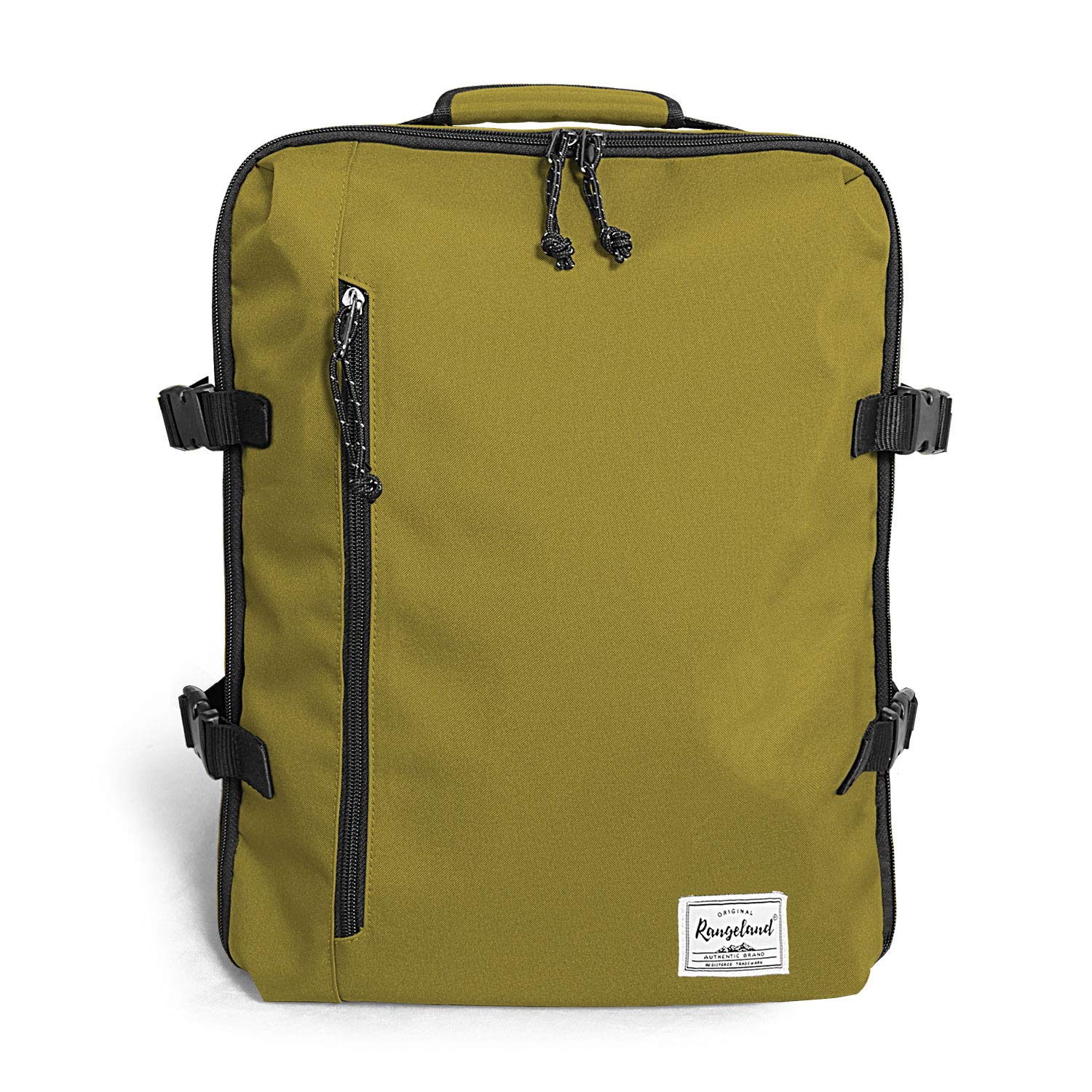
Rangeland 21L Travel Backpack

91 /100
Traveler Score Outstanding

Key details

Weight
1.39 lb
Capacity
21 L
Dimensions
12 x 16 x 7 in
Laptop Sleeve
Fits 15"
Check Details on Amazon

Lay this bag flat, unzip it, and it stops looking much like a backpack. The Rangeland opens a full 180 degrees like a small suitcase, so you pack it in flat layers instead of mining it from the top, and four compression straps pull a half-full load tight against your back.

It's a personal-item bag first. The 21-liter body measures 12 by 16 by 7 inches, a sleeve inside takes a 15-inch laptop, and the rectangular cut is why packing cubes work so well in it — there's no taper eating the corners. It's built to slide under the seat on the airlines that charge for everything else; measure it against your carrier's published limit, because they don't all agree.

Inside there's the laptop sleeve, a mesh pocket and not much else. This is a bag that expects you to bring your own organization, and the upside is one big uninterrupted compartment that takes two cubes side by side.

What you get here is the flat-packing style at the lowest price in the group. We found the front zip the least reassuring part of the bag — give it a few passes before a trip, and don't expect the fabric to shrug off a downpour. For a weekend under an airplane seat, it does what packs costing far more do.

Pros

  • Opens flat like a suitcase
  • Sized as a personal item for most airlines
  • Four compression straps cinch a half-full load
  • Sleeve fits a 15-inch laptop

Cons

  • Dry clean only, per the care label
  • Front zip feels less sturdy than the rest
Our verdict

If your idea of minimalist is a bag that opens flat and slides under the seat for the least money here, this Rangeland is the one to order.

Check Latest Price
6

Best for Carrying a Laptop

tomtoc Navigator-T66 28L

91 /100
Traveler Score Outstanding

Key details

Weight
2.09 lb
Capacity
28 L
Dimensions
7.87"D x 11.81"W x 17.72"H
Laptop Fit
16" laptop plus 13" tablet
Check Details on Amazon

Where the Osprey above is soft and forgiving, this tomtoc is the structured one, and that's the whole argument for it. The 28-liter body is a clean rectangle at 7.87 by 11.81 by 17.72 inches, and the back opens to a padded compartment that takes a 16-inch laptop and a 13-inch tablet. That section unzips through 90 to 180 degrees, so you can lay it flat on the security tray instead of emptying the bag.

The harness is where the structure pays off: a 3D padded back panel, contoured shoulder straps, an adjustable chest buckle and a rear strap that slides over a rolling bag's handle. Premium YKK zips run throughout, and the design is plain enough that it reads as a travel bag rather than an office one.

The trade is bulk. This is the least packable bag here, the one that wants to be carried rather than stowed, and it's priced near the top of the group. The chest strap also runs short, doing little on a broader frame. If your trips include a laptop and a security line, none of that is disqualifying — this is the pick.

Pros

  • Padded 16-inch laptop compartment
  • Clamshell opens flat and stands on its own
  • Padded back panel and contoured straps
  • Solid YKK zips

Cons

  • Chest strap runs short on bigger frames
Our verdict

Take this over our top pick when a laptop comes along: the padded compartment, flat TSA opening and structured back are worth the extra bulk.

Check Latest Price
7

Pocket-Size Spare

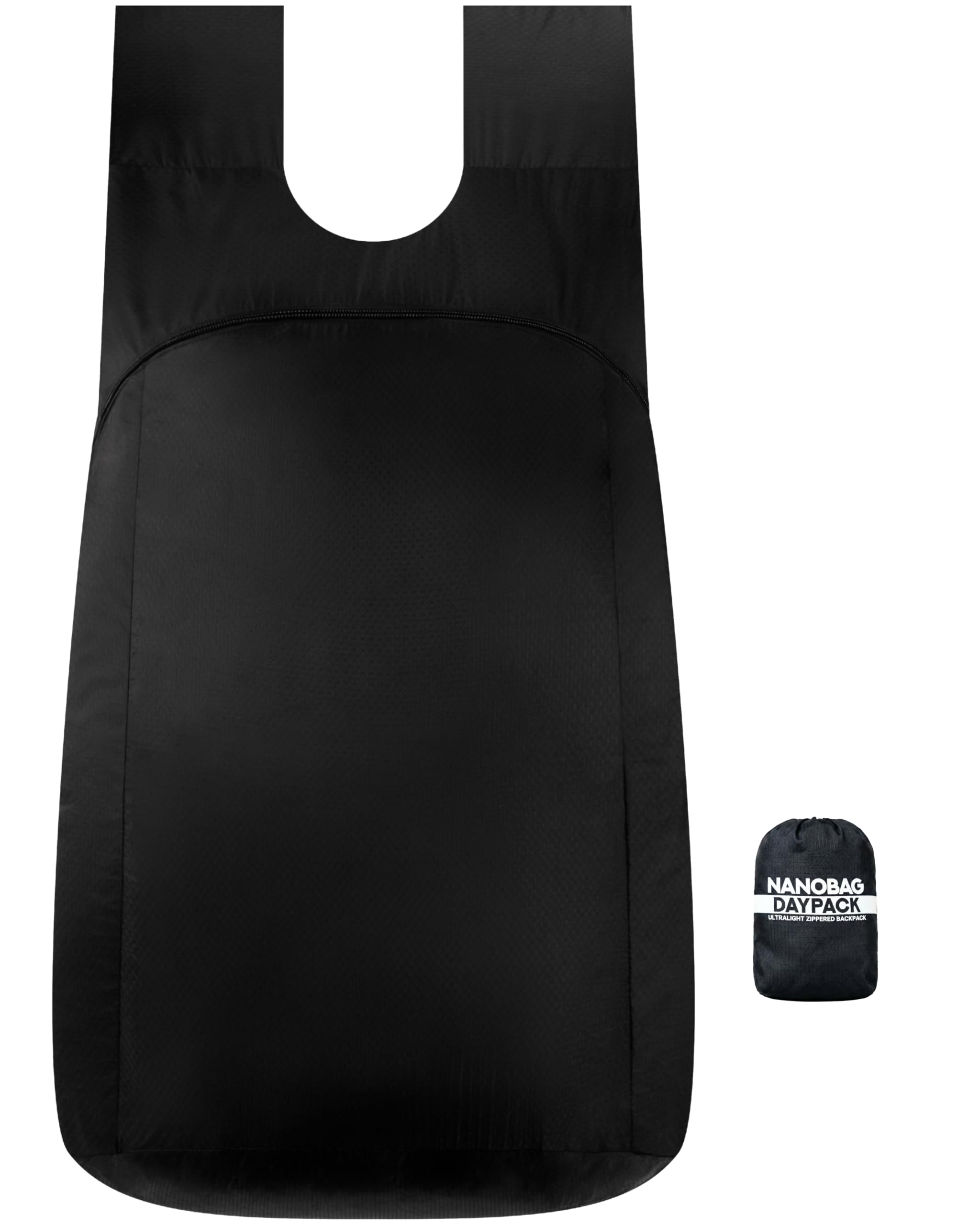
Nanobag Daypack 16L

90 /100
Traveler Score Outstanding

Key details

Fabric
0.05 mm ripstop nylon
Weight
1.15 oz
Capacity
16 L
Stated Load
66 lb
Check Details on Amazon

At 1.15 ounces, this is the lightest thing on the page by a distance — less than the hardware on a proper backpack. It stuffs into an attached pouch with no folding at all, so it goes from a jacket pocket to a 16-liter pack in a few seconds. The fabric is 0.05 mm diamond ripstop nylon, bartacked at the stress points, with a YKK zip on the main opening.

The listed ceiling is 66 pounds, which we read as a number for the fabric rather than a plan. On unpadded straps, anything near that is a walk from the car to the apartment, not a hike. What it carries well is groceries, beach gear, souvenirs and a rain layer, and the wide 27-inch straps spread a light load better than the thin webbing on most stuff packs.

This is the one that costs you nothing in luggage space, and we've kept one in a jacket pocket for an entire trip and forgotten about it until the moment it was needed. The packed bag is small enough to forget about entirely, and the prints are good enough that it doesn't read as an emergency purchase.

The catch is adjustment: the straps are a fixed length, so the fit is whatever it is, and on a smaller frame the bag sits lower than you might like. It also costs more than the cheapest stuff packs here, which is the premium you pay for the weight. Small is the point, and nothing here is smaller.

Pros

  • 1.15 oz, the lightest pack here
  • Stuffs into its pouch with no folding
  • Wide straps spread a light load

Cons

  • Shoulder straps are a fixed length
Our verdict

The one to keep in a jacket pocket: lighter than anything else here, happy with groceries and souvenirs, and not adjustable enough for a long carry.

Check Latest Price
8

Cheap Spare Bag

G4Free 10L Packable Daypack

91 /100
Traveler Score Outstanding

Key details

Weight
4.59 oz
Capacity
11 L
Dimensions
6.3"D x 8.27"W x 13"H
Water Resistance
Water resistant
Check Details on Amazon

This is the cheapest pack in the group, and we treat it as disposable in the useful sense: it lives folded in a suitcase and comes out when we've bought more than we planned.

It's listed at 11 liters and 0.13 kg, with two zipped compartments, two side mesh pockets, tear-resistant polyamide and SBS zips. It folds into its own pouch, and the shoulder straps adjust through a wide range, which makes it easy to hand to someone else.

The catch is the fabric. It's thin — noticeably thinner than the Eddie Bauer or the Osprey — so a full pack slumps and the corner of a hard object presses through. Zips and seams are where this bag goes first if you load it hard.

For a spare that rides in a suitcase and brings souvenirs home, none of that matters much, and it's cheap enough to keep one in the car as well. If the bag has to be your only bag for a week, put the money into one of the picks above.

Pros

  • Cheapest pack in this group
  • Folds into its own pouch
  • Two zipped compartments and mesh bottle pockets

Cons

  • Thin fabric with no structure
  • Main compartment has no interior pockets
Our verdict

Buy it as a cheap spare that rides in a suitcase and carries souvenirs home; the thin fabric rules it out as your only bag.

Check Latest Price

How We Tested Minimalist Travel Backpacks

We started with a long list of roughly 40 packs from brands that make travel gear and narrowed it with three filters: it had to fit the carry-on sizer for the major U.S. airlines, it needed a padded laptop sleeve that kept the machine off the floor, and it had to land between 28 and 45 liters. That left 11 bags, which we weighed empty, measured flat, and then packed with an identical loadout — three days of clothes, a 16-inch laptop, a dopp kit, a charger pouch, and a spare pair of shoes.

Over eight months, every pack did a four-day work trip that started in an airport security line, went into an overhead bin, got shoved under the seat in front of me, and ended with a mile-long walk through a city and a crowded train ride. We packed and unpacked each one on a hotel bed to see whether it opened flat or had to be excavated, and timed how long it took to find a charger in a dark room. We also hoisted each one by a single strap while it was fully loaded and noted whether it slumped or held its shape.

Sturdiness got its own pass: we loaded each bag to capacity and dropped it from waist height onto pavement three times, then looked for pulled seams, skipped zipper teeth, and a base panel that had gone soft. To check for thin material, we held the front panel up to a window, pinched the fabric between two fingers, and pressed on the bottom to feel whether anything separated the laptop from the ground. And we carried each one for a full hour to see exactly where the straps landed — a minimalist pack only earns its place if it still feels portable when it's full.

How to Choose Minimalist Travel Backpacks

Decide Which Job the Bag Has

A packable daypack and a carry-on travel pack answer different questions. The packable, somewhere between 10 and 20 liters and folded into its own pocket, is the bag that stays in your suitcase until you need to carry a jacket, water and a picnic. The carry-on pack is your luggage: 26 to 28 liters, a flat opening, and a harness that can take a full load through an airport. We keep one of each, and that split is the reason.

The trap is buying a stuff pack to do the second job. A bag that weighs a few ounces and has unpadded straps can carry a day's gear; it can't carry your clothes for a week, and it won't protect a laptop. If you fly carry-on only, buy the structured pack first and add a packable later for very little money.

Packed Size and Stated Liters

Every packability figure describes the empty bag, so a folded size of 6.7 by 7 inches tells you what the pack costs in luggage space, not what it will hold. Stated liters are just as slippery: a rectangular clamshell in the low twenties packs more than a tapered daypack of the same nominal volume, because there are no dead corners eating your clothes.

Read the shape and the opening instead of the number. If you pack in cubes, a flat-opening rectangle is worth more than two extra liters; if you're stuffing a jacket and a bottle between errands, a top-loader is faster. Measure the packed size against the corner of your luggage before you commit.

Fit the Bag to Your Airline

Personal-item limits are set by the airline and they don't match each other. A pack can be legitimately flight approved and still miss the sizer on a stricter carrier, especially once it's full. Check your own airline's published personal-item dimensions rather than a general claim on the product page, and treat the gate agent as the authority.

Depth is the dimension that betrays you, because that's where a full pack grows. A clamshell listed at 7 inches deep can easily reach 9 when packed, so the compression straps on the Rangeland or an expansion zip you choose not to open earn their keep.

Straps, Structure, and What You'll Carry

Padding is where packable bags save weight, and it's the first thing you notice on a long walk. Flat webbing is fine for a couple of miles with a light load; a padded back panel and a hip belt change what a bag can do, which is why the Eddie Bauer Stowaway handles a trail that would flatten a Nanobag.

Match the harness to the worst day of the trip, not the average one. If there's a hike in the plan, take the hip belt. If the bag spends most of its life folded in a suitcase, buy the lightest thing that holds your groceries and accept the trade.

What Minimalism Costs You in Use

Simpler packs hand you fewer pockets, so small items need their own containers — a pouch for cables and a dry bag for a phone are worth more than another zip. Thin fabric is also unforgiving: it takes the shape of whatever is inside, and a sharp edge is what presses through first.

Zips and stress points fail before the fabric does on bags this light, so work every zip under load at home before you leave. A stuck front pocket on the second day of a trip is the failure that actually spoils a holiday.

Frequently Asked Questions

Final Verdict

The Osprey Daylite 26+6 is the pack we recommend to almost everyone shopping this category: 26 liters that boards as a personal item, six more when the trip runs long, and a harness that makes a full load tolerable. If you already travel with a carry-on and want a bag that disappears inside it, the Eddie Bauer Stowaway is the better buy — the hip belt is what lets it handle a real trail rather than a promenade.

Buy the Osprey for the trip, the Stowaway for the destination.