Best Luggage Scales of 2026

The dread usually hits at the check-in counter, when your bag thumps onto the belt and you're doing mental math about overweight fees. A luggage scale is a small, unglamorous thing that deletes that entire moment — you weigh the bag on the hotel room floor, zip it shut, and get on with your trip. But a scale that's off by two pounds is worse than no scale at all, and plenty of cheap ones drift, wobble under a heavy bag, or go dead between trips.

I've weighed bags on bathroom scales, on hotel floors, and once, memorably, by hanging a duffel off a coat hook. Over the past three months, my team and I packed and repacked the same carry-ons and checked bags against 16 luggage scales, checking every reading against a calibrated reference weight. The ones worth carrying share a few things: a strap or hook that grips a loaded bag without slipping, a display you can read while the bag is swinging, and a body that survives a week in a jacket pocket. Here's what survived that.

1

Best Overall

Etekcity EL11 Luggage Scale

95 /100
Traveler Score Outstanding

Key details

Units
pounds/kilograms
Weight
4.7 oz
Maximum Capacity
110 lb
Readout Accuracy
1.6 oz
Check Details on Amazon

The Etekcity EL11 reads the room temperature, which is the strangest thing we can say about a luggage scale and also the least useful. It's a real mode — press through the options and there it is — and not once at a check-in desk have we needed to know how warm the lobby was. What earns this one the top spot is duller and more important: 110 pounds of capacity, a readout in 1.6-ounce steps, and a display you can read while a packed suitcase hangs from your hand.

Weighing a bag is a two-hand job, and the EL11 makes the second half easier. The number stays on the screen once the load settles, so you can set the suitcase down before you lean in to read it. The grip is rubberized and the hook hangs a bag cleanly by its handle, which sounds like a small thing until you've tried to balance a 50-pound case on a bare plastic edge in a hotel corridor. Switching between pounds and kilograms takes one press, which is the difference between comprehension and arithmetic when your airline quotes 23 kg.

The 1.6-ounce step is finer than anything an airline will argue about, as long as you give yourself room: pack to a pound under the limit and the scale's small disagreements with the airport machine stop mattering. We weigh each bag twice, because every suspension scale wanders while the load swings, and this one hands back the same number on the second lift more dependably than the cheaper picks here.

If you want the smallest thing that will do the job, the Longang is about three ounces and reads in the same steps; if you want to spend least, the travel inspira is the cheapest here and still lights its screen. Neither feels as solid in the hand as this one, and on a full suitcase that difference is a quick check versus a wrestling match. It's the one we reach for first.

Pros

  • Large display holds the number after you lower the bag
  • Rubberized grip and hanging hook handle a full suitcase
  • 1.6-ounce steps with pounds and kilograms

Cons

  • Heavier and bulkier than the smallest picks here
Our verdict

For most travelers this is the one: 110 pounds of capacity, big readable digits that hold after you lower the bag, and a rubberized grip that makes a full suitcase less of a fight.

Check Latest Price
2

Best Budget

travel inspira Digital Luggage Scale

95 /100
Traveler Score Outstanding

Key details

Battery
Included
Display
Backlit LCD
Maximum Capacity
110 lb
Check Details on Amazon

The travel inspira is the least expensive scale here, and it's the one we point at anyone who flies a couple of times a year and resents spending more than the problem deserves. It covers the basics without a gap: 110 pounds of capacity, a backlit LCD, a battery in the box, and a body small enough to live in a jacket pocket between trips.

Reading it is the part we appreciate. The backlight is bright, the digits are large, and there's no squinting at a grey smear while a suitcase dangles from your fist — which is exactly how cheap scales get abandoned in hotel rooms. We've used it the way most people will, on the floor late at night with the bag already zipped and the souvenirs inside, and it gave us a number in about five seconds. For the smallest outlay here, nothing about the way it works feels like a compromise, and it earns a place in the carry-on rather than the bottom of a checked bag.

Pros

  • Bright backlit display is easy to read while lifting
  • Battery included and small enough for a pocket
  • 110-pound capacity at the lowest outlay here

Cons

No notable drawbacks to flag.

Our verdict

The one to buy when the whole point is spending as little as possible: a genuinely bright backlit screen, 110 pounds of capacity, and a battery already in the box.

Check Latest Price
3

Best for Packing Light

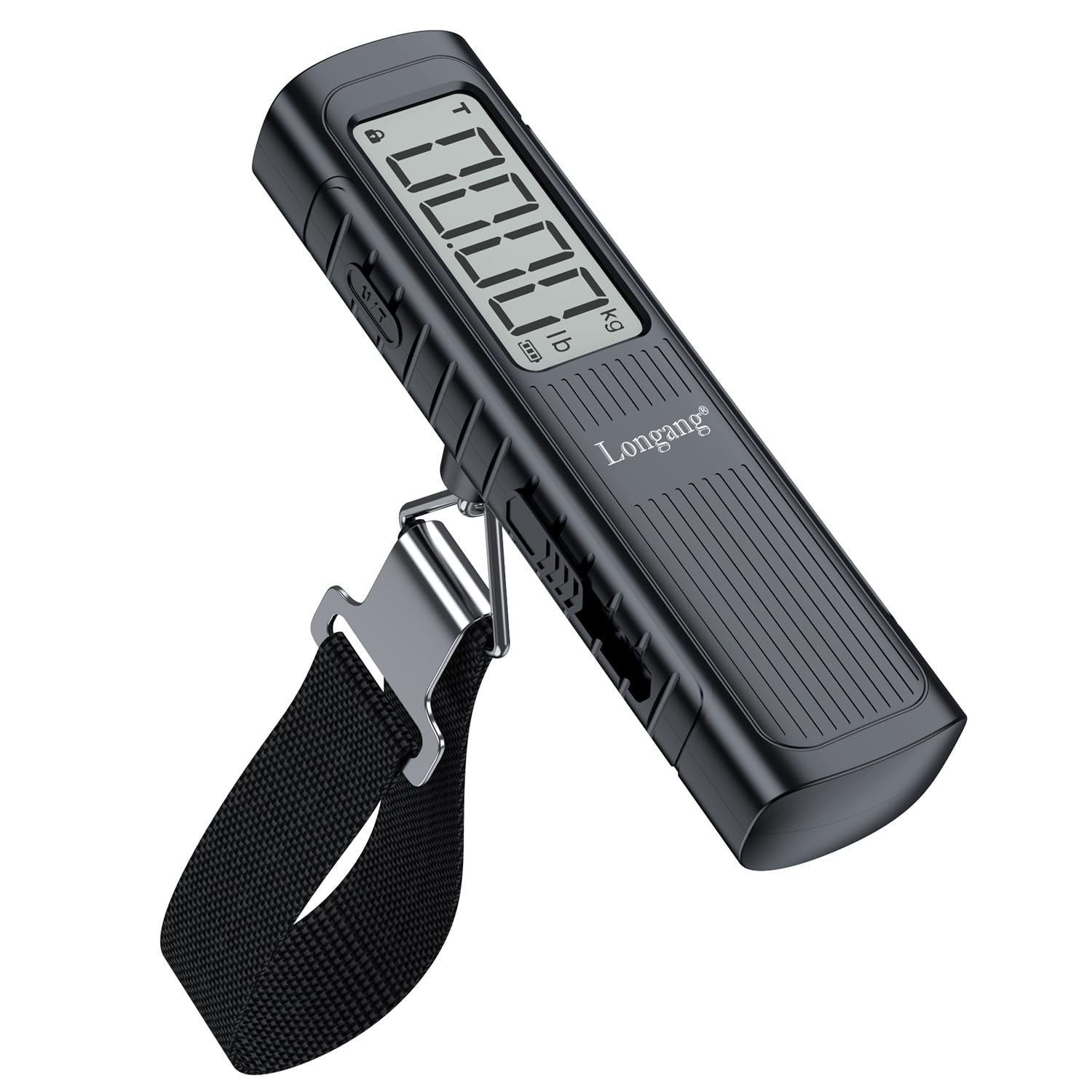
Longang Digital Luggage Scale

95 /100
Traveler Score Outstanding

Key details

Weight
3.17 oz
Display
Backlit LCD
Maximum Capacity
110 lb
Readout Accuracy
0.1 lb
Check Details on Amazon

Nine hundredths of a kilogram is what the listing claims, which works out to roughly three ounces, and that figure is the reason to notice this one at all. It's the lightest scale here — well under the Etekcity's 4.7 ounces and less than half the Meilen's 7.58 — so it disappears into a laptop sleeve or a side pocket and stays there instead of getting left at home to save weight.

The rest of the package is more than the price implies: 110 pounds of capacity, a backlit LCD, 0.1-pound steps, a tare button, auto shut-off, and a CR2032 already installed. Longang backs it for 360 days, longer than most of the field bothers with, and the body is plain silver plastic with no rubber anywhere on the handle.

Packing it is the pleasure. This is the scale we leave in the suitcase rather than the one we reach for when four bags need weighing in a row, and at three ounces there's no reason to take it out. The tare button earns its keep too: zero it with an empty tote, load the tote, and you get the contents rather than the container, which is how you split weight between two bags without unpacking either.

Pros

  • Lightest scale here at about three ounces
  • 0.1-pound readout with a tare function
  • Backlit display plus a 360-day warranty

Cons

  • Bare plastic handle digs in with a heavy bag
Our verdict

For packing light, this is the one: about three ounces, 0.1-pound steps, a tare button, and a backlit screen, with a bare plastic handle as the trade.

Check Latest Price
4

Best Warranty

Fosmon Digital Luggage Scale

93 /100
Traveler Score Outstanding

Key details

Units
g, oz, kg, lbs
Weight
3.9 oz
Maximum Capacity
110 lb
Readout Accuracy
+/- 0.1 lbs or +/- 0.05 kg
Check Details on Amazon

A limited lifetime warranty is an odd thing to find on a small plastic gadget that gets dropped on hotel bathroom tile, and that's exactly why the Fosmon stands out. The company backs it for life and staffs a U.S. service line, which for a tool this easy to break is a more useful feature than another unit conversion. It's the reason this one sits a tier above the budget picks.

The spec sheet is the fullest here. It reads in 0.1-pound or 0.05-kilogram steps and switches among grams, ounces, kilograms, and pounds, so it will also weigh a parcel or a market haul. There's a tare function, a backlit LCD, and an overload indicator that warns you a bag is past the limit rather than simply refusing to settle on a number. At 3.9 ounces it's lighter than the Etekcity.

What you're paying for is mostly the cover and the indicators. Our lifts with it were uneventful in the way you want from a scale — settle, read, set down — and the low-battery icon means you find out about a fading cell before a bag does. If a scale has died on you mid-trip and you'd rather not repeat it, the warranty is the argument; if you only want a number before you leave, a cheaper scale hands you the same number.

Pros

  • Limited lifetime warranty with U.S.-based service
  • Four units including grams and ounces
  • Overload and low-battery indicators

Cons

No notable drawbacks to flag.

Our verdict

The pick for anyone who wants to buy once: four units, a 0.1-pound readout, and a limited lifetime warranty on something that lives at the bottom of a bag.

Check Latest Price
5

Best with Extras

Meilen Luggage Scale

92 /100
Traveler Score Outstanding

Key details

Weight
7.58 oz
Battery
2 AAA
Maximum Capacity
110 lb
Readout Accuracy
1.6 oz
Check Details on Amazon

Airlines charge for weight, but the tape measure is the other half of the story: some carriers price a bag on length plus width plus height, and that's the moment the Meilen's built-in tape stops being a gimmick. It pulls out to 5 feet, long enough for the longest side of any checked bag, and it lives in the body so there's nothing extra to pack.

The handle is the other difference. It's ABS with a rubber coating and enough bulk for a full hand, and the reading locks when the weight settles, so the number waits on the screen while you set the bag down. With a suitcase near the limit, that combination — a grip you can pull against and a figure that stays put — is worth more than it sounds.

It runs on two AAA batteries rather than a coin cell, the easier cell to find on the road, and it arrives with a pouch that keeps the hook away from your clothes. The blue backlight is bright enough to read in a dim room, and the auto-lock means you don't have to hold the bag at eye level to see the result.

So the tape decides it. If you fly carriers that charge by dimensions, or you're checking a bag you've never measured, the Meilen is the one to pack. If you only ever need a weight, the Etekcity does the same job in something you'll forget is in the bag.

Pros

  • Built-in 5-foot measuring tape
  • Rubber-coated handle suits two-handed lifting
  • Auto-lock holds the reading; runs on two AAA

Cons

  • Heaviest scale here at 7.58 ounces
Our verdict

Buy it if you also need dimensions: a built-in 5-foot tape, a rubber-coated handle and a reading that locks, in the heaviest body in this guide.

Check Latest Price
6

No Batteries

Samsonite Manual Luggage Scale

91 /100
Traveler Score Outstanding

Key details

Weight
5.6 oz
Tape Measure
Built in
Maximum Capacity
80 lb
Measurement Type
Mechanical
Check Details on Amazon

Eighty pounds is the smallest capacity here, and it doesn't matter. A checked bag over 50 pounds is already a fee on most U.S. carriers, so the ceiling has nothing to do with how well this weighs a 47-pound suitcase. What the Samsonite offers instead is a spring, a needle, and no battery to die the night before a flight.

The design is old-fashioned in a way that holds up: a comfort-grip handle, an adjustable strap that loops soft or rigid handles alike, and a built-in tape measure for the carriers that care about dimensions. It measures 5 by 1 by 6 inches and weighs 5.6 ounces, and there's nothing to charge, pair, or switch on. Pull the strap, watch the pointer, read the number.

The needle is the trade. A spring mechanism lands within a couple of pounds of the real weight, and no amount of squinting gets you closer than the gap between two marks. If you pack to 47 pounds and your airline allows 50, that's enough precision for the job; if you dance along the limit at 49.5, buy digital. The upside is a scale that will still work after a year in a sock drawer, which is more than we can say for anything with a coin cell in it.

Pros

  • No battery or charging, ever
  • Built-in tape measure for dimension limits
  • Comfort-grip handle and adjustable strap

Cons

  • Body and strap feel light-duty for the money
Our verdict

The battery-free choice: a needle, a strap, and a built-in tape measure, with accuracy good to a couple of pounds and nothing to charge before a flight.

Check Latest Price
7

Digital, No Battery

Longang Battery-Free Luggage Scale

95 /100
Traveler Score Outstanding

Key details

Power
No battery required
Weight
3.68 oz
Maximum Capacity
110 lb
Readout Accuracy
1.6 oz
Check Details on Amazon

Instead of a battery, this Longang has a pushbutton you slide four or five times to generate the power for a reading — a tiny hand-crank in a plastic body. It answers a specific and irritating scenario: the scale that worked at home and is dead on the return leg, when the souvenirs have pushed the bag over and you need a number before the taxi arrives.

We like having a digital scale that can't strand us, and the cost is small. It reads in 1.6-ounce steps up to 110 pounds, with the tare and auto shut-off functions the rest of the field has, and at 3.68 ounces it slips into a side pocket and disappears. The screen is a plain LCD with large digits, and there's nothing inside it to leak or corrode in a humid suitcase.

The Samsonite solves the same problem with a needle and no electronics at all. This one keeps the digital readout, and that's the reason to pick it over the mechanical option — a number to the tenth of a pound is easier to argue with than a pointer floating between two marks, especially when the airport's scale is the one that decides.

Pros

  • Never needs a battery or a charger
  • 1.6-ounce readout to 110 pounds
  • 3.68 ounces, with tare and auto shut-off

Cons

  • You pump the trigger before every reading
Our verdict

Worth it if a dead battery is the failure you dread: a digital readout with no cell inside, charged by a few pushes of your thumb before each weigh-in.

Check Latest Price

How We Tested 16 Luggage Scales

We started by gathering every luggage scale we could find from travel-gear brands and luggage makers, then filtered by capacity, resolution, display type, and whether the design used a strap or a hook. Anything listing a resolution coarser than 0.2 pounds got cut, and we prioritized models small enough to disappear into a pocket or a Dopp kit. That left 16, which we've been living with for three months.

Each scale went on real trips: a packed carry-on, a checked bag loaded to roughly 45 pounds, and a week of riding in a jacket pocket or rattling around a toiletry bag. For accuracy, we hung a known 45-pound reference weight from each one ten times in a row and recorded every reading, then compared the scales against each other. Good ones repeated within a fraction of a pound; the disappointing ones drifted half a pound or more between lifts, and drifted further when the bag hung off-center. We also weighed the scales themselves — the gap between a two-ounce model and a six-ounce one matters when you're chasing a hard limit.

Ease of use got tested the way it actually happens: lifting a fully packed bag one-handed at arm's length to see whether the display stayed readable while the bag turned, and whether the hold button locked a number before the bag came back down. Straps were yanked, hooks were loaded past the weight we'd ever fly with, and every scale was dropped from waist height onto a tile floor and shaken in a bag with keys to check for cracked housings, frayed stitching, and battery doors that worked loose. After three months we re-weighed the reference load on each one. Two had clearly drifted, which is the kind of thing you want to learn in your living room and not at the check-in desk.

How to Choose Luggage Scales

Capacity Is Not the Number to Shop On

Most of these are rated to 110 pounds and one to 80, and none of that has much to do with your suitcase. A checked bag is capped at 50 pounds by most U.S. carriers, with 70 on some international routes, so every scale here clears the job with room to spare. A larger capacity number doesn't buy accuracy at 48 pounds — the sensor and the resolution do.

Look for a readout in 0.1-pound or 1.6-ounce steps, which are the same increment written two ways, then give yourself a pound of margin. Pack to 49 pounds for a 50-pound limit and the small disagreements between your scale and the airport's machine stop mattering.

Hook, Strap, and How You Lift

Two attachment styles do the work. A metal hook drops over a hard-shell handle in a second and stays put; a webbing strap loops through a soft duffel handle that has nothing rigid to grab. The Samsonite uses a strap, the Meilen and Etekcity a hook. If you travel with a duffel as often as a suitcase, the strap is the more useful of the two.

Whichever you pick, you'll be lifting a 50-pound bag at arm's length, so two details decide how pleasant that is: a grip wide enough for a full hand, and a display that holds the reading after the weight settles so you can lower the bag before you read it.

Where These Scales Actually Fail: Power

Nothing in this category fails more quietly than the battery. A cell that sat in a warehouse, a tab you never pulled, or a battery that drains between trips all produce the same result: a scale that worked in March and is dead the night before an August flight. Press the button the day it arrives, and again the week before you travel.

If you'd rather not think about it, buy out of the problem. The Samsonite runs on a spring and the Longang battery-free model on a few pushes of your thumb; the Meilen's two AAA cells are the easiest to replace on the road, since a hotel gift shop is likelier to stock them than a coin cell.

What You're Actually Carrying

The scale rides in the bag it's weighing, so its three to eight ounces come out of your allowance — trivial at 50 pounds, less so on a carry-on where every ounce is counted. Packed size matters more than the number on the spec sheet: the lightest scales here are pocket-sized, while the Meilen takes up a hand's worth of room.

Then the extras. A tare button lets you zero out a tote and weigh only its contents, which is how you balance two bags. A built-in tape measure answers the carriers that price a bag on length plus width plus height instead of weight alone. Temperature, which the Etekcity offers, is the one extra nobody has ever needed at check-in.

Frequently Asked Questions

Final Verdict

If you check a bag more than once a year, buy the Etekcity and stop thinking about it. The display is readable at arm's length, the reading holds after you set the bag down, the capacity covers anything an airline will take, and the rubberized grip means a full suitcase isn't a fight. If the purchase is pure insurance against one overweight fee, the travel inspira does the same work for the smallest outlay here.

And if a dead battery at 5 a.m. is the scenario that keeps you up, the Samsonite's needle and the Longang's crank both work without one — the first at the cost of some precision, the second at the cost of a few clicks before every reading.