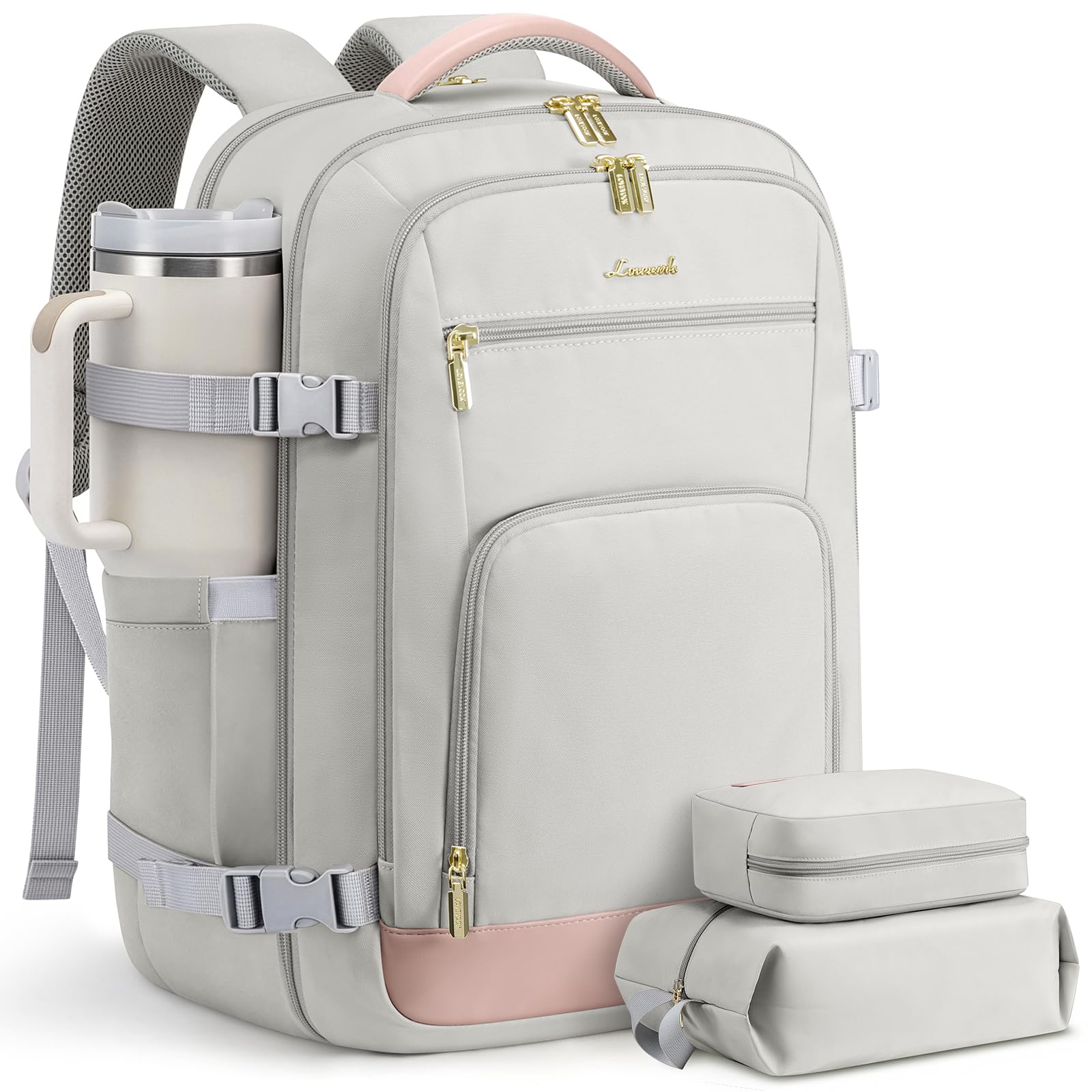
Best Lightweight Travel Backpacks of 2026

A lightweight travel backpack makes a small promise: carry less, move faster. The trouble is that every ounce a maker shaves off has to come from somewhere — thinner fabric, a flimsier frame sheet, one fewer pocket — and you usually find out where somewhere is on day three of a trip, when a strap starts digging into your shoulder or the bottom corner has worn through. A good one does the opposite. It disappears on your back between the airport and the hotel and still swallows a week of clothes.

Years of one-bag trips have taught me that the number on the hangtag matters far less than how a bag carries once it's full, and that liter capacity is not measured the same way by every brand — the size you order can arrive noticeably smaller than what you pictured. My team and I have spent the past eight months traveling with 11 lightweight backpacks, and the differences in quality, capacity, and durability were obvious long before the first flight landed. The ones actually worth carrying are below.

1

Best Overall

Osprey Daylite 26+6

93 /100
Traveler Score Outstanding

Key details

Access
Clamshell opening, luggage pass-through
Weight
1.7 lb
Capacity
26 L, expands to 32 L
Dimensions
6.3 x 13 x 16.9 inches
Check Details on Amazon

Two inches of zipper is what separates the Daylite 26+6 from the daypacks here. Closed, it's a 26-liter pack that measures 16.9 inches tall — inside the personal-item size most major airlines publish. Open it up and the main compartment grows another 6 liters, which is a jacket and a pair of shoes, or a week of souvenirs on the way home.

The other half of the design is access. The pack unzips down both sides like a suitcase, so you load it flat on a bed and see everything at once, with no digging for a clean shirt the way a top-loading daypack makes you. There's a luggage pass-through on the back for riding on a rolling case, two stretch bottle pockets, and a small front pocket within reach.

At 1.7 pounds it's light for the volume, and the AirScape back panel keeps the load off your spine instead of pressed flat against it. We noticed that most on the long walk to a gate, when a pack that sits badly starts to feel twice its weight. This is the real difference between a travel backpack and a packable: the weight lands on a harness, not on two thin straps.

Organization is where it goes quiet. There's a tech sleeve and a front pocket, and after that the main compartment is one open space — no shoe bag, no dividers, nothing to sort a week into. Packing cubes solve it, and we prefer that to paying for pockets we never fill. If compartments are what you want, the coofay gives you a dozen for a lot less money.

Pros

  • Expands 6 liters for the trip home
  • Clamshell opening packs like a suitcase
  • 1.7 pounds with a ventilated harness
  • Sized to most airlines' personal-item limits

Cons

  • Sparse interior organization
  • Costliest pack in this guide
Our verdict

The one pack that does the whole trip: 26 liters for the flight, 6 more for what you bring home, and a harness that makes the weight disappear. Buy it if you travel with one bag.

Check Latest Price
2

Best Budget Carry-On

coofay Travel Backpack

93 /100
Traveler Score Outstanding

Key details

Weight
1.43 lb
Capacity
25 liters
Dimensions
16.5 x 11.9 x 7.9 inches
Laptop Sleeve
Fits up to 15.6 inches
Check Details on Amazon

This is the pack for the traveler flying with a personal item and nothing else. coofay builds 25 liters into a body 16.5 inches tall, so it slides under the seat in front of you, and then spends the space on compartments rather than on a frame.

The sorting is why it earns a place. A shoe compartment at the bottom keeps soles off clean clothes, a wet pocket takes a swimsuit or a bottle that leaked, and a hidden pocket against your back holds a passport and phone where a hand can't reach. We've carried packs twice this size that made us unpack half the bag to find a charger.

It isn't a featherweight: about 650 grams empty, several times what a packable costs you. What that weight buys is padding — a ventilated back panel, padded shoulder straps, a soft shell that sits well against your back — plus a bag you can put in a washing machine, which is rarer in this category than it should be.

Pros

  • Shoe compartment keeps soles off clothes
  • Wet pocket for a swimsuit or a spill
  • Hidden back pocket for passport and phone
  • Machine washable, unlike most picks here

Cons

  • No frame sheet or hip belt
Our verdict

A 25-liter personal item with a shoe compartment, a wet pocket and a price that makes the decision easy. Buy it if you fly with one underseat bag.

Check Latest Price
3

Best Daypack

Osprey Daylite Plus

92 /100
Traveler Score Outstanding

Key details

Weight
1.3 lb
Capacity
20 liters
Dimensions
9.4 x 11 x 18.9 inches
Laptop Sleeve
Fits up to 14 inches
Check Details on Amazon

Same family as our top pick, different job. The Daylite Plus is a 20-liter daypack that travels well; the 26+6 is a travel pack that happens to work as a daypack. At 1.3 pounds the Plus is the lighter of the two, and it's the one we take when the day involves more walking than packing.

What you get for that weight is a real backpack: an AirScape back panel, a chest strap, a webbing hip belt, and a stretch shove-it pocket across the front that swallows a rain shell without opening the main compartment. The side pockets hold a 40-ounce bottle, which is more than most packs this size manage, and the close-to-body fit keeps a loaded pack from swinging when you turn.

The hip belt is webbing rather than padding — enough to steady a loaded pack on a climb, not enough to move real weight onto your hips. Set that aside and there's little to argue with: a shell, water and lunch disappear into it, and it rides close enough to wear all day on a trail or through a city. Where it runs out is volume, not comfort.

Pros

  • 1.3 pounds with a full harness
  • Side pockets take 40-ounce bottles
  • Front stretch pocket for a rain shell

Cons

  • Sleeve tops out at 14 inches
  • Premium price for 20 liters
Our verdict

The daypack of the Osprey pair: lighter, lower-priced and happiest on a trail or a long city walk. Buy it if the pack will live on your back, not in an overhead bin.

Check Latest Price
4

Best Packable Backup

ZOMAKE Packable Backpack

93 /100
Traveler Score Outstanding

Key details

Size
Small
Pockets
Front zip pocket
Packability
Folds into its own pouch
Check Details on Amazon

Cheap enough to buy without thinking about it, and that's exactly the job: a folded pouch in the bottom of a suitcase that becomes a day bag at the other end of the flight.

It holds more than its folded size suggests — a beach towel, a pair of shoes, a bottle and a phone, with room left over — and it stuffs back into its own pouch at the end of the day. That's why we keep one in the suitcase and another in the car. For theme parks, shore excursions and market mornings, it's close to the ideal shape: light on the shoulders, quick to rinse out, no fuss.

The fabric is thin, and that's the trade you're making. Seams and the front zip pocket are where a pack this light gives out first, so keep it to a day's gear rather than a week's, and don't ask it to carry a laptop and bottles at the same time.

Two of these in two suitcases costs less than one of the structured packs, and you'll use both. That's the argument, and it's a good one — nobody who buys this as a spare bag comes back annoyed about it.

Pros

  • Folds into its own pouch
  • Holds a day's gear with room left
  • Light enough to forget you packed it
  • Cheapest pack in this guide

Cons

  • Thin fabric and front pocket wear first
Our verdict

A pack this cheap has no business being this useful: it folds into its own pouch and opens into a real day bag. Buy it as your second bag, not your only one.

Check Latest Price
5

Best Ultralight for Day Trips

4Monster Hiking Daypack

91 /100
Traveler Score Outstanding

Key details

Capacity
16 liters
Material
30D water-resistant nylon
Dimensions
7.1 x 11.8 x 18.5 inches
Packability
Folds into a wallet-sized pouch
Check Details on Amazon

The nylon here is 30-denier, the same order of thinness as a windbreaker, and it's the reason the pack folds down to something you can hold in one hand. It shrugs off drizzle, it adds almost nothing to your luggage, and it's the lightest way to have a second bag on a trip.

As a spare it works well. Sixteen liters takes layers, water and lunch, the two mesh side pockets hold bottles upright, and the straps are wider than the string straps on cheaper packables, which makes a difference by mid-afternoon. Load it past a day's gear, though, and you'll feel where the money went — this is a pack for the hours between leaving the hotel and coming back.

Pros

  • Folds to roughly wallet size
  • Wider straps than most packables
  • Two mesh pockets hold bottles upright

Cons

  • No frame, so it slumps when part-loaded
  • Seams take the strain when overpacked
Our verdict

Sixteen liters of thin nylon that folds to wallet size and weighs almost nothing in your luggage. Buy it as the spare day bag you stop noticing.

Check Latest Price
6

Best Mid-Size Packable

WATERFLY Packable Backpack

91 /100
Traveler Score Outstanding

Key details

Weight
10.2 oz
Capacity
20 liters
Folded Size
8.7 x 6.3 inches
Compartments
4
Check Details on Amazon

Ours spends most of its life folded inside a carry-on, which is the whole point of a packable. What makes the WATERFLY worth unpacking is that it doesn't behave like a stuff sack: 20 liters across four compartments, side mesh pockets that take a large bottle, and front pockets you can reach without opening the main one.

At 10.2 ounces it disappears into luggage, and it folds to about 8.7 by 6.3 inches — small enough for a glovebox and easy to find again when you want it. The recycled nylon is water resistant, and the main compartment takes a rain jacket and a change of clothes with room left for a camera.

Where it stops is what you can put in it. This is a bag for a jacket, water and lunch; it has no interest in being a suitcase, and we treat it as the pack that lives in the luggage and comes out at the destination rather than the one we fly with. Twenty liters, used as twenty liters, is a good day.

Pros

  • Folds to 8.7 by 6.3 inches
  • Four compartments for a day's gear
  • Water-resistant recycled nylon

Cons

  • Straps are unpadded and cut in when loaded
Our verdict

Twenty liters, four compartments and packable weight, with enough organization to be your only day bag. Buy it if you want packability without stuff-sack manners.

Check Latest Price
7

City Days Out

SKYSPER Ishell 10L

93 /100
Traveler Score Outstanding

Key details

Weight
0.6 lb
Pockets
Hidden back pocket, mesh side pockets
Capacity
10 liters
Folded Size
6.7 x 7 inches
Check Details on Amazon

The detail that sold us is a flat zip pocket on the panel that sits against your back — the one place a hand can't reach while you're wearing it. Wallet, phone, passport: out of reach, and out of your way when you're not thinking about them.

The rest is a proper small daypack rather than a stuff sack. Ten liters, 0.6 pounds, side mesh pockets that hold a 21-ounce bottle, and a folded size of about 6.7 by 7 inches — small enough to pack inside a smaller bag and forget until you need it. The ripstop polyester is water resistant, and the zips and seams are neat for the money.

Ten liters is a day, not a trip: a jacket, water, a book and a camera fill it. That suits a market, a museum or a walk to dinner, where a 25-liter pack is a nuisance and a tote is a liability. For a layer plus a laptop, move up to the 16- and 20-liter picks instead.

Pros

  • Hidden pocket against your back
  • Folds to about 6.7 by 7 inches
  • Side pockets hold a 21-ounce bottle

Cons

  • Unpadded straps on a loaded pack
Our verdict

A 10-liter daypack that folds to pencil-pouch size and hides your wallet against your back. Buy it for city days when a big pack is a nuisance.

Check Latest Price
8

Long Weekends

LOVEVOOK 40L Travel Backpack

95 /100
Traveler Score Outstanding

Key details

Weight
2.9 lb
Capacity
40 liters
Dimensions
14 x 8.3 x 18.5 inches
Laptop Sleeve
Fits up to 17.3 inches
Check Details on Amazon

Forty liters puts this in a different category from everything else here, and so does the 2.9 pounds it weighs empty. It's a weekender with shoulder straps: 18.5 inches tall, inside most overhead bins and small enough to squeeze under a seat, and it takes three to five days of clothes if you pack it with the two cubes that come with it.

Organization is the pitch. Eighteen pockets, a padded compartment that takes a 17.3-inch laptop, a shoe bag, a wet pocket, a strap on the back that slides over a rolling suitcase handle, and grab handles on the top and the side so you can carry it three ways through a terminal.

That's also the catch: eighteen pockets means eighteen places to lose a charger. The packing cubes did more for us than any of the compartments — cube the clothes, keep small things in one outer pocket, and stop hunting. The padded straps are comfortable from the gate to the hotel and less so after an hour on your back.

For a long weekend with one bag, this is the pick: it holds several times what the packables here do for a fraction of what the Osprey packs cost. For anything that has to fold into a suitcase and disappear until you reach the hotel, it's the wrong shape entirely.

Pros

  • Fits 3-5 days with included cubes
  • Padded sleeve takes a 17.3-inch laptop
  • Suitcase strap and three carry options
  • Fits under seats and in overhead bins

Cons

  • Heavy empty at 2.9 pounds
Our verdict

Forty liters that clears most overhead bins and carries like a weekend bag. Buy it for three- to five-day trips when you refuse to check a bag.

Check Latest Price

How We Tested Lightweight Travel Backpacks

We built a shortlist of roughly 40 bags from brands known for travel packs and lightweight hiking lines, then cut anything without a luggage pass-through or a real warranty, and anything whose empty weight crept past three pounds. That left 11 backpacks, which we carried for eight months.

Each bag was weighed empty on a kitchen scale, then packed with the same week's worth of clothes and a laptop and weighed again. Several claimed a liter count their main compartment couldn't hold once packing cubes went in, so we noted exactly how many days of clothing each one took. We ran them through airport security, hoisted them into overhead bins, shoved them under seats on regional jets, and walked the mile from train stations to rentals with a full load to see how they sat. Two testers — one 5-foot-4, one 6-foot-2 — wore each pack for at least an hour straight and marked where the straps dug in.

Back home, we packed and unpacked each bag daily for a month to watch the zippers and lining, dragged them across gravel and pavement to check the base fabric, and walked 20 minutes through steady rain to see whether anything near the seams came through damp. We also tracked the small things: whether the hip belt moved weight off the shoulders or just flapped, whether a side pocket could hold a water bottle one-handed, and whether a half-empty bag slumped or kept its shape.

How to Choose Lightweight Travel Backpacks

Packable or Structured: Pick by Role

Under about a pound you're buying thin fabric, unpadded straps and no frame; over about a pound and a half you're buying a back panel, a real harness and some shape. Neither is better, because they're for different jobs. If the pack lives in your suitcase and comes out at the destination, a packable such as the ZOMAKE or the 4Monster is the right tool and the saved weight is the whole point of it.

If it's the bag you fly with and walk out of the terminal wearing, pay for structure. The Daylite Plus carries 20 liters far better than any ten-ounce sack will, and after an hour the difference stops being about specifications and starts being about your shoulders.

Match Liters to the Trip

Capacity makes sense once you learn the scale: 10 liters is a day of essentials, 16 to 20 liters adds a layer and lunch, 25 liters holds two or three days with packing cubes, and 26 to 32 liters is where one-bag trips begin. The expansion on our top pick shows the idea cleanly — 26 liters gets you through the flight, and the extra 6 are for the return leg and everything you bought there.

Buy for the trip you take most often, not the longest one you can picture. A 40-liter pack for a weekend you take twice a year is dead weight on the twelve city breaks in between.

Check the Sizer, Not the Word Approved

"Airline approved" on a product page means the seller measured the pack against some carrier's limits, not yours. Personal-item sizes differ between airlines and between fare classes, and a soft pack grows once it's full — a listed 7.9-inch depth can become nine inches of bulging clothes with nowhere to go.

Find your carrier's published dimensions before you buy, then compare them to the packed bag rather than the empty one. The packs here run from 16.5 to 18.5 inches tall, and height is the number to check first when the bin closes over your knees.

Access Matters More Than Pocket Count

How a pack opens decides how you live out of it. A clamshell, like the Daylite 26+6 and the LOVEVOOK, lays flat on a bed and lets you see everything at once; a top-loader makes you unpack to find a clean shirt. Dedicated shoe and wet compartments earn their space on shorter trips, when dirty and damp things travel with clean ones.

Past that, pockets add weight and hiding places. If you pack in cubes, one big opening beats eighteen compartments. If you don't, a couple of outer pockets and a reachable front pocket will do more than a divider for every sock.

Fabric, Zippers and Where Packs Fail

Denier is the number to read: 30D nylon is windbreaker territory and packs down small, while 300D polyester is luggage territory and takes abrasion. Ultralight packs fail at the seams, the zippers and the bottom panel rather than in the middle of a fabric, so look at where the straps are anchored and how the zip pulls feel in your hand.

If you'll regularly carry a laptop, a camera and water, choose the heavier cloth and the better hardware and treat the featherweights as day bags. A pack that weighs four ounces is a bargain until it's the only bag you brought.

Frequently Asked Questions

Final Verdict

The Osprey Daylite 26+6 is the pack we recommend to most travelers. It carries 26 liters under the seat, grows by 6 when you need it to, and puts the load on a harness instead of two thin straps — the thing no packable here can do.

If budget decides it, the coofay covers the same personal-item flight with more pockets and less comfort. If you want a daypack rather than a travel pack, the Daylite Plus is the better walker, and the packables are what you fold into a suitcase and forget about until you need them.