Best Earplugs for Sleeping of 2026

Sleeping in earplugs is a small bargain you make with yourself: a little discomfort now, a quieter night later. The trouble is that most pairs ask for too much — foam goes itchy by 2 a.m., silicone seals so tight you hear your heartbeat, and flimsy plugs vanish under the pillow before the alarm. What you want is unglamorous: soft enough to forget, quiet enough to matter, and still in your ear at sunrise. A good pair doesn't just muffle the world; it hands back the second half of your night.

I've kept earplugs on my nightstand since a neighbor's renovation, and the lesson was that the number on the box matters less than whether a plug actually seals. My team and I spent four months sleeping in 16 different pairs, and the gaps showed up around night three, not night one. Some cheap ones beat pairs at twice the price, and the picks below are the ones I kept reaching for.

1

Best Overall

Moldex Softies

91 /100
Traveler Score Outstanding

Key details

Made In
USA
Material
Slow-release foam
Pack Size
50 pairs
Noise Reduction Rating
33 dB NRR
Check Details on Amazon

The Softies take their time. Roll one down between your fingers and you get a few seconds of working time before the foam starts to come back — enough to walk it past the bend of the canal and hold a thumb on it until it fills. Rush the job and it pushes itself back out; give it those seconds and the plug stays where you put it until morning.

That patience is why these finished first in our set. Blocking a snore overnight is a seal problem before it is a decibel problem, and the Softies are the plug whose seal we trusted most, night after night. The 33 dB rating is the highest here, and it is the one we felt we were actually getting rather than a number printed on a box. They are also comfortable in the way that matters at 3 a.m.: low pressure against the canal, no hard edge to find when you roll onto your side, and nothing to explain in the morning.

Fifty pairs arrive in a plain box, which is the least interesting thing about them and also the point — this is a supply, not a gadget. There is no tin and no travel case, just a long run of plugs at a price that makes throwing a spent pair away painless.

Against the rest of the set: the jar of Mack's Ultra Soft costs less pair for pair, and the Flents Quiet Time is the softer-feeling foam for anyone who notices a plug at all. Neither seals as dependably for us, and the difference is worth paying for.

Pros

  • Slow recovery gives real working time to seat it
  • 33 dB NRR, the highest rating in this set
  • Low canal pressure for all-night wear
  • 50 pairs in one box, made in the USA

Cons

  • Standard cut only, with no narrower version
Our verdict

We recommend these to anyone who wakes at every creak: the slow-recovery foam seats properly and holds its seal, and 33 dB is the highest rating in this set.
Check Latest Price
2

Best Value

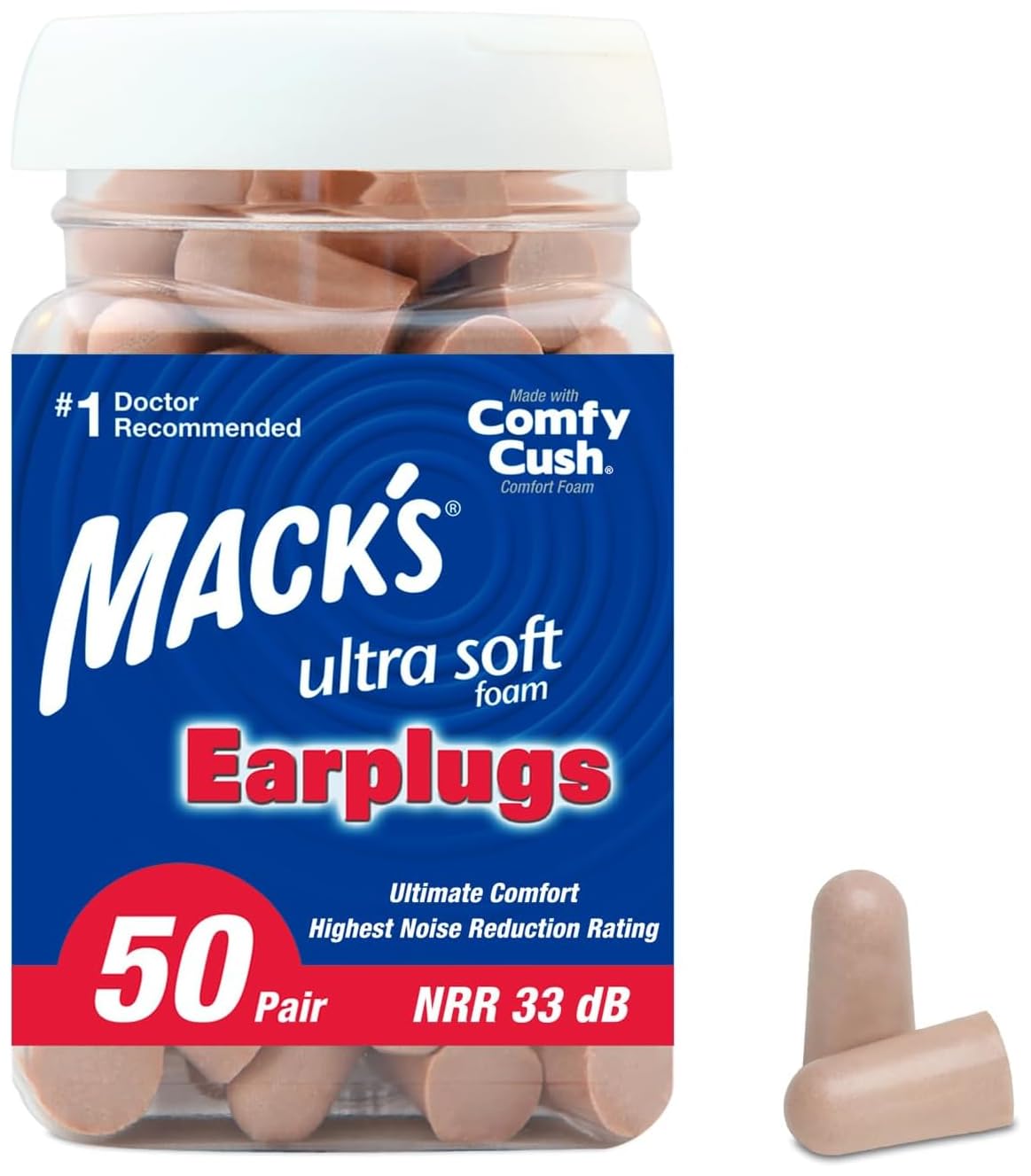
Mack's Ultra Soft

91 /100
Traveler Score Outstanding

Key details

Material
Comfy Cush slow-release foam
Container
Flip-top jar
Pack Size
50 pairs
Noise Reduction Rating
33 dB NRR
Check Details on Amazon

Fifty pairs of 33 dB foam, the cheapest pair for pair of any 33 dB plug here, in a flip-top jar you can work one-handed in the dark. If you have never slept in earplugs and want to find out whether you can, this is the box to find out with: the cost of not getting on with them is small, and you end up with spares for the car, the desk drawer, and the bottom of a bag.

The foam is the soft, slow-release kind, tan rather than neon, and it rolls down easily. Where it gives ground is the cut. This is a generous plug, and in a narrow canal it can creep back out over a few hours — you wake with it half out and the snore back in the room.

Two things we appreciated more than we expected: the jar, which dispenses one plug at a time instead of making you unscrew a lid half asleep, and the color, which disappears against a pillow rather than glowing at you. Softness holds up across a night, and the pressure stays low enough that you forget they are in. A pair stops expanding crisply after a week or so of nights, which is the signal to take a fresh one.

Pros

  • Cheapest 33 dB plug here, pair for pair
  • Soft slow-release foam with a 33 dB rating
  • Flip-top jar dispenses one at a time

Cons

  • Generous cut can work loose in narrow canals
Our verdict

Our pick for a big jar of genuinely quiet plugs on a small budget: the cut is less forgiving in narrow ears, but no other 33 dB plug here costs less pair for pair.

Check Latest Price
3

Best for Light Sleepers

Flents Quiet Time

89 /100
Traveler Score Excellent

Key details

Material
Slow-recovery foam
Pack Size
50 pairs
Expansion Time
Up to 30 seconds
Noise Reduction Rating
33 dB NRR
Check Details on Amazon

Most earplug packaging promises silence. This one says, right in the bullet points, that it is for light to moderate noise — and that is the most useful sentence on the label, because it is true of every foam plug here. What a 33 dB plug buys you is a snore pushed down to a hum and a truck outside turned into weather.

The Quiet Time is a slow-recovery foam, purple, 50 pairs to the tub, and it wants the full half-minute to expand. It feels slightly firmer in the hand than Mack's Ultra Soft, which seats with a more definite pop and holds its shape on the way in. Overnight it stayed where we put it and left no soreness.

Where these earn their place is consistency. Of the foams here, this is the one whose nights read quietest across the widest range of noise — a partner's snoring, a hallway, traffic — without demanding a perfect insertion. It is the plug we suggest first to someone whose problem is a snore two feet away rather than a building site.

Pros

  • 33 dB NRR with a dependable overnight seal
  • Slow recovery that seats with a definite pop
  • Consistently quiet for light sleepers

Cons

  • Runs large, so narrow canals feel pressure
Our verdict

A firm, honest 33 dB foam that keeps light sleepers down through snores and hallways; if your canals are narrow, choose a moldable rather than forcing these.

Check Latest Price
4

Best Moldable Silicone

Mack's Pillow Soft

88 /100
Traveler Score Excellent

Key details

Made In
USA
Material
Moldable silicone putty
Pack Size
18 pairs
Waterproof
Yes
Check Details on Amazon

There is no insertion with these. You warm a blob between your fingers until it softens, press it over the opening of the canal, and flatten the edges until it holds — a seal sitting on the outside of the ear rather than a plug jammed into it.

For anyone whose canals ache an hour into a foam plug, that difference is the whole purchase. We wore these on nights when foam felt like too much and got no pressure at all, which is also why they suit side sleeping: there is nothing pushing back against the pillow. The putty is waterproof, so the same pair covers a swim.

The catch is handling. Silicone putty is tacky, and if you have long hair or sleep on flannel it will find both. Tying hair back is the fix, and a blob that has collected lint and lost its grip is finished — we get a few weeks from a pair, not a few months.

Eighteen pairs is the smallest box here, so these are a pick for a specific problem rather than for stockpiling. If the problem is pressure rather than volume, nothing else in this set solves it as cleanly.

Pros

  • No pressure inside the ear canal
  • Molds to narrow or irregular ear shapes
  • Waterproof, so it doubles for swimming

Cons

  • Costliest per pair of the picks here
Our verdict

The answer for anyone who finds foam plugs painful after an hour: moldable silicone sits outside the canal, seals without pressure, and doubles for swimming.

Check Latest Price
5

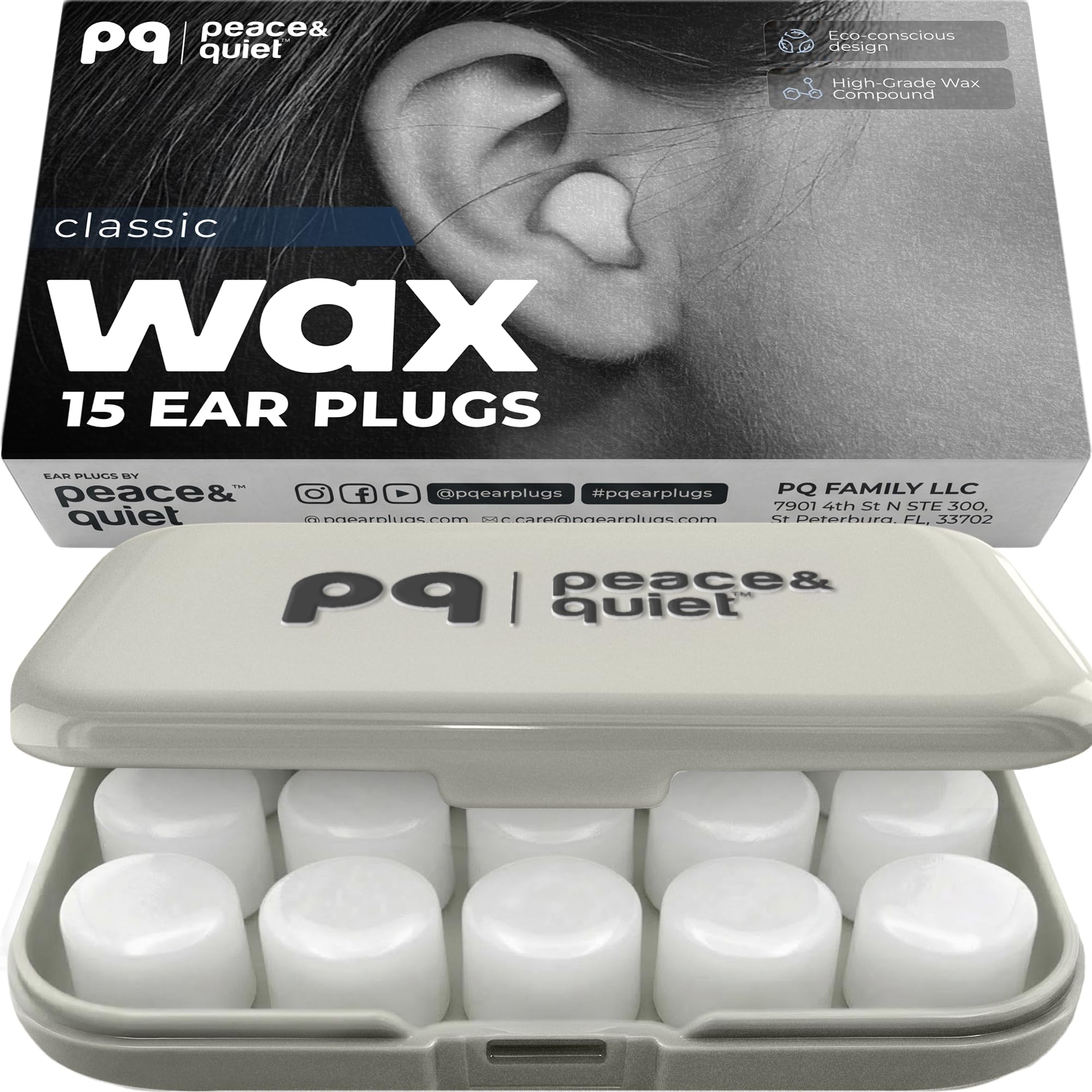
Best Wax Option

Peace&Quiet PQ Wax

88 /100
Traveler Score Excellent

Key details

Case
Carrying case included
Count
15 pillows, up to 150 uses
Material
Moldable silicone wax
Check Details on Amazon

Fifteen pillows sounds like a small box until you read the rest of the label: each one splits in half, and the maker claims up to 150 uses from the lot. Wax is also the least expensive way into a moldable plug — you are buying material that gets remolded rather than replaced.

The material behaves differently from silicone putty. It softens with body heat, shapes closer to the ear, and sits low against the head, which is what makes it a real side-sleeper option. Hand-shaping also means it can be formed small enough for a narrow canal in a way foam cannot.

We like these as the budget moldable and as a travel plug, since half a pillow takes up almost no room in a bag. The wax is sticky, though, the kind that finds hair and pillowcases, so tie long hair back before you settle. Keep the pillow over the canal opening rather than inside it and it holds all night.

Pros

  • Least expensive moldable here
  • Splits in half for up to 150 claimed uses
  • Low profile for side sleeping

Cons

  • Can crumble once it stops holding shape
Our verdict

Wax does most of what silicone putty does for less: soft, low against the head, shaped by hand — provided you keep hair clear of it.

Check Latest Price
6

Bulk Buying

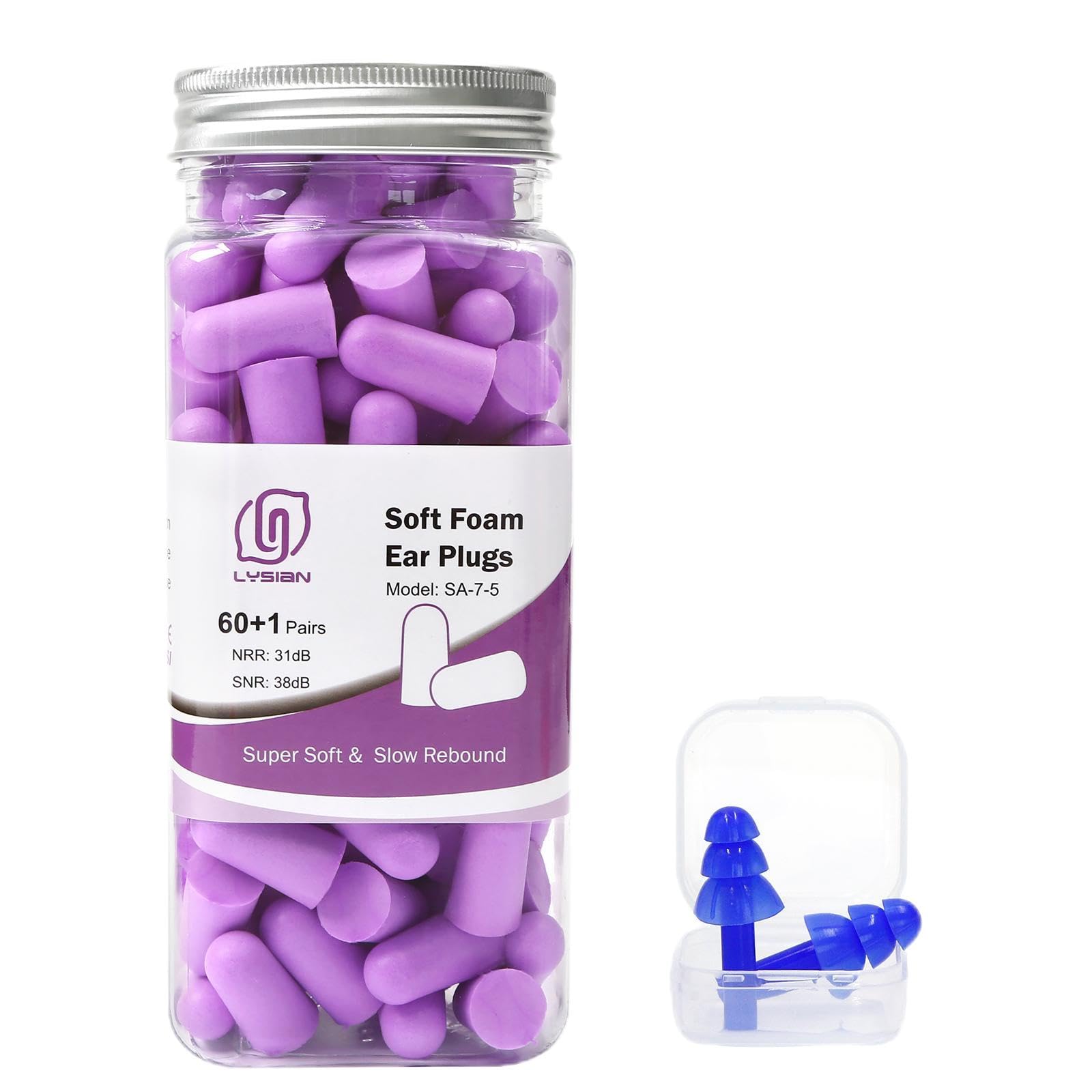
LYSIAN Soft Foam

88 /100
Traveler Score Excellent

Key details

Includes
Reusable silicone pair and case
Pack Size
60 pairs
Expansion Time
20 to 60 seconds
Noise Reduction Rating
31 dB NRR, 38 dB SNR
Check Details on Amazon

Sixty pairs, a spare pair of reusable silicone plugs, and a case — no other box here gives you as much for the money, and that is the strongest thing we can say about it. We keep it as a glovebox-and-desk supply rather than the plug we reach for against a snoring partner.

The foam is where it comes apart. LYSIAN rates these at 31 dB NRR, with a 38 dB SNR figure on the European scale, and the plugs are meant to expand over 20 to 60 seconds. In practice the rebound varies pair to pair: some roll down and bloom properly, others stay stubbornly springy and never seat, which is where the disappointing nights come from.

That is a bulk-box problem rather than a design flaw — pull a plug, and if it does not want to compress, take another. The bonus silicone pair is decent for a nap and the case is genuinely useful in a bag.

Pros

  • Cheapest per pair of any plug here
  • 60 pairs plus a reusable pair and case
  • Disposable enough to stash everywhere

Cons

  • Foam rebound varies from pair to pair
Our verdict

Buy it as a bulk supply rather than your best hope: unbeatable cost per pair with a case and a spare silicone pair, but the foam does not expand the same way twice.

Check Latest Price
7

Shared Rooms

AZEN Silicone Ear Plugs

91 /100
Traveler Score Outstanding

Key details

Material
Silicone with attached cord
Pack Size
55 pairs
Packaging
Individually wrapped
Noise Reduction Rating
25 dB NRR
Check Details on Amazon

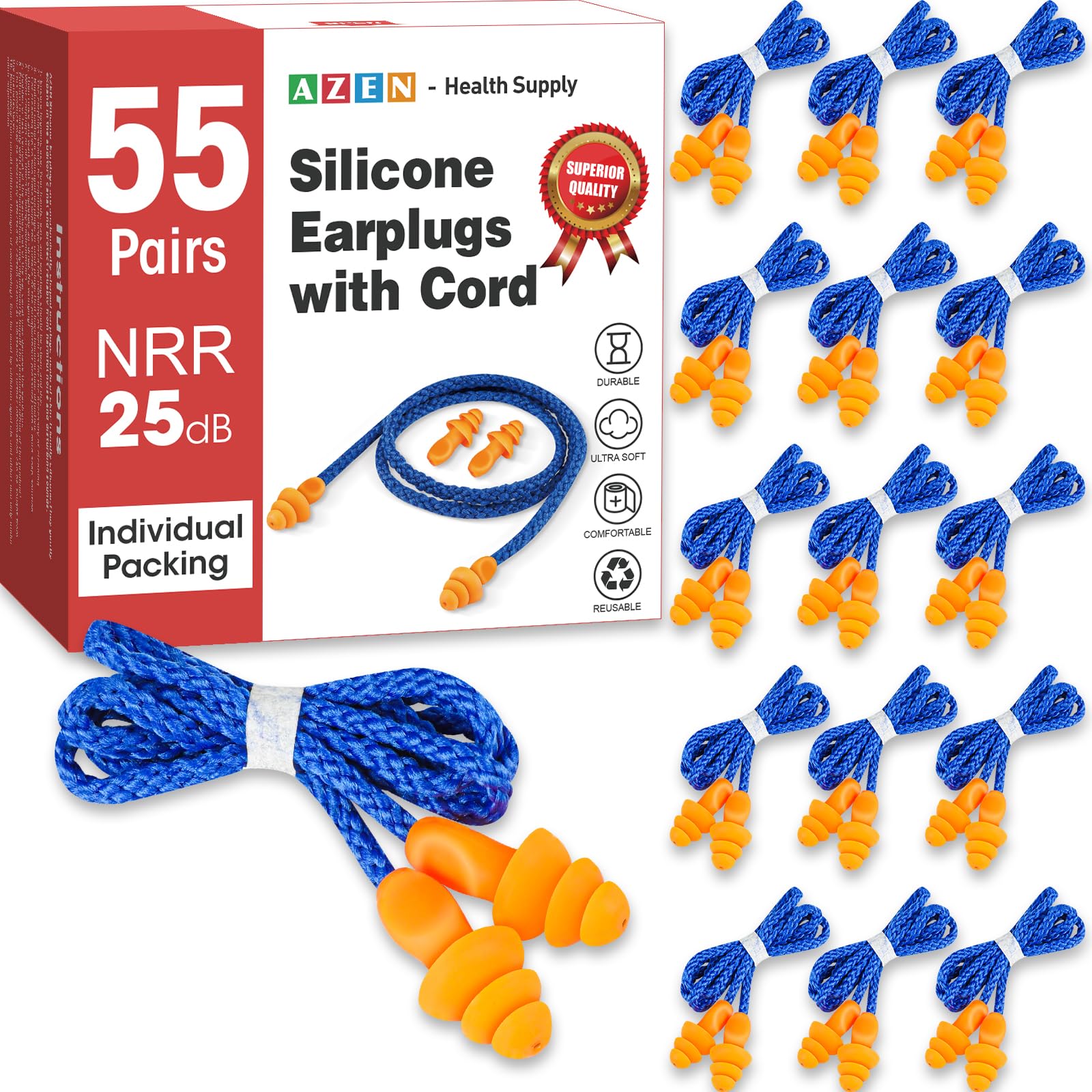
Fifty-five pairs, each sealed in its own wrapper with a cord attached. This is the odd one out in the set, and the packaging tells you what it is for: a locker, a shared room, a bag you do not want to dig through.

Silicone does not bloom like foam, so what you get is a plug that holds its shape and a modest rating. For a noisy dorm, a mower, or a plane that is fine, and the fit is what stands out: they sit securely in small to medium canals and stay there. For a snoring partner at 2 a.m., we want foam.

The cord is the divider. It keeps a pair traceable and stops you dropping one on a grimy floor, and because the plug is washable and reusable, the box outlasts its pair count by a wide margin.

Pros

  • Reusable and washable, unlike foam
  • Individually wrapped pairs with attached cords
  • Secure fit in small to medium canals

Cons

  • Cord tangles against a pillow
Our verdict

The reusable, corded, individually wrapped option for shared rooms and travel — with the least blocking of anything here at 25 dB.

Check Latest Price
8

Side Sleepers

The Ear Buddy

89 /100
Traveler Score Excellent

Key details

Reuse
Up to 3 times
Shape
Flared bell
Pack Size
50 pairs
Noise Reduction Rating
32 dB NRR
Check Details on Amazon

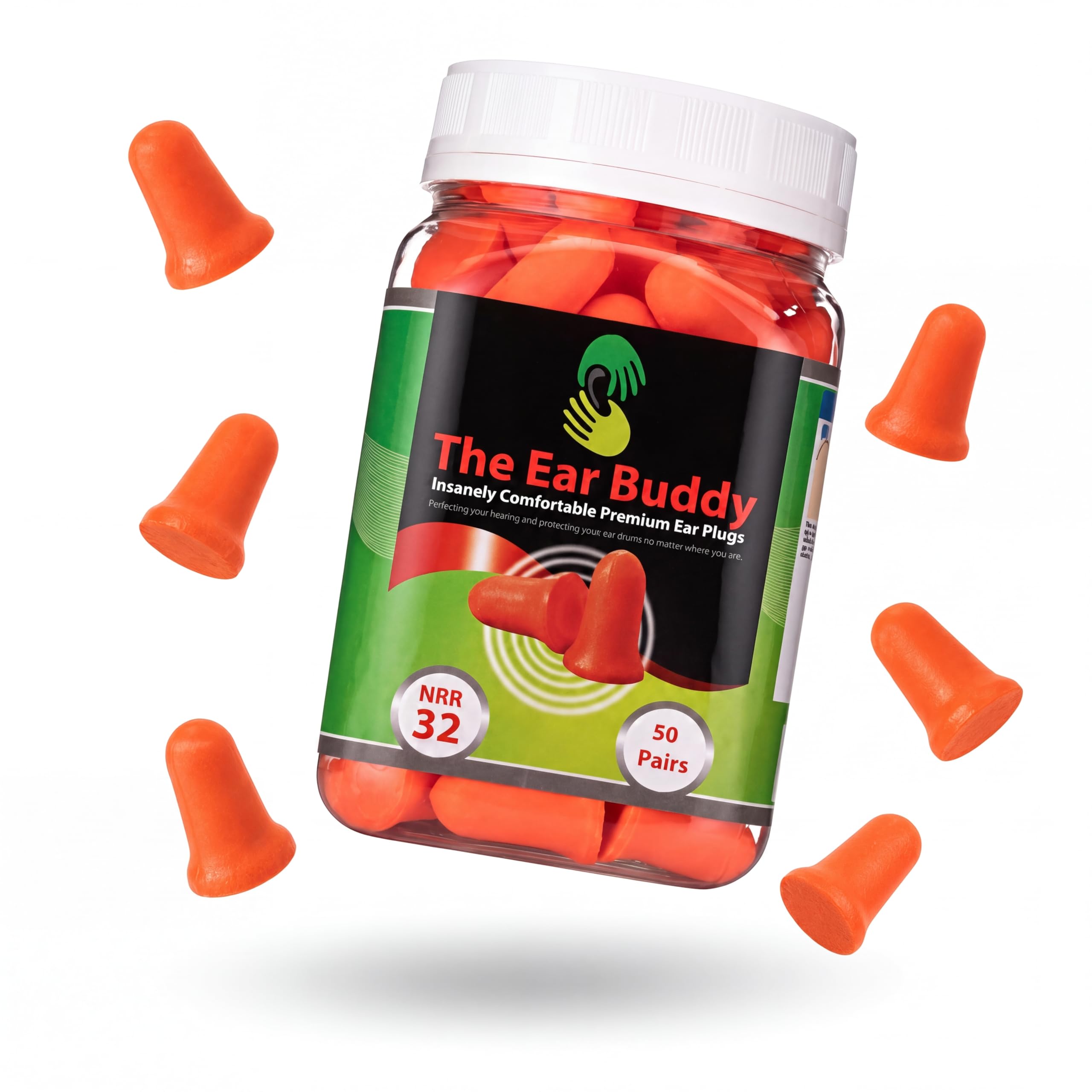
The flare is the whole idea. Instead of tapering to a point you push deep, these finish in a bell that sits at the entrance of the canal, so the plug does its work near the surface and lying on your side does not drive it further in.

That shape is why they are easy to live with. NRR 32, 50 pairs, foam that squishes down readily; the bell also gives your fingers something to hold when you are inserting them half asleep, which sounds trivial until you have done it at 3 a.m.

The economics are the sticking point. The listing caps reuse at three times before a pair becomes disposable, which turns 50 pairs into something closer to 150 nights rather than a year of them.

We still point side sleepers at them, because the bell genuinely changes where the pressure lands — and that is worth something no spec sheet shows you.

Pros

  • Flared bell sits at the canal entrance
  • 32 dB NRR with soft, squishy foam
  • Easier to grip and insert half asleep

Cons

  • Priciest per pair of the foam picks
Our verdict

A flared bell that keeps pressure at the canal entrance instead of deep inside — our pick for side sleepers who do not mind paying more per night.

Check Latest Price

How We Tested Earplugs for Sleeping

We started by reading spec sheets and several hundred customer reviews, then filtered for pairs that came in more than one size, listed an actual noise reduction rating, and worked out to under a dollar a night. That left 16 pairs, which we tested over four months.

Each pair got at least five consecutive nights and rotated through the places earplugs actually earn their keep: a bedroom facing a busy street, a hotel on a work trip with a hallway that never went quiet, a shared house with a snoring bedmate, and Sunday naps on the couch. I kept a notepad on the nightstand and wrote down every time I woke up, which is crude but honest. I also checked at 3 a.m. — the hour that separates a plug that stays put from one that's rolled under your shoulder — and again at sunrise, to see whether it was still seated and whether my ear felt sore from lying on it.

Softness was judged at hour six, not minute one, by whether the material still felt like nothing against the ear canal. We rolled each plug between thumb and forefinger to see if it sprang back, washed them as directed, and counted nights until they turned tacky or tore; one pair quit at nine days. We also checked pillowcases for residue, tried the smallest and largest sizes on narrow and wide ear canals, and listened for whether a plug muffled evenly or made our own breathing louder than the traffic. Cost per night of use settled the value question.

How to Choose Earplugs for Sleeping

The Rating Matters Less Than the Seal

Everything worth buying on this page lands between 25 and 33 dB, and that spread is smaller in practice than it looks on paper: a 33 dB foam plug inserted halfway blocks less than a 31 dB plug seated properly. Roll foam thin, walk it past the bend of the canal, and hold a finger on it while it expands.

Most foams want 20 to 60 seconds to finish the job. If a plug backs out on its own within an hour, the problem is size rather than rating, and no amount of rolling will fix it.

Foam, Silicone Putty, or Wax

Foam is the default for good reason: cheap, effective, and the only material that expands to fill an irregular canal. Its weakness is pressure, and after a few hours some ears ache. Moldable silicone and wax sit over the canal opening instead of inside it, so nothing pushes outward, which is why side sleepers and sore-eared sleepers migrate to them. They are tackier to handle and collect hair and lint.

If you have never worn plugs, start with foam. If you stopped wearing them because your ears hurt, go moldable — that is the single most useful switch in this category.

Size, Not Brand, Is What Usually Goes Wrong

The most common reason a plug fails is that the plug is bigger than the canal. Standard foam is cut for an average adult ear, and a narrow canal will push it back out or register it as soreness within an hour.

Some makers sell a version described as a percentage smaller than their standard plug, and that label, not a softer foam, is what fixes it. Soreness after an hour means the wrong size, not a bad night's sleep.

What a Box Actually Costs You

Pack size hides the real cost. A 50-pair tub of foam and a 15-pillow box of wax look similar on a shelf, but a foam pair is spent after a handful of nights while a wax pillow can be split and remolded for weeks. At a new foam pair roughly every week, a 50-pair tub covers most of a year of nightly use.

Decide how often you will replace, then compare boxes. Occasional wearers, the ones who only plug in on noisy trips, should buy small and let the rest sit.

Frequently Asked Questions

Final Verdict

Buy the Moldex Softies. They are the plug in this set where the seal, the rating, and the comfort line up, and that combination is what gets you through a night rather than through an hour.

If money decides it, the jar of Mack's Ultra Soft is the better value and carries the same 33 dB rating on an average canal. And if you gave up on earplugs because your ears ache by morning, skip foam entirely and start with the moldable silicone — the pressure problem disappears.