4 Best Camera Backpack for Long Lenses 2026: Match Your Real Kit

Pick a travel camera backpack for long lenses using attached-lens fit, real leftover space, harness, and travel profile — not just the listed max lens size.

The biggest mistake in this category is treating the listed maximum lens size as the whole story. A pack that holds a 600mm f/4 with the body attached may still leave almost no room for a filter kit, a rain shell, or food for a day hike. The realistic question is whether the bag fits the lens you actually carry and the load you bring with it.

Long-lens backpacks are specialized by design; the main compartment is optimized for glass, so every inch of padding and divider is a trade-off against personal-gear space. Some solve this with a taller, heavier frame and a tuned harness. Others stay slim and light for airports but force you to pack lean. The right pick depends on whether you prioritize hiking endurance, airline fit, or weather protection.

1

Best Overall

Vanguard Alta Sky 66

88 /100
Traveler Score Excellent

Key details

Access Design
Rear access plus side
Harness System
Padded shoulder straps
Interior Space
30L with accessory pockets
Travel Profile
5.6 lb, rain cover
Check Details on Amazon

Carries a 600mm f/4 attached to a pro DSLR and still has room for a second body, memory cards, batteries, and a tripod system in the 30L interior. Padded dividers section the main compartment so the big lens does not roll into other gear when the pack is set down. The build is heavy-feeling and water-resistant, with a rain cover tucked into the bottom for field protection. The shell is stiff enough that the bag keeps its shape when loaded, and the lid seal keeps light rain off the zipper track.

The side-access opening is the fastest way to pull a camera with a long lens attached, and it reduces how often you need to open the rear panel during a shoot. The tripod system mounts cleanly on the front and keeps a carbon-fiber tripod out of the way of the harness straps. Small pockets around the front, top, and hip area put filters, cards, lens caps, and a phone within reach without unbuckling the pack. The exterior lash points also handle a second tripod or a water bottle when the interior is full.

Best for wildlife and sports shooters who already carry a 600mm f/4 class lens and want a 30L pack that does not force a premium price. The rear-access zipper/flap can be sticky and the harness fit is body-dependent, so a loaded test fit with your own torso and lens is the right way to judge those quirks. Minimalist travelers who want a slim, low-profile pack and photographers who are sensitive to rear-flap operation will do better with the lighter option in this set. The premium alternative offers a more adjustable harness and explicit 800mm/gripped-body engineering; the Alta Sky 66 keeps the core 600mm-attached use case accessible at a lower cost.

The interior is organized like a camera bag, not a luggage container: dedicated battery/card pockets keep small items fixed, and the padded dividers can be rearranged for a 300mm f/2.8 kit or a shorter telephoto setup. The rain cover is stored in a dedicated pocket and can be deployed without unloading the bag. The 23 lb load limit covers a pro body plus 600mm f/4 plus accessories, which keeps the pack in realistic territory rather than theoretical max capacity. The rear panel opens completely for packing, and compression straps in the main compartment keep the long lens from shifting while hiking. For the price, this is the direct way to turn a heavy lens kit into a carryable field setup.

💡 Use the side-access opening for quick camera pulls and save the rear panel for loading and unloading the full kit.

Pros

  • Carries a 600mm f/4 attached to a pro DSLR with room for a second body and accessories.
  • Water-resistant shell with a rain cover and reinforced build handles field use.
  • Storage layout includes dedicated battery/card pockets and a tripod system.
  • Side access lets you grab a long-lens camera without opening the rear panel.

Cons

  • The rear-panel zipper can stick and the flap may not hold itself open during gear changes.
  • Shoulder strap spacing and hip belt position may not suit every torso shape.
Our verdict

When the task is moving a 600mm f/4 attached to a camera without overpaying for the bag, the Alta Sky 66 is the one to start with.
Check Latest Price
2

Premium Workhorse for Gripped Bodies

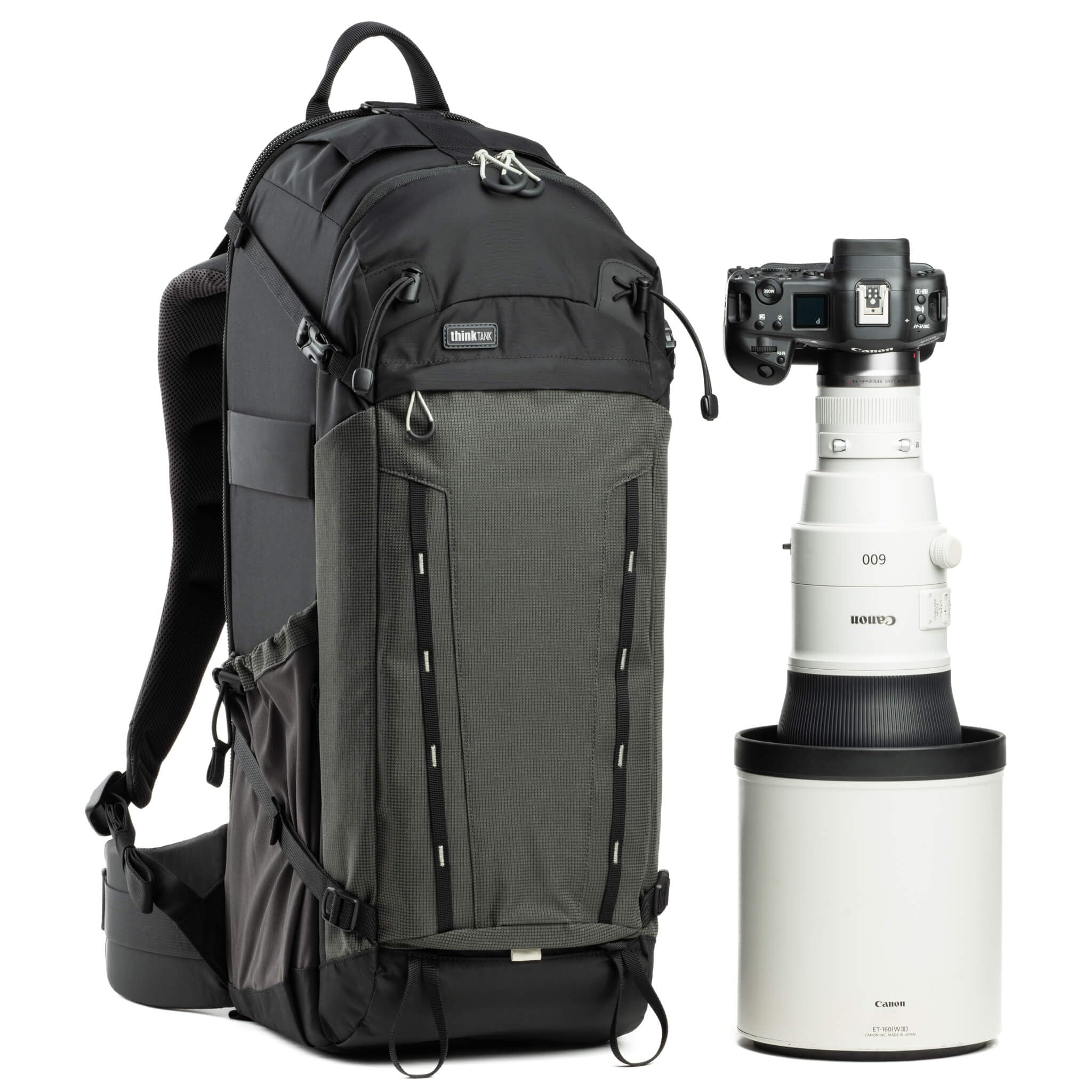
Think Tank BackLight

88 /100
Traveler Score Excellent

Key details

Access Design
Back-panel opening
Harness System
9-point adjustable, load lifters
Interior Space
32L plus 7L personal
Travel Profile
4.8 lb, 24.75in tall
Check Details on Amazon

Rated for a 600mm f/4 or 800mm f/5.6 attached to a gripped body with a teleconverter or adapter, this 32L pack is the max-spec option in this set. The rear-panel opening exposes a compartment whose adjustable dividers can be shaped around long glass and a second body. The 7L front section holds slim personal gear without eating into the main photo area. That layout keeps the lens attached and ready rather than requiring a detach-and-reassemble routine.

The 9-point harness with load lifters and a quick-fit waist belt distributes the weight of super-telephoto gear more deliberately than a standard backpack strap. On long hikes, the padded straps and cushiony hip belt keep a heavy kit settled against the body rather than pulling back from the shoulders.

This is for working wildlife and sports photographers who shoot from a gripped body with a 600mm f/4 or 800mm f/5.6 and plan long hikes. It is not an under-seat personal-item bag, and the main photo compartment takes priority over small-item storage; shooters who need cabin-friendly dimensions or a separate pocket for filters and batteries should bring a small pouch or choose a different pack.

💡 A small belt pouch handles filters and batteries during shoots.

Pros

  • Supports a gripped 600mm f/4 or 800mm f/5.6 with room for a second body in a 32L main compartment.
  • Rugged materials and structured construction stand up to field use.
  • Padded straps, load lifters, and a cushioned hip belt keep heavy kits manageable on long hikes.
  • Adjustable dividers and filter-friendly storage make the main compartment easy to reconfigure.

Cons

  • Front personal-gear area is small relative to the 32L photo compartment.
  • At 24.75 inches tall, this pack is not an under-seat personal-item bag for airline travel.
Our verdict

This is the premium-priced choice when a gripped 600mm f/4 or 800mm f/5.6 stays attached and harness support matters more than budget.

Check Latest Price
3

Rugged Expedition Choice

Lowepro Pro Trekker 650

90 /100
Traveler Score Outstanding

Key details

Access Design
Rear-panel access
Harness System
ActiLift performance harness
Interior Space
Two-camera kit capacity
Travel Profile
8.3 lb, 24.4in tall
Check Details on Amazon

The Lowepro Pro Trekker BP 650 AW II is the only pack in this set that pairs waterproof zippers and a coated main fabric with a full All Weather AW cover and an 800mm lens rating. Other long-lens backpacks here treat rain protection as an add-on; this one builds it into the zippers and shell. That makes it the reference point for anyone who treats rain as part of the job rather than a reason to stop shooting.

The interior is sized for two-camera expedition kits, and a gripped body with a 600mm f/4 attached fits without forcing you to detach the lens. A Sony A1 with a 200-600mm zoom comes out in seconds, and the ActiLift harness distributes full loads well enough for long approaches over uneven ground.

The buyer this pack fits best is an expedition or wildlife photographer who needs up to 800mm support in harsh weather and already carries two bodies plus multiple lenses on multi-day trips. The 8.3 lb empty weight and expedition-sized footprint make it a poor fit for minimalist travel; it is a field tool, not a personal-item bag.

The same weather sealing that protects the camera also removes the need to shelter it when rain moves in quickly, which matters for photographers who have missed shots while fumbling with a rain cover.

💡 When moving through an airport, plan for a bag that goes in the overhead bin rather than under the seat.

Pros

  • Waterproof zippers and the AW cover keep the whole kit dry in sustained rain without a separate rain cover.
  • The 800mm-rated interior fits a gripped body with a 600mm f/4 attached plus a second camera and multiple lenses.
  • The ActiLift harness keeps a fully loaded pack stable and comfortable on uneven terrain.

Cons

  • The premium price is a hurdle for anyone who does not spend regular time in wet or remote conditions.
  • The pack is at its best when fully loaded; a light daypack load does not play to its strengths.
Our verdict

For expedition photographers who need 800mm-rated capacity and weather sealing, this is the pack to carry; the protection it provides outweighs the extra effort.

Check Latest Price
4

Compact Travel Specialist

Think Tank Glass Limo

88 /100
Traveler Score Excellent

Key details

Access Design
Position-holding zippers
Harness System
Interior Space
Medium-large kit capacity
Travel Profile
2.6–3.9 lb, 9x21in
Check Details on Amazon

The Glass Limo carries a 500mm f/4 with a pro body attached or a 600mm f/4 detached inside a 9 x 21-inch pack that stays between 2.6 and 3.9 lb. That compact footprint makes it the travel-first alternative to the larger 30L pack in this set, which supports attached super-tele lenses but takes up more space and adds load. The slim shape also keeps the center of gravity close to the back, which reduces the strain of a long-lens setup.

Build quality holds up through repeated airline travel: the stitching is clean, the materials stay light, and the position-holding zippers keep the main compartment closed without sagging. A mirrorless or 4/3 kit with a medium telephoto fits comfortably, and the narrow profile avoids the slab-like feel common to long-lens backpacks. Shooters who keep the load to one camera-plus-primer rig find the harness comfortable for shorter walks and airport sprints.

This pack is for backpackers and airline travelers who want the smallest possible long-lens carry and are comfortable packing lean. The interior is snug by design; a 600mm f/4 fits only detached, and once the camera module is loaded there is little room for personal gear. Mirrorless and 4/3 shooters with medium telephotos get the most flexibility, while 500mm f/4 users with a pro body can keep the lens attached. Photographers who need a 600mm f/4 ready to grab from the pack should look at the larger option in this set.

💡 Position-holding zippers need an even pull to close securely once the pack is loaded.

Pros

  • Compact 9 x 21-inch profile keeps a long-lens kit manageable in overhead bins and on the trail.
  • Stitching and hardware hold up through regular trips while keeping the pack light.
  • Slim profile distributes a long-lens load comfortably, without the bulk of larger packs.

Cons

  • Interior space goes quickly once a long-lens body combo is loaded, leaving little room for personal gear.
  • A 600mm f/4 fits only detached from the body; 500mm f/4 is the largest attached setup.
Our verdict

This is the long-lens pack for trips where a small footprint matters more than attached-super-tele convenience.

Check Latest Price

How to Choose

Attached Lens Support

Attached and detached are different use cases. A 600mm f/4 prime with a pro body adds significant depth at the mount, so the pack needs a longer tunnel and thicker pads. That extra structure is why only a few packs claim attached support for this class. If you only need detached storage, a much slimmer bag can work.

Interior Space

Every padded divider takes up volume. Once a 600mm f/4 tunnel is installed, a 30L pack leaves only narrow slots for a second body, cards, and small accessories. A separate front compartment or a listed personal volume makes a big difference on travel days. If the bag lists only camera capacity, assume non-photo gear rides in a second bag.

Harness Comfort

A long lens rides high and shifts the center of mass backward. A stiff frame and load-bearing hip belt pull that weight onto your hips; shoulder padding alone lets the pack drift off your back. The same harness can feel secure on one torso and loose on another, so test any pack with the main compartments loaded before a trip.

Access Design

Rear-panel access protects gear from rain and theft because the opening sits against your body, but that flap carries the pack's weight, which is why sticky zippers show up. Side access is faster in the field and adds another long zipper plus more weather risk. A stiff main zipper while the pack is half-empty is a design issue, not a break-in problem.

Travel Dimensions and Protection

Attached 600mm support forces a pack to be at least 20 inches tall, which will not fit under most airline seats. Empty weight spans roughly 2.6 lb to 8 lb, with heavier packs usually adding waterproof zippers and stiffer frames. Rain covers protect after the fact, but fully waterproof construction adds weight and cost. Check exact external dimensions against the carrier you actually fly.

Frequently Asked Questions