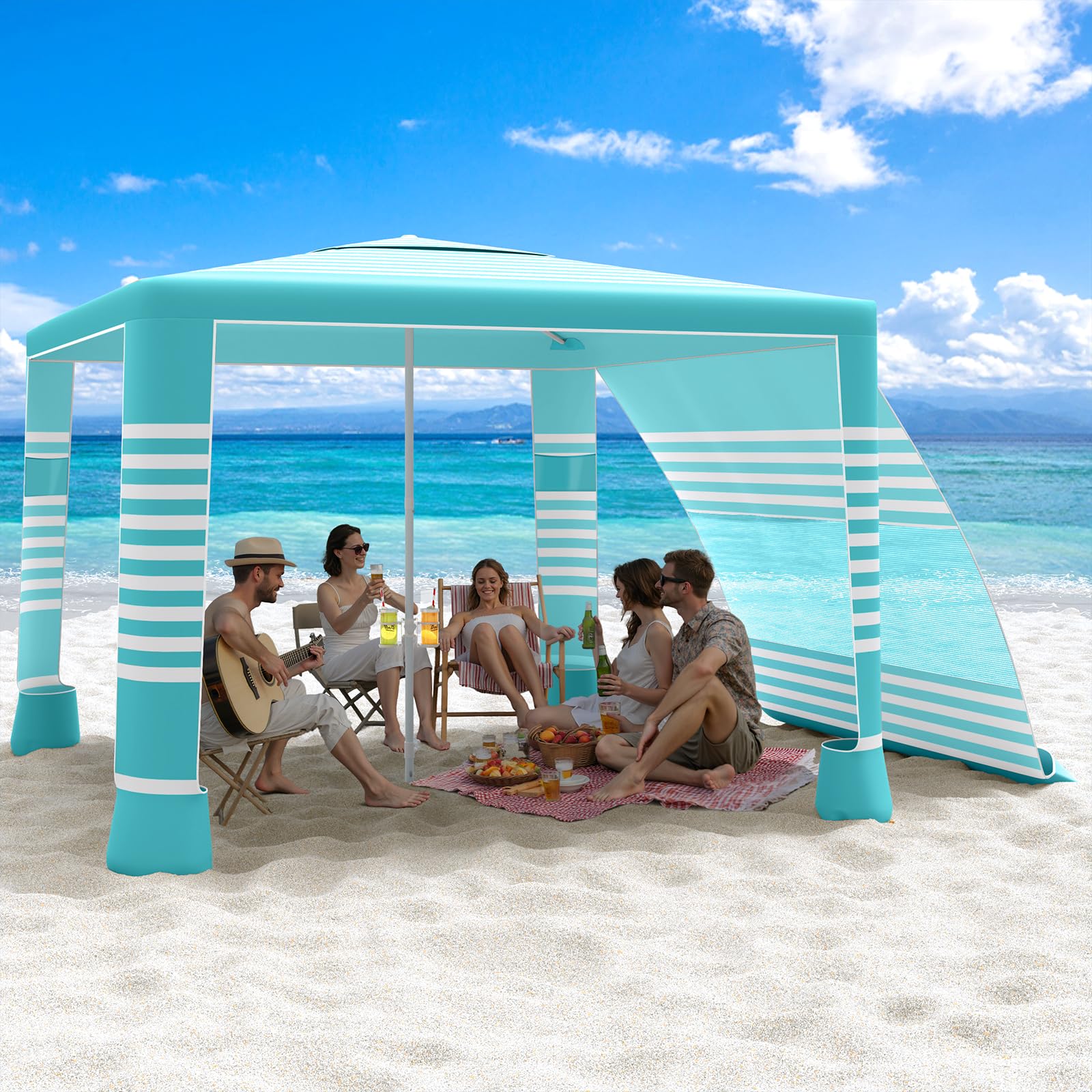
Best Beach Tents of 2026

A beach tent solves one problem — shade that stays put — and creates another: the fold. Anyone who has wrestled a pop-up back into its bag on a windy afternoon knows the trade-off. The tents that go up in 20 seconds are often the ones that skitter down the sand in a gust, and the ones that hold firm take two people and a bad mood to assemble. What you want is a tent where those two things stop fighting each other, that fits the people and the cooler you actually brought, and that comes in from the car in one trip.

I've spent enough afternoons under a sagging canopy to be picky. Over eight months, my team and I pitched 12 beach tents — pop-ups, pole-and-sleeve models, and a couple of inflatables — and the gaps showed up within minutes. A UPF rating describes the fabric, not the shade; how low the canopy sits and how much air moves through it change what it feels like underneath. The picks below are the ones that came home with sand in the seams and went out again the next weekend.

1

Best Overall

WhiteFang Deluxe Pop Up Beach Tent

91 /100
Traveler Score Outstanding

Key details

Weight
6.6 lb
Anchoring
5 sandbags and stakes
Floor Area
68 square feet
Peak Height
55 inches
Check Details on Amazon

Pop-up domes in this group top out at 47 or 48 inches, which is fine until you try to sit up in one. The WhiteFang gives you 55 inches at the peak, and that hand's width is the reason it is our top pick: an adult can sit upright on a towel instead of slouching, and a toddler can stand. The floor runs 99 inches long, the longest of the domes here, so two beach chairs and a cooler fit with room to spare.

Opening it is the easy half. Unstrap it, let the frame spring, stake the corners, and it is standing before the chairs come out of the car. Closing it is the half nobody warns you about. The frame has to twist into a figure eight while the panels fold toward each other, and the first two attempts look like a losing fight with a kite. Do it once in the yard before you take it to the beach.

The layout is what sells it for families. An extension flap unrolls in front of the door to give sandy feet somewhere to land, three mesh windows roll up for cross-flow, and there are pockets by each window for phones and sunscreen. Five sandbags are sewn into the skirt, and the bag also carries six steel stakes and six sand stakes, which is more anchoring hardware than most domes here include.

It is a warm tent on a still day, since a dome holds air and the windows only do so much; roll them all up, leave the door open, and it is bearable through a nap. The detail we keep coming back to is the color. Mint green stands out from the water when every other shelter on the sand is blue.

Pros

  • 55-inch peak lets adults sit upright
  • Springs open with no poles to thread
  • 68 square feet plus an extended floor flap
  • Five sandbags plus steel and sand stakes

Cons

  • Bag leaves no slack for a hurried fold
  • Thin fabric and stakes bend in a blow
Our verdict

For a family that wants shade up before the kids get restless, this is the tent we hand people first.

Check Latest Price
2

Best for Large Groups

SUN NINJA Beach Tent Sun Shelter

88 /100
Traveler Score Excellent

Key details

Weight
8.8 lb
Peak Height
79 inches
Shade Coverage
100 square feet
Frame And Anchors
4 aluminum poles, anchor bags
Check Details on Amazon

Eight people, four chairs, a cooler and one sheet of stretch fabric on four aluminum poles: that is the Sun Ninja's brief, and on a settled day it is the best seat on the sand. It throws 100 square feet of shade and stands 79 inches at the peak, so adults walk in and out without ducking, which none of the domes here can offer.

The fabric is a spandex blend, and the order of operations is everything. Lay it flat and peg the corners, fill all four anchor bags to the brim, then extend the poles and let the fabric pull itself tight. Rush the bags and you get a blue tarp that flaps itself loose by lunchtime. Do it in that order and the canopy stands through the steady onshore breeze that most beach afternoons actually deliver.

There is no floor and no wall, so this is shade rather than shelter: sand blows through, there is nowhere to change a baby, and a crawler will be out the far side in seconds. You also pay a premium for it, for the fabric, the four poles, the ground pegs and the shovel, and for the fact that two people can carry the whole bundle between them.

What surprised us is how much cooler it feels than a dome at midday. Heat rises out of the open sides instead of collecting under a roof, and you get a breeze across your face that a mesh window cannot match. Sitting under it with a book and a cold drink is the version of a beach day we are all actually buying.

Pros

  • 100 square feet of walk-in shade
  • Stretch fabric drums tight once tensioned
  • Four aluminum poles, pegs and shovel included
  • Open sides vent heat better than a dome

Cons

  • No floor or walls, so no privacy
  • Premium outlay for fabric and poles
Our verdict

Buy this when the group is adults in chairs and you want the biggest, coolest patch of shade on the beach.

Check Latest Price
3

Best for Windy Beaches

Rhino Valley 10x10 Beach Tent

87 /100
Traveler Score Excellent

Key details

Fabric
Lycra, triple-stitched
Weight
8.7 lb
Anchoring
8 sandbags, 4 poles
Shade Coverage
100 square feet
Check Details on Amazon

Most of the canopies here ship with four sandbags. Rhino Valley sends eight, plus four aluminum poles, four windproof ropes and a sand shovel, and that arithmetic is the entire pitch: twice the ballast, twice the chance it is still standing when you come back from the water.

The price of it is time. Filling eight bags is several minutes of squatting at the waterline, and emptying them at the end of the day is another stretch of work, so give the job to two people and let a third thread poles. The Lycra is triple-stitched and wants real tension: with the ropes evenly snug it drums tight, and with one corner slack the middle sags into a blue puddle.

Where this one earns its place is an exposed stretch of sand, with a steady crosswind, no dunes to hide behind, and a family that intends to stay put for four hours. It does the job of our group pick with more anchoring hardware and a good deal less outlay, and the included shovel means you are not filling bags with a child's spade.

The footprint is a full 10 by 10, generous for four people and tight on a crowded beach in August. At 8.7 pounds before the sand gets involved it is a wagon item rather than a shoulder item, and the lofted poles mean you can walk under it with the cooler, with no floor to sweep out at the end of the day.

Pros

  • Eight sandbags hold in a stiff crosswind
  • 100 square feet for chairs and a cooler
  • Poles, ropes and a sand shovel included

Cons

  • Sold without a manufacturer warranty
  • 8.7 pounds before the sandbags are full
Our verdict

The canopy we take to an exposed beach, where staying put matters more than packing light.

Check Latest Price
4

Best for Fast Setup

Wolfwise Pop Up Beach Tent

87 /100
Traveler Score Excellent

Key details

Setup
Pop-up, no assembly
Footprint
87 x 57 inches
Peak Height
47 inches
UV Protection
UPF 50+
Check Details on Amazon

The Wolfwise opens by throwing it. Unzip the bag, let go, and the fiberglass frame springs into an 87-by-57-inch dome, with no poles to thread and no hub to push. On a beach with a baby that speed is the whole feature: shade is over the car seat before anyone has found the sunscreen.

Folding it back is the tax. The frame has to twist into a figure eight while the fabric is tucked as it goes, and a first attempt at the beach usually ends with the tent half-folded under someone's arm. Learn it on a lawn at home, where there is no wind and nobody watching, and it takes seconds after that.

Inside, 47 inches of peak means crawling rather than sitting up, and three people is three adults cross-legged or two with a cooler wedged between them. The rear zip opens from either side, which makes loading bags through the back easier than dragging them through the door, and the two pockets below the windows keep phones out of the sand.

The 190T polyester is coated and taped, and it is thin. The same thinness that makes the tent light is what tears at the sand pockets when a shell ends up underneath, so keep a towel between the floor and the beach and it will last a summer of Sundays.

Pros

  • Opens in seconds with no assembly
  • Rear zip opens from either side
  • Compact 87-by-57-inch footprint

Cons

  • Thin fabric and sand pockets are the weak point
Our verdict

The one to grab when shade has to exist in the next thirty seconds, especially with an infant on the sand.

Check Latest Price
5

Best Budget Pick

Venustas Beach Tent Sun Shelter

89 /100
Traveler Score Excellent

Key details

Weight
3.5 lb
Footprint
86.6 x 59 inches
Floor Area
46.22 square feet
Peak Height
48 inches
Check Details on Amazon

Three and a half pounds is less than most of the beach chairs you will be carrying alongside it, and the packed bundle is small enough to disappear into a daypack. If you are parked a quarter mile from the sand, that is the whole case for this one: the shelter that gets used is the shelter that does not feel like a second trip.

It is a build, not a throw. Two 8mm fiberglass poles go through sleeves, the frame clicks into shape, and then the stakes and guy lines go in. Unlike a pop-up, it comes down in the order it went up, without a wrestling match, and the first assembly needed the instructions while the second did not.

Set up, it is 86.6 by 59 inches with a 48-inch peak and 46 square feet of floor: an honest three-person tent if two of them are kids, or two adults with chairs and a cooler. Mesh panels run along four sides for airflow, and the silver-coated fabric knocks the glare down inside, which matters more than it sounds when you are trying to read.

Where it gives ground is at the joints and the floor. The poles are slim, the fabric is light, and both want a clean patch of sand and a patient hand, because forcing the frame is how you end up with a spare pole and a sagging corner. At a budget price, though, this is the tent we hand families doing a week of day trips.

Pros

  • 3.5 pounds, the lightest shelter here
  • Folds into a small packable bundle
  • Four-sided mesh keeps air moving

Cons

  • 8mm poles can snap if the frame is forced
  • Light floor fabric needs a clean patch of sand
Our verdict

The shelter for someone parked far from the sand who wants light and packable over armored.

Check Latest Price
6

Best Headroom

Elegear CumbreX Beach Tent

82 /100
Traveler Score Excellent

Key details

Weight
6 lb
Capacity
4-5 person
Footprint
86.61 x 59.06 inches
Peak Height
61 inches
Check Details on Amazon

Sixty-one inches at the peak is the tallest of the pop-up domes here, and it changes how the tent feels. You can sit in a low beach chair with your head clear of the fabric, and changing a toddler stops being a contortion act.

The frame is the better idea. The poles snap onto the outside of the fabric instead of threading through sleeves, which removes the worst few minutes of any tent setup, and the rear door unzips into a second entrance so air runs front to back. Five configurations get advertised; in practice we used two, wide open at midday and zipped up with the windows rolled when the wind started pushing sand.

Space is where the description runs ahead of the floor plan. It is sold as four to five person, but the footprint is 86.6 by 59 inches, the same as the three-person tents in this group. Four small people fit. Four adults with chairs do not.

The coating is a double-layer silver with a waterproof rating, more weatherproofing than most beach shelters bother with, and the trade is weight: six pounds and a bag that wants two hands and a clear path. For a family that wants one tent to do shade, naps and a dry spot for the bags, that is a fair swap.

Pros

  • 61-inch peak, the tallest dome here
  • Snap-on frame is quicker than sleeves
  • Rear door opens for cross ventilation

Cons

  • Six pounds plus a bulky carry bag
  • Zips and stitching wear first
Our verdict

Worth it if you want to sit up straight and change a toddler without folding yourself in half.

Check Latest Price
7

Crowded Beaches

Bestset 10x10 Beach Tent

81 /100
Traveler Score Excellent

Key details

Poles
2 fiberglass poles
Weight
7.8 lb
Footprint
10 x 10 feet
Peak Height
78 inches
Check Details on Amazon

Two poles instead of four, and a strap at each corner that lengthens or shortens to change the footprint. On a packed beach in August that adjustability is the reason to look twice: you can pull it in to fit the gap between two families instead of asking anyone to move.

At 7.8 pounds it is a one-hand carry, and the bag holds four sandbags and a sand shovel. The shovel matters more than it sounds, because filling bags by hand takes twice as long. The nylon is a fine 45D/55S weave rated UPF 50+, and the canopy tilts on its poles so you can lean the shade toward the afternoon sun.

Two poles means the roof is a slope rather than a dome. One side rides high, the other comes down toward the sand, so the shade is directional and you rotate the whole thing as the sun swings west. That is the trade: a big, light patch of shade that tracks the sun, in exchange for the all-round cover a four-pole canopy gives you.

Wind is the open question. With all four bags full and the poles leaned into the breeze it stands; leave one half-filled and it walks. Set it up once on a breezy day and you will understand exactly why every corner needs its own full bag of wet sand.

Pros

  • Corner straps shrink the footprint to fit
  • 7.8 pounds with sandbags and shovel
  • Shade angle tilts with the sun

Cons

  • Sandbag buckles can slip and spill a corner
Our verdict

A clever pick for a packed beach, where being able to shrink the footprint is worth more than a fourth pole.

Check Latest Price
8

Walk-In Shade

MoKo Beach Cabana

82 /100
Traveler Score Excellent

Key details

Frame
Alloy steel
Shade Area
64 square feet
Packed Size
43 x 7 x 7 inches
Height Range
6.5 to 9 feet
Check Details on Amazon

The MoKo's trick is a telescoping center pole: the canopy lifts anywhere from 6.5 to 9 feet. Raise it for headroom when everyone is standing around, and drop it when the sun is low and you want the shade thrown out over the chairs instead of straight down.

Setup is closer to an umbrella than a tent. One person pops it open, hooks the removable side wall onto whichever side faces the wind, and pegs the base. The frame is alloy steel where most of this group uses fiberglass, and it feels sturdier in the hand, heavier too, and more likely to dent than to snap if it takes a knock.

Eight by eight feet gives 64 square feet of shade, with a vent at the top and mesh panels on the sides to let heat out. Folded, the whole thing is 43 inches long and seven wide, which lies flat across a trunk instead of standing in the corner of the garage.

For a family of four who want to walk in and out rather than crawl, and who would rather have a movable wall than a bigger roof, this is the tidiest design in the group. The side panel moves to any edge, so it becomes a windbreak in the morning and an extra sun shield after lunch.

Pros

  • Height adjusts from 6.5 to 9 feet
  • Removable side wall moves to any edge
  • Packs to a 43-inch bundle

Cons

  • Not water resistant, so fair-weather only
Our verdict

The tidiest walk-in shelter here for a family of four who want a wall against the wind.

Check Latest Price

How We Picked and Tested the Best Beach Tents

We started with every beach tent we could find that claimed real sun protection and seated at least two people, then filtered out anything over roughly 12 pounds packed or missing sandbags and guy lines in the box. That left 12 tents, from basic pop-ups to canopy-style shelters, and we spent eight months with them. Each one got a practice pitch in a backyard first, so we could learn the assembly without an audience, before it ever saw sand.

Setup was timed from the moment the bag opened to the last sandbag filled — once solo, once with a kid helping, because that's the honest version. Wind got its own afternoon: we pitched each tent on an open stretch of beach on a breezy day and watched how much the poles flexed, whether the canopy scooped air like a sail, and how many sandbags it took before the thing stopped shifting. Low profiles with a rear vent held noticeably better than tall domes.

Sun protection we judged from the inside, sitting under each tent at midday to see whether the fabric glowed when we held a hand up to it and whether shade reached the whole floor or just the middle. Size claims got checked with actual bodies and a cooler. After eight months of salt and UV, we went back over seams, zippers, and pole joints for wear. Pack-down was the great separator: we folded each tent with sandy hands in a crosswind, timed it, and noted whether it went back in its bag without a fight, then weighed the packed result against the length of a car trunk. Value came down to what shipped in the box — sandbags, stakes, a carry strap, a floor that didn't feel like a grocery bag.

How to Choose Beach Tents

Dome or Flat Canopy? Start With How You'll Sit

Two designs cover nearly everything here. The pop-up dome is a low enclosed tent with a floor, 47 to 61 inches at the peak, mesh windows and a zip door, and a footprint that fits between other families. The pole canopy is a sheet of stretch fabric on two or four aluminum poles, weighted with sandbags, with 6.5 feet or more of headroom and three times the shade but no floor and no walls.

Choose the dome for naps, babies, changing and privacy. Choose the canopy for adults in chairs who want to walk in and out. Whatever the listing says, a three-person dome seats three adults cross-legged or two with a cooler; four-person domes are the ones you can lie down in.

The Wind Decides Whether You Get Shade

Every shelter here is held down by sand, not by thin stakes alone. Sand stakes bite in wet sand and pull straight out of dry, so the bags do the real work: fill them at the waterline where the sand is heavy, bury them halfway, and tension the guy lines before the poles go up. A canopy that stands before it is anchored is a kite with your cooler underneath it.

On an exposed beach, more anchoring beats more fabric. Eight sandbags hold where four will not, and the shelter that is still standing at four in the afternoon is worth more than the one with the better view.

Who Sets It Up, and How Often

Ask how many people it takes rather than how many seconds it takes. Pop-ups open alone. A four-pole canopy with eight sandbags goes faster with two, and the slow part is filling bags, not raising poles. Anything you will pitch and strike twice a day for a week should be a one-person job, because by the third morning nobody wants to help.

Count the whole ritual too: unpacking, anchoring, and the folding at the end when everyone is sandy and ready to leave. That last step is where cheap shelters lose their charm.

Shade, Headroom and Airflow

A UV rating describes the fabric, not the patch of sand you are sitting on. As the sun swings west the shade moves off your chairs, and you are the one adjusting. Height decides what you can do underneath: under 50 inches you are crawling or slouching, 55 inches and up lets an adult sit in a low chair, and a walk-in canopy starts around 6.5 feet.

Airflow matters as much as coverage. Look for mesh on at least two sides. A dome with one window traps hot air and turns into an oven by noon, while an open canopy stays cooler because heat escapes out the sides.

Weight, Packed Size and the Walk

Packed weight across these shelters runs from about 3.5 to 9 pounds, and that is before the sand in the bags and the wet towels. The number that matters is the round trip: a shelter you can carry in one hand with a chair in the other gets used every weekend; one that needs a second person stays in the garage.

Packed length matters just as much. A 43-inch bundle lies flat across a trunk, while a long pole bag rides in a wagon or across someone's shoulder for the whole walk.

Frequently Asked Questions

Final Verdict

If you want one shelter that goes up in seconds and gives a family room to sit up, the WhiteFang is the one we point people to. The 55-inch peak, the 99-inch floor, and the sandbags and stakes that come in the bag cover an ordinary beach day without a lesson in patience.

Take the Sun Ninja instead when the party is adults, the shade has to cover several chairs, and someone will fill four anchor bags properly. If the walk from the parking lot is the deciding factor, the Venustas at 3.5 pounds is the one that actually gets carried.