Best 2 Burner Camp Stoves of 2026

A two-burner camp stove is a kitchen that folds into a suitcase, and the whole category is a negotiation: more heat usually means more weight and more trunk space. Get it right and you're frying bacon on one burner while coffee boils on the other. Get it wrong and you're cupping a dying flame against the wind or hauling an anchor out of the trunk that you dread lifting. That's the difference between a 20-minute breakfast and an hour of fiddling.

I've cooked on everything from palm-sized canister stoves to hulking three-burners, and for most trips the two-burner is the sweet spot. My team and I spent nine months cooking on 12 of them — at campsites, tailgates, and a few backyards — and the surprise was how much the spec sheet leaves out: simmer control, how the drip tray cleans up after a pound of bacon, whether the hinges still feel tight in month six. Plenty of stoves only have two settings, roaring and off. The ones below know how to do both.

1

Best Overall

Coleman Triton 2-Burner

94 /100
Traveler Score Outstanding

Key details

Weight
5 lb
Burners
Two independently adjustable
Warranty
3-year limited
Total Output
22,000 BTU
Check Details on Amazon

At 5 pounds, the Triton is the stove we reach for when the car is already packed and we still want two real burners. The 22,000 BTU output and two independent burners are enough for a weekend of coffee, eggs, and one-pot dinners, and the package is easy to carry, set on a picnic table, and latch shut with one hand. For most car campers, that balance is the right one.

The two burners adjust independently, and the folding wind guards do useful work on an exposed table. We found the broad grate leaves room for two full-size pans, and the knobs have enough range to bring coffee or eggs down to a low simmer without fighting the flame. The removable chrome-plated grate is a practical touch at cleanup time, too.

The three-year limited warranty is longer than most here, and the 5-pound body makes it the easiest pick to move between the picnic table and the trunk. We keep coming back to it because it makes two-burner cooking feel simple rather than specialized.

Pros

  • Light 5-pound package
  • Two wind guards and a removable grate
  • Simmers low for coffee and eggs
  • Three-year limited warranty

Cons

  • 22,000 BTU is modest for very large pots
  • Needs a stable, heat-safe table
Our verdict

We recommend the Triton as the default two-burner for car camping: light enough to pack, steady enough for two pans, and simple to live with.

Check Latest Price
2

Best High-Output Portable

Camp Chef Everest 2X

90 /100
Traveler Score Outstanding

Key details

Weight
15 lb
Ignition
Matchless
Cooking Area
215 square inches
Total Output
40,000 BTU
Check Details on Amazon

The Everest 2X is what we choose when two burners need to behave like a real range. Two 20,000 BTU burners give it 40,000 BTU total, and the 215-square-inch cooking surface is wide enough for two full-size pots. Matchless ignition, a folding lid with a windscreen, and a carry handle make it feel like a portable appliance rather than a bare burner.

That output is the reason to pay for it. We found it gets a wide pan hot quickly and still has a low end that can hold a simmer, which is not a given on stoves this powerful. The lid and windscreen shield the burners on a breezy table, and the drip tray is a welcome detail when breakfast gets messy.

At 15 pounds, it is a car-camping stove, not a backpacking one. The folding lid and handle keep it manageable, and the windscreen earns its space. The weak point is the copper gas line feeding the burners, which can break; inspect it before every trip and store the stove without putting weight on the line.

Pros

  • 40,000 BTU across two burners
  • Wide 215-square-inch cooking surface
  • Matchless ignition and useful windscreen
  • Holds a low simmer

Cons

  • Premium option for casual campers
Our verdict

For campers who want range-level heat in a portable stove, the Everest 2X earns the upgrade; just treat the gas line gently.

Check Latest Price
3

Best for Basecamp Cooking

Camp Chef Explorer

95 /100
Traveler Score Outstanding

Key details

Dimensions
34"L x 14"W x 29"H
Cooking Area
448 square inches
Total Output
60,000 BTU
Accessory Fit
14-inch system
Check Details on Amazon

A 448-square-inch cooking surface is the reason the Explorer exists. This is a stand stove built to hold two big pots, with two 30,000 BTU burners for 60,000 BTU total, a three-sided windscreen, and detachable steel legs that bring the cooking height up to a comfortable adult level. It is 34 inches long and 29 inches high, so it clearly wants vehicle space.

We like it for the kind of cooking that does not fit on a picnic table: a seafood boil, a batch of chili, or two stockpots going at once. The wide grate keeps large pans steady, and the appliance-style knobs make it easy to move between a hard boil and a gentler simmer. The 14-inch accessory system also gives it room to grow if you already own Camp Chef gear.

For a family basecamp, the Explorer's size is not a flaw; it is what makes two big pots feel secure. We see it as a dedicated outdoor range you set up for the weekend, not a stove you move for every meal. It is the one here that feels most like a permanent camp kitchen.

Pros

  • 60,000 BTU across two burners
  • 448 square inches of cooking area
  • Three-sided windscreen and detachable legs
  • Accepts 14-inch Camp Chef accessories

Cons

  • Pots can blacken with use
Our verdict

The Explorer is our pick for basecamp cooks who need two big burners and a stable stand; it rewards space and planning, not backpacking.

Check Latest Price
4

Best for Versatile Camp Menus

Coleman Cascade 3-in-1

92 /100
Traveler Score Outstanding

Key details

Weight
15.8 lb
Ignition
Rotary matchless
Total Output
24,000 BTU
Cooking Surfaces
Cast-iron grill and griddle
Check Details on Amazon

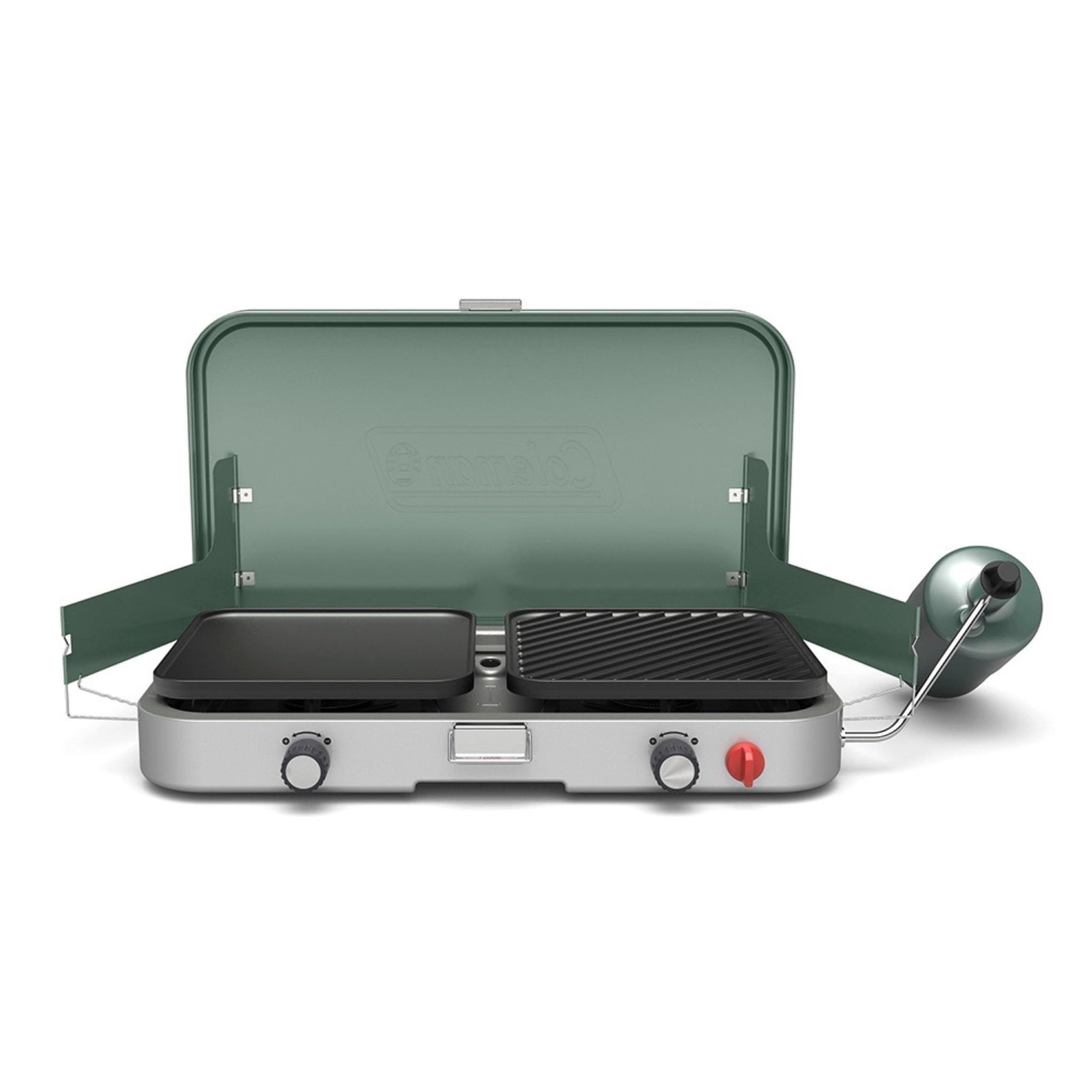
The Cascade's cast-iron grill and griddle plates are what make it more than another two-burner tabletop stove. Two adjustable burners deliver 24,000 BTU total, and the rotary ignition, removable pan support, and aluminized steel cooktop are built for real meals. We think the accessory set is the point: pancakes on the griddle, sausages on the grill, and a pot of coffee going at the same time.

We found the two burners give you useful separation for a griddle-and-pot setup, and the removable plates make the stove more flexible than a plain cooktop. The nylon carry case for the plates is a small thing that makes packing easier, and the recessed handle keeps the whole package manageable when it is closed.

The Cascade earns its place when a family wants one stove to do breakfast and dinner. We reach for it when the menu matters more than the setup, and it has become the stove we show people who are tired of cooking everything in one skillet.

Pros

  • Cast-iron grill and griddle included
  • 24,000 BTU across two burners
  • Rotary matchless ignition
  • Removable plates simplify packing

Cons

  • Cast-iron surfaces need seasoning and scrubbing
  • Heavy at 15.8 pounds
Our verdict

The Cascade is for car campers who want a grill and griddle built into their two-burner stove; it is heavy and premium, but the cooking range is the payoff.

Check Latest Price
5

Best Budget High-Output

Outvita 2 Burner

90 /100
Traveler Score Outstanding

Key details

Burners
Two 75,000 BTU
Warranty
2-year manufacturer
Dimensions
34.3"L x 19.7"W x 29.7"H
Total Output
150,000 BTU
Check Details on Amazon

A 150,000 BTU stand stove at the budget end is a lot of heat for the money. The Outvita splits that output across two 75,000 BTU burners, with individual knobs, a cast-iron body, detachable legs, and a two-year manufacturer warranty. It is 34.3 inches long and 29.7 inches high, so it stands at a comfortable cooking height.

We like it for big-pot cooking: frying, boiling, brewing, and the kind of backyard batch cooking that makes a tabletop stove feel small. The two burners are independently controlled, and the removable legs make it easier to move between the garage and the yard. The two-year warranty is the reassurance at this end of the market.

The Outvita is a budget basecamp stove, not a precision simmering station. We see it as the pick for a large pot and a crowd, where output matters more than finesse. It earns its place by putting high heat within reach, not by feeling as refined as the Camp Chef.

Pros

  • 150,000 BTU total output
  • Two independent 75,000 BTU burners
  • Two-year manufacturer warranty
  • Detachable legs for transport

Cons

  • Flame can be uneven across the burner
  • Assembly instructions are unclear
Our verdict

The Outvita is our budget pick for high-output stand cooking, with two 75,000 BTU burners and a two-year warranty.

Check Latest Price
6

Prep Space

Pipopa 2 Burner

86 /100
Traveler Score Excellent

Key details

Weight
41.5 lb
Included
Side shelves, windscreen, cover, handles
Regulator
CSA-certified 0–20 PSI
Total Output
150,000 BTU
Check Details on Amazon

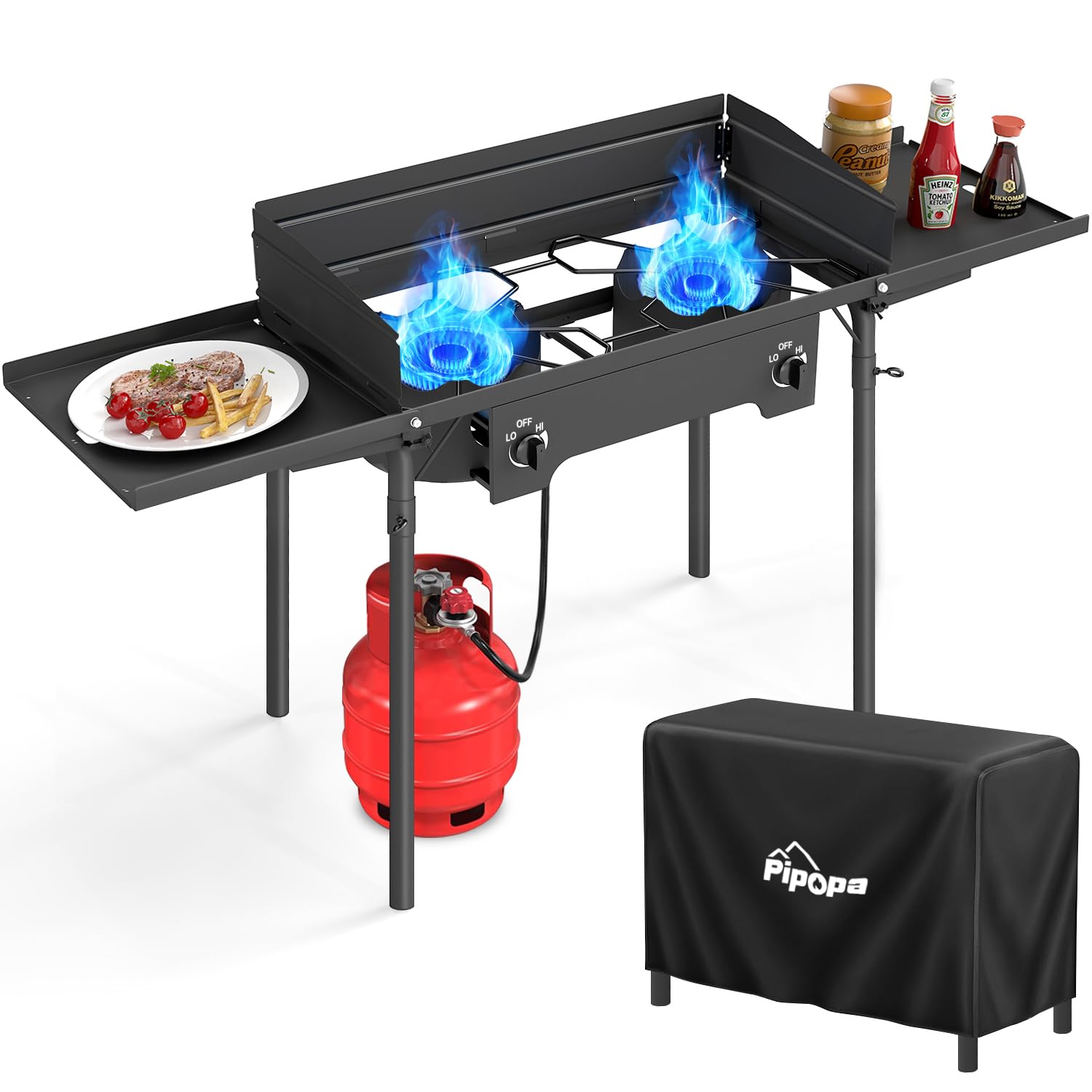
The Pipopa turns a high-output stand stove into a small prep station. Two 75,000 BTU burners give it 150,000 BTU total, and the package includes folding side shelves, a three-sided windscreen, a waterproof cover, and a CSA-certified 0–20 PSI regulator. At 41.5 pounds and 59.1 inches long with the shelves out, it is clearly a vehicle-supported stove.

We think the side shelves are the detail that makes it useful: they give you a place for a cutting board, utensils, or a hot pad without dragging out a folding table. The windscreen and cover make it feel like a complete kit, and the CSA-listed regulator is the kind of detail we look for on a high-pressure stove.

This is a basecamp range, and that is the role we judge it by. Set it up once for the weekend and let the shelves and windscreen do their job. For a family camp kitchen, the extra setup surface is worth the space it takes.

Pros

  • Two 75,000 BTU burners
  • Folding side shelves add prep space
  • Three-sided windscreen and cover included
  • CSA-certified 0–20 PSI regulator

Cons

  • One burner may run weaker than the other
  • 180-day warranty is short
Our verdict

We recommend the Pipopa when a high-output stove also needs to be a prep station; the shelves, windscreen, and CSA regulator make it a complete basecamp setup.

Check Latest Price
7

Compact Travel

Cofiyard 2 Burner

86 /100
Traveler Score Excellent

Key details

Weight
4.2 lb
Cookware Fit
Two 10-inch pans
Total Output
17,000 BTU
Folded Dimensions
9.5"L x 9"W x 4.6"H
Check Details on Amazon

The Cofiyard folds to 9.5 by 9 by 4.6 inches and weighs 4.2 pounds, which is the whole argument for a two-burner stove you can actually carry to a picnic table. The woven carry bag is included, and the hexagonal body folds into a compact block rather than leaving a loose grate to pack separately.

Two 17,000 BTU burners are independently adjustable, and the spacing is designed for two 10-inch fry pans. We found the built-in igniters convenient and the flame control useful from a low simmer to a rolling boil. It is a small stove, but it cooks like a real two-burner rather than two backpacking burners tied together.

The limits show up with wide cookware: the burners are small, so a 12-inch skillet gets a hot center and cooler edges. Keep pans centered and use the lower half of the range for longer cooking; the Cofiyard stays within its lane.

For the camper who values pack size over power, this is the one we reach for. It asks you to cook within its limits, and it rewards you with a stove that disappears into the trunk. We like it as a second stove for overflow or a compact main stove for simple meals.

Pros

  • Folds to 9.5 by 9 by 4.6 inches
  • Weighs 4.2 pounds with carry bag
  • Fits two 10-inch pans
  • Built-in igniters on both burners

Cons

  • Painted body can scorch with hard use
Our verdict

We recommend the Cofiyard for campers who need a true two-burner stove that packs small; it is a compact cooking tool, not a high-output range.

Check Latest Price

How We Chose and Tested 12 Two-Burner Camp Stoves

We started with more than 30 two-burner stoves, from familiar propane workhorses to newer low-pressure and dual-fuel models, and cut the list with three filters: whether two 10-inch pans actually fit side by side, whether replacement parts and hoses were easy to track down, and whether the packed weight was something one person could carry from the car to the picnic table without a second trip. That left 12 stoves, which we cooked on for nine months.

Most of the testing happened where these stoves live: weekend car-camping trips, a couple of tailgates, a backyard table, and one memorably gusty morning beside a lake. We timed how long a quart of cold water took to boil with the lid on, then repeated it with the windscreens up and the stove turned into the wind. We eased each burner down as low as it would go and watched whether the flame held steady or quit outright, and we ran a 10-inch skillet and a 2-quart pot at the same time to see how much of the grate was genuinely usable.

Setup got timed too — out of the case, lid latched open, fuel connected, first burner lit — once in daylight and once with a headlamp. We weighed every stove packed in its own case and carried each by its handle across a parking lot to see where the grip dug in. After every greasy breakfast we lifted out the drip tray and wiped the grates, noting which trays fit in a camp sink and which needed a paper towel and patience. Each stove also got a monthly once-over of hinges, latches, and burner caps, looking for wobble, rust, and anything that had worked loose.

How to Choose 2 Burner Camp Stoves

Start With Tabletop or Stand Stove

The first fork is tabletop versus stand stove. A tabletop model like the Coleman Triton or Camp Chef Everest sits on a picnic table, packs into the trunk, and suits car camping and tailgating. A stand stove like the Camp Chef Explorer or Outvita gives you a higher cooking surface and room for larger pots, but it needs more vehicle space and a level outdoor patch.

Choose the tabletop if you move every day or cook mostly for two to four people. Choose the stand if you set up a basecamp, can, fry, or feed a group. We prioritize packability for weekend campers and cooking area for basecamp cooks; a high-output tabletop can split the difference.

Match Burner Output to Pot Size

BTU numbers get attention, but the useful question is what size pot you need to move. A 20,000 to 24,000 BTU tabletop stove like the Triton or Cascade is enough for two pans of coffee, eggs, and one-pot meals. A 40,000 BTU model like the Everest gives more headroom for searing and big pasta pots. The 60,000 to 150,000 BTU stand stoves are for stockpots, canning, frying, and crowd cooking.

More output is not automatically better. High-pressure burners can be touchy at the low end, and a stove that is too powerful for your menu just burns fuel and makes simmering harder. Match the stove to the largest pot you actually use; if you mostly boil water for two, a compact tabletop is the smarter buy.

Check Cooking Surface, Wind Protection, and Stability

A two-burner stove is only useful if two pans actually fit. Look at the grate spacing and the windscreen, not just the overall width. The Everest's 215-square-inch surface and the Explorer's 448-square-inch surface describe different jobs: one is a portable two-pan cooktop, the other is a stand stove for big pots. Side shelves, as on the Pipopa, add prep space but also width.

Wind is the quiet dealbreaker. A three-sided windscreen and a steady base matter more on an exposed campsite than an extra thousand BTU. Set the stove on a level, heat-safe surface, keep the hose away from the burner, and use the windscreen even on a calm day.

Plan for Fuel, Setup, and Cleanup

Check the regulator and hose before you buy. High-output stand stoves usually want a bulk propane tank and a matched regulator; compact tabletop stoves are built around smaller canisters or a supported adapter. The connection should be CSA-listed where the listing says so, and the hose should be long enough to keep the tank clear of the cooking area.

Setup and cleanup are part of the ownership cost. Removable legs and a latching lid make a stove easier to live with; a removable grate and drip tray make cleanup faster. We look for knobs that are protected from the burner and a finish that can take a spill. A stove that is fussy to clean tends to stay in the garage.

Frequently Asked Questions

Final Verdict

For most campers, the Coleman Triton is the two-burner stove we recommend: it is light enough to pack, steady enough for two pans, and simple enough to set up before the coffee water boils. It will not match a high-pressure stand stove for a 60-quart pot, but that is not the job most car campers need done.

If you want more heat in a portable package, the Camp Chef Everest 2X is the upgrade. If you cook for a crowd from a vehicle, the Camp Chef Explorer's wide stand is the better basecamp tool. Choose the Triton first unless your menu clearly demands one of those specialties.